
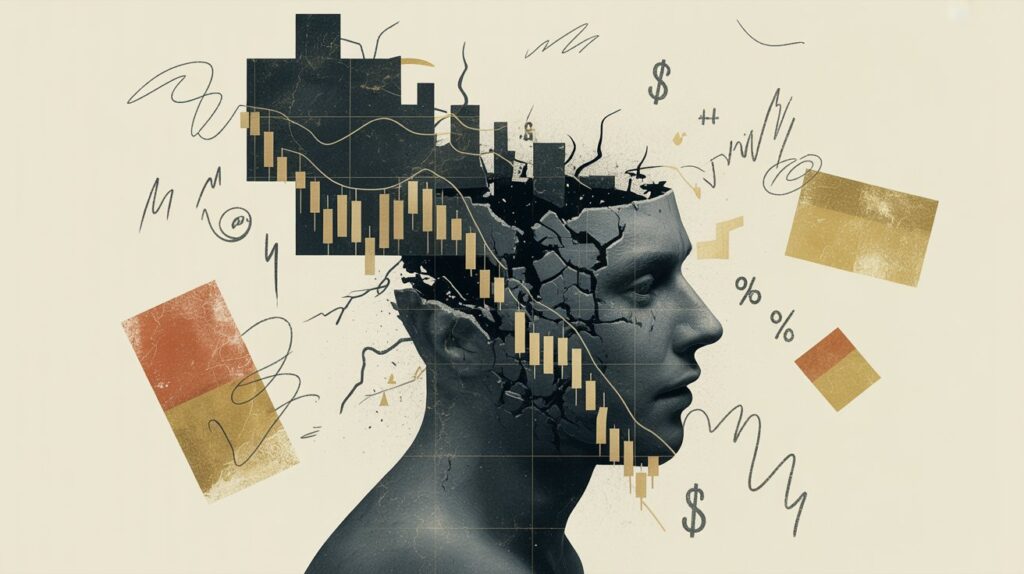
Silver’s 300% surge from $30 to $120 didn’t just make millionaires, it destroyed them. The 68% monthly gain triggered mass delusion that “this time is different.” When silver crashed, it exposed trading’s deepest psychological flaw: we can’t recognize euphoria as danger. Elite traders survived not by predicting the crash, but by recognizing crowd madness and protecting themselves. The difference wasn’t intelligence, it was understanding human behavior when greed takes over.
Let me tell you about the most expensive lesson thousands of traders learned.
I watched people turn $50,000 into $500,000 in three weeks. Then I watched them lose it all, plus their original capital in a single day.
But here’s what haunts me: the crash didn’t destroy these traders. The euphoria destroyed them.
When silver climbed from $30 to $120, nobody wanted to hear about risk. Nobody cared about position management. Nobody believed the party could end. That psychological certainty, that absolute conviction you’ve found the trade of a lifetime, makes you vulnerable to total destruction.
Let me show you what really happened, and what your mind does during market mania that makes rational thinking impossible.
The rally that made no sense
Silver was trading at $30 per ounce. Nothing special, just another commodity while traders focused on forex pairs, day trading tech stocks, and crypto.
Then things shifted. Within weeks: $45… $60… $80… finally $120 per ounce. A 300% gain.
This was silver’s strongest monthly performance outside the 1979 inflation crisis. But this time? No supply shock. No currency crisis. No inflation spike to justify a 300% move.
Yet traders didn’t care about fundamentals. They cared about one thing: the price kept going up.
That’s where the trap was set.
The four mental traps that destroyed accounts
Trap 1: “If it went up this much, it’ll keep going”
When silver doubled from $30 to $60, traders started calculating:
“If it doubled, it could hit $120. Then $200 by year-end.”
Your brain sees patterns and projects them forward. Three price points ($30, $60, $90) and your mind automatically fills in the rest ($120, $150, $180). This isn’t stupid, it’s how your brain evolved.
The problem? Markets don’t care about your pattern-completion instincts.
Traders created elaborate technical analysis justifying $200 silver. Fibonacci extensions. Elliott Waves. Historical comparisons. Every analysis pointed to higher prices.
But all this “analysis” was just their brains justifying a position they’d already taken because of FOMO. They weren’t analyzing, they were seeking confirmation.
The same pattern destroys forex traders. A currency pair trends for weeks, traders extrapolate indefinitely, ignoring that all trends eventually reverse.
Also read this: $3 Trillion Vanished in Minutes: The Gold Crash Nobody Was Ready For
Trap 2: “I’ve been right every day, so i must be good”
Here’s the dangerous truth: the more money you make quickly, the more danger you’re in.
When silver traders were up 100%, 200%, 300%, something shifted. They stopped thinking “I’m lucky.” They started thinking “I’m skilled.”
“I turned $10,000 into $40,000 in two weeks. I’m clearly better at this than I thought.”
This is recency bias on steroids. Your recent wins dominate your risk perception. After three weeks of profits, your brain recalibrates. Buying silver stops feeling risky. It starts feeling like printing money.
The traders who lost the most weren’t beginners. They were the ones who’d been right for weeks and kept increasing position sizes because “this is working perfectly.”
Many had 50-80% of their portfolio in silver. One trader told me: “I’ve been right every single day for three weeks. Why would I risk less on something that’s working?”
That reveals the trap: he wasn’t evaluating current risk. He was evaluating recent performance. And recent performance is the worst predictor at market extremes.
Trap 3: “Everyone’s making money, so it must be right”
Silver traders weren’t making decisions alone. They were in the biggest social media echo chamber commodity markets had ever seen.
Twitter flooded with silver charts. Reddit calculating fortunes at $200 silver. YouTube thumbnails: “$500 SILVER COMING!” Every platform reinforced: silver’s going to the moon, and you’re stupid if you’re not in.
When everyone around you makes money doing the same thing, your brain interprets this as proof the strategy works. You’re not “following the crowd”, you’re “recognizing obvious opportunities.”
But here’s reality: the larger and louder the consensus, the closer you are to the top.
Why? Because every buyer who was going to buy has already bought. Social media euphoria isn’t showing future buyers, it’s showing the last buyers are in. Nobody’s left to push prices higher.
Elite traders understand this. When they see unanimous bullish sentiment, they don’t see opportunity. They see distribution, smart money selling to the euphoric crowd.
Trap 4: When you forget markets can go down
After three weeks of straight gains, silver traders developed what I call loss amnesia: you know intellectually markets can decline, but you can’t actually imagine it happening to your position.
Traders acknowledged “yes, there could be a pullback,” then immediately added “but I’ll just buy more if it dips.” They weren’t planning for a crash, they were planning for a buying opportunity.
Your brain protects you from uncomfortable thoughts. Imagining a 50% crash creates psychological pain, so your mind creates rationalizations:
- “Can’t happen, momentum’s too strong”
- “I’ll see it coming and get out first”
Both assumptions are wrong. Crashes happen faster than your reaction time, and you won’t see them coming because everyone else watches the same indicators.
The crash: Reality in real-time
Silver opened near $118. Pre-market chatter: when silver hits $150, not if.
Then something broke, silver crashed. Two weeks of gains erased in one day.
Traders up 300% at the open ended down 40% from their entry. Leveraged traders got margin calls, liquidated at the lows. Total psychological devastation.
But understand this: the crash didn’t destroy these traders. Their psychological positioning during the rally destroyed them. The crash was just the inevitable consequence.
What happened inside traders minds
Stage 1: This is just a dip, buy more
Silver dropped from $118 to $110. Traders didn’t panic, they got excited.
“Finally! The dip I’ve been waiting for. Time to add.”
Your brain sees the decline as confirmation your “buy the dip” strategy works, the same strategy that worked perfectly during the rally. You’re not afraid, you’re opportunistic.
Hundreds bought between $110-$105, thinking they’re “getting a discount.”
They were catching a falling knife.
Stage 2: Wait, what’s happening?
By $95, the narrative shifted from “buying opportunity” to “this is strange.”
Traders checked the news. Fed announcement? Geopolitical event? They needed a reason because their mental model didn’t include the possibility of a crash without a catalyst.
But there was no news. Just selling pressure overwhelming demand.
This confusion creates paralysis. You can’t decide because you don’t understand. Your trading plan (if you had one) didn’t cover this. So you freeze, watching your position deteriorate.
Stage 3: This is temporary, it’ll recover
Silver hit $85… $80… $75. Down 30-40%. But instead of cutting losses, most held.
Why? Because admitting you’re wrong after being right for three weeks is psychologically impossible.
Your brain creates protective stories:
“Just a shakeout. Big players scaring weak hands before the next leg up. I’ve seen this, it always recovers.”
This is cognitive dissonance. Your belief (“silver to $200”) conflicts with reality (silver crashing). Your brain resolves this not by changing your belief, but by creating a story that preserves it. Denial keeps you in far longer than logic would.
Stage 4: Get me out
By $75, denial shattered. The pain became unbearable. Traders up $10,000 days ago stared at losses.
Panic-selling begins. Not because traders became emotional, but because the pain of watching losses compound finally exceeded the pain of admitting defeat.
The problem? Everyone panics simultaneously. No buyers at $75. You get filled at $65… $62… $58 if margin-called.
You exit at the absolute worst price because your emotional regulation was completely overwhelmed.
Stage 5: What just happened?
Silver closed at $75. Traders sat in shock.
The damage wasn’t just financial, it was existential. Three weeks ago: geniuses. Now: fools. This cognitive whiplash creates trauma that makes normal trading impossible for months.
Two immediate traps:
Revenge Trading: “I need it back NOW.” Jump into the next hot trade, desperate to repair ego and account. Almost always leads to more losses.
Trading Paralysis: “I can’t trust myself.” So afraid of another mistake, I can’t take any action, even legitimate opportunities.
Both responses are emotional, not strategic. Both prevent learning and growth.
What elite traders did differently
The traders who survived, or profited weren’t smarter. They didn’t have inside information. They had a different psychological framework for evaluating extremes.
Strategy 1: Recognizing when everyone’s lost their minds
Elite traders don’t predict crashes. They recognize when the crowd has gone insane.
When silver hit $100, professionals weren’t asking “how high?” They asked “are people thinking clearly?”
The answer was obvious: everyone had lost their minds.
How they knew (psychological red flags):
- 95%+ bullish consensus → you’re at a top
- Non-traders asking about it → last buyers have arrived
- Absurd price targets ($500 silver) → logic left the building
- Margin debt exploding → forced selling is coming
- Fundamentals ignored → emotions run the show
None of these tell you the exact top. But together, they paint a picture: risk has gotten crazy.
At $100 silver with universal euphoria, the math was terrible:
- Upside if madness continues: maybe 20%
- Downside when it breaks: 50%+
So they got out. Not because they’re geniuses, because they value protecting money over making more.
Strategy 2: Bet small when you don’t understand
The less elite traders understood something, the smaller they bet.
Amateurs: “This is huge, so I’ll bet big.” Position size matched excitement.
Professionals: “This makes no sense, so I don’t understand what’s driving it. When I don’t understand, I keep bets tiny regardless of performance.”
One trader held 2% in silver from $40 to $95. He could have bet 20% and made 10x more. But he didn’t understand why silver was rallying, so he kept it small.
When silver crashed, he lost 2% of his portfolio. Annoying, not devastating.
More importantly: he was mentally fine. Trading normally the next day while others were traumatized.
The key insight: position sizing controls psychological exposure, not just financial.
- 50% in silver → can’t think clearly, ego attached, future attached
- 2% in silver → can afford to be wrong, can cut losses without pain
Strategy 3: Ask “what would prove me wrong?”
Elite traders use the Inversion Principle: instead of asking “why will this go up?”, ask “what would show me I’m completely wrong?”
For silver: “What would destroy the bull case?”
Answer: A single day of heavy selling that breaks the momentum narrative.
Silver’s rally was built on momentum and social proof, not fundamentals. Psychologically fragile. The moment the pattern breaks, the structure collapses.
So they set trip-wires: “If silver drops more than 10% in one session, momentum’s dead. Exit immediately.”
When silver dropped from $118 to $105 in minutes, these traders exited. Didn’t wait. Didn’t check the news. Executed the rule.
Got out at $105, missing the drop to $75, but protecting most gains. Meanwhile, traders without rules were still deciding what to do at $80… $70….
The difference? Pre-commitment removes emotion from decisions.
The pattern you’ll see again
Crowds aren’t random. They follow a predictable sequence at every extreme:
- Skepticism ($30-$45): “This seems overdone…”
- Acceptance ($45-$65): “Maybe there’s something here.”
- Enthusiasm ($65-$85): “I should get in.”
- Greed ($85-$105): “I’m going to be rich!”
- Euphoria ($105-$120): “Everyone else is stupid!”
- Denial ($120-$95): “Just a healthy pullback.”
- Panic ($95-$79): “GET ME OUT!”
If you can identify which phase the crowd is in, you can protect yourself, not by predicting price, but by understanding behavior.
Elite traders knew silver was in Phase 5 (Euphoria) when they saw:
- Mainstream media everywhere
- $500 targets appearing
- Non-traders entering
- Skeptics mocked
- Fundamentals dismissed
These aren’t market indicators. They’re psychological indicators. Far more reliable for spotting extremes than any chart.
This pattern repeats in forex, stocks, commodities, crypto. The asset changes. Psychology doesn’t.
Your defense system: The frameworks that save accounts
Defense 1: The euphoria checklist
Before entering any position that “feels amazing,” check:
What’s everyone saying?
- Is social media overwhelmingly positive?
- Price targets getting ridiculous?
- People saying “this time is different”?
- Non-traders asking you about it?
- Doubters being mocked?
How am i feeling?
- Excited rather than analytical?
- Betting more than usual?
- Already spending profits mentally?
- Dismissing risks (“I’ll get out in time”)?
- Feel smarter than people not in this?
If you check 2+ boxes: you’re in danger.
The trade might be real, but your mental state makes you vulnerable.
Fix: Skip it, or bet 1/5th what you planned with a tight stop.
Defense 2: Decide your exit before you enter
Write down (don’t just think):
- Maximum loss: “I exit if this loses more than X%”
- Pattern break: “I exit if price breaks below Y”
- Time check: “I review on [date] and exit if things changed”
- Euphoria exit: “I sell 50% if this goes up Z% too fast”
For silver, this would’ve been:
“Entering at $40. I exit if:
- Drops below $35 (12% loss)
- Goes above $80 (100% gain, too fast)
- Three days falling volume despite rising price
- 30 days from entry (time review)”
Why this works: Removes the burden of deciding during chaos. You’re not deciding whether to sell at $118, you already decided when to calm.
Defense 3: The inverse excitement formula
Your bet size should be opposite to your excitement.
Uncertain and hesitant? Bet slightly more (you’ll exit quickly if wrong).
Certain and excited? Bet tiny (certainty is euphoria in disguise).
Formula: Position Size = Risk Tolerance ÷ (Excitement × Confidence)
If your normal risk is 2% per trade, but you’re super excited (×3) and very confident (×2):
2% ÷ (3 × 2) = 0.33% bet
Feels backwards? That’s the point. “Best trade ever” is usually a psychological warning, not reality.
Defense 4: Keep a pattern journal
Document market extremes not your trades, but crowd behavior.
Every extreme you notice:
- What market?
- What’s the consensus?
- What phase does it seem?
- What happened 30 days later?
When silver hit $100, traders with this journal thought: “Everyone agrees + crazy targets + new people = late-stage euphoria = danger.”
They wouldn’t know when it crashes. But they’d know to reduce bets and tighten stops.
Also read this: The Role of Journaling in Trading Psychology
Your action plan
| When | Action | Why |
| TODAY | Print euphoria checklist, put where you’ll see it | Physical reminder before trades |
| THIS WEEK | Audit positions, cut in half any size on excitement | Immediate risk reduction |
| THIS WEEK | Write exit rules for all current positions | Identifies emotional positions |
| THIS MONTH | Take partial profits on one winner before you “want to” | Trains exit-on-strength habit |
| THIS MONTH | Find one market in late rally, document signs | Real-time euphoria practice |
| ONGOING | For every trade: “If I’m right, what’s next? If everyone agrees, who buys?” | Second-order thinking habit |
The bottom line
The silver crash will be studied for decades. But the lesson isn’t about silver. It’s about human psychology under extreme greed and fear. You’ll face this again. Different markets. Different assets. The same rally that “feels different,” “has real reasons,” “isn’t like past bubbles.”
Your brain will play the same tricks. You’ll feel the same certainty. You’ll ignore the same warnings.
The question: will you recognize the pattern when you’re in it?
Traders who survived the silver crash didn’t predict it. They recognized the psychological warnings and protected themselves. They didn’t need to be right about the top. They just needed to avoid being catastrophically wrong.
That’s the real edge: not predicting markets, but surviving them.
Final thoughts: The Reborn Trader
If you lost money in the silver crash, you’re not alone. Some of the smartest traders I know got caught. The difference between those who’ll recover and those who won’t isn’t intelligence or capital. It’s whether you use this as evolution or trauma.
The traders who’ll come back stronger aren’t promising “never again.” That’s emotion talking. The reborn traders figure out what mental traps they fell into, build systems to prevent them, and develop understanding, not just pain.
You weren’t destroyed by the silver crash. You were destroyed by how your mind responds to euphoria. Once you understand that, you can build defenses. The next rally is forming right now. The next crazy market is somewhere you’re not watching. Maybe a currency pair in forex. Maybe crypto. Maybe another commodity.
Join 5,000+ serious traders who get “The Reborn Trader” premium newsletter, weekly insights on trading psychology, real-time euphoria warnings, risk management frameworks, and the mental discipline that separates survivors from casualties. Whether you’re day trading forex, swing trading commodities, or position trading stocks, these psychological principles apply.
Subscribe to the premium weekly newsletter
FAQ
Why do markets collapse right after everyone becomes bullish?
Because markets don’t fail from fear. They fail from certainty. When nearly everyone agrees on higher prices, demand is already spent. At that point, even small selling has an outsized effect. Once early participants take profits, there’s no fresh buying power left to support price. What follows isn’t a slow decline, but a psychological air pocket.
Why did the 300% silver rally feel “safe” right before it crashed?
Parabolic moves create emotional confirmation. Rising prices reward risk-taking and silence doubt. Traders stop asking what could go wrong and start assuming continuation. That feeling of safety isn’t clarity. It’s collective overconfidence and it peaks right before reversals.
How can traders spot euphoria before it damages their account?
Euphoria shows up when:
1. Risk management feels unnecessary
2. Extreme price targets sound reasonable
3. Skeptics are mocked or ignored
4. New, inexperienced participants rush in
When excitement replaces analysis, you’re no longer trading a market, you’re trading a crowd.
Why do traders freeze instead of exiting during crashes?
Because admitting error hurts more than losing money. After large gains, the mind protects identity by reframing losses as temporary. This delay creates worse exits. By the time emotion overrides denial, prices have already collapsed. This is why losses after big wins feel so devastating.
What role did social proof play in the silver crash?
Social proof convinced traders they couldn’t be wrong. When everyone around you agrees, doubt feels irrational. But markets don’t reward agreement. They punish it. Social validation is useful in communities, not in decision-making under risk.
Why does technical analysis fail during market manias?
Because indicators measure price, not belief. During euphoric markets, technical signals stay overextended far longer than logic suggests. Psychology reveals risk earlier than charts do. At extremes, behavior matters more than levels.
What is the biggest mental mistake traders make during big rallies?
Confusing recent success with permanent skill. Winning streaks distort judgment. Traders start trusting feelings instead of systems. This shift is subtle, but deadly. The market doesn’t care how right you were yesterday.