
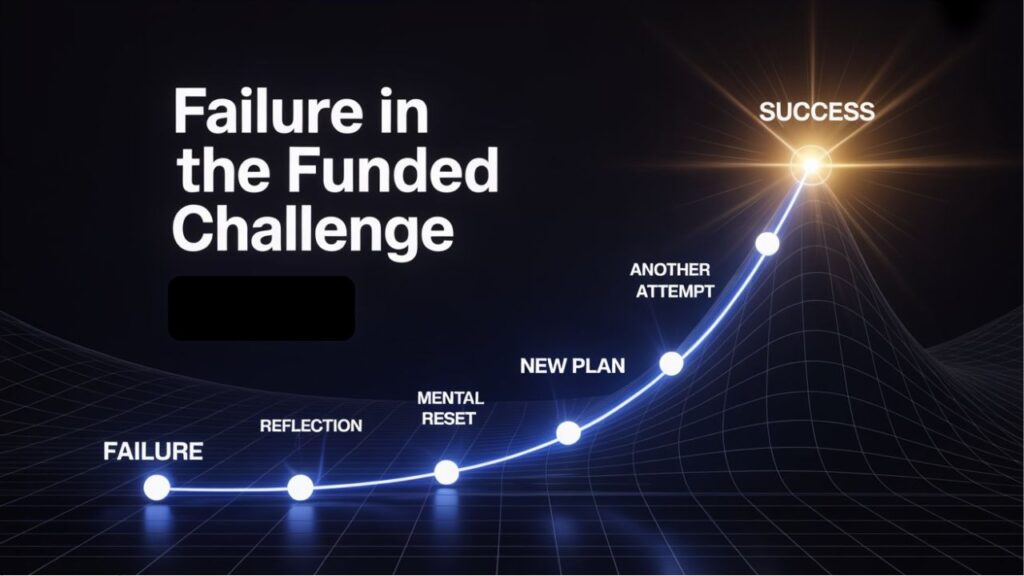
Failing a prop firm challenge isn’t the end of your trading journey. It’s data pointing you toward what needs to evolve. This article breaks down the mindset reset, the post-mortem process, the rule analysis, the strategy refinement, and the comeback plan required to pass your next challenge with confidence and emotional discipline.
If You’ve Ever Failed a Prop Firm Challenge, Read This
If you’ve blown a challenge, you already know the silence that hits afterward. I know that silence too. You sit there staring at the screen, hoping the numbers refresh into something else. They never do.
But here’s what most traders never learn:
A failed prop firm challenge isn’t proof that you’re a bad trader. It’s proof that your psychology, risk model, or system wasn’t aligned with the rules.
That’s it. Recovering isn’t about motivation. It’s about clarity. Discipline. Pattern recognition. Fixing what cracked under pressure. Let’s break this down in a way that helps you come back stronger, not just emotionally, but statistically.
What “Failure” Really Means in a Prop Firm Challenge
When Mark Douglas said traders must think in probabilities, he wasn’t being poetic, he was telling you how your brain works.
Losses activate the same neural circuits as physical danger. Your system goes into threat mode. And threat mode destroys decision-making.
Prospect Theory (Kahneman & Tversky) backs this up: Losses feel twice as painful as gains feel good.
This means one thing: Your brain treats a failed challenge as a threat, not a mistake.
But mistakes can be fixed. Threats can’t. So we need to reframe what failure actually means:
- Your process wasn’t aligned with the rules
- Your risk wasn’t aligned with the environment
- Your execution wasn’t aligned with your plan
None of that means you’re incapable. It means you’ve now discovered what needs refinement.
As Morgan Housel would say: Most failure is simply early.
Why Failing a Prop Firm Challenge Hurts So Much
Loss aversion hits you hard. Add ego, expectations, and the pressure to “finally get funded,” and the emotional pain compounds.
So you’re not weak. You’re reacting exactly like a human reacts to loss, stress, and public accountability.
But humans can learn. And here’s where your recovery starts.
Rebuild Your Mindset After Failing
When a challenge ends with a violation, your mind jumps into survival mode. You’ll feel the urge to revenge trade, blame the market, or jump into a new challenge too quickly.
Here’s the thing: Your mindset after failure determines how fast you rebuild.
If you ignore this step, everything else collapses.
Start With a Mental Reset
For 24–48 hours:
- Don’t open charts
- Go for a slow daily walk
- Do four cycles of box breathing
- Write down every emotion without judging it
Your nervous system is your trading system. If one is unstable, both are unstable.
Shift Your Interpretation of Failure
Ask: What is this failure trying to teach me?
Instead of: Why did this happen to me?
One opens a path. The other locks you in the past.
Conduct a Trade Post-Mortem Like a Professional
Most traders jump into a new challenge within days. That’s like crashing a car and assuming a fresh car fixes your driving.
A post-mortem isn’t optional, it’s survival.
How to Do It
Review every losing day and note:
- Rule breaches
- Over-risking
- Setup inconsistency
- Emotional trades (FOMO, hesitation, revenge)
- Overtrading
- Impulsive sizing
Then ask:
- What repeated?
- What violated my rules?
- Which setup had the best edge?
- Which setup caused most damage?
- What should I have done instead?
Blind spots become patterns the moment you write them down.
Read this: Top 5 Prop Firm Trading Mindset Shifts to Pass Challenges
Analyze the Prop Firm Rules You Violated
Prop firms don’t fail traders because of bad strategy. They fail traders because of rule conflict.
Here are the most violated rules across FTMO, FundedNext, TFT:
| Rule | Why Traders Fail | What It Means |
|---|---|---|
| Daily Drawdown | Oversized positions | Your risk model is too aggressive |
| Overall Drawdown | Compounded emotion + overtrading | Your strategy variance is too wide |
| Profit Target | Forced trades | You’re trading outcomes, not process |
| Consistency Rule | Wild variance in lot sizes | Lack of position sizing discipline |
| News Rule | Gambling during events | No probability logic |
Now ask:
- Did I break the daily drawdown rule?
→ Risk too high. - Did I overtrade trying to hit the target?
→ Outcome-based trading. - Did I size positions like it was my personal account?
→ Prop firms require low-variance execution.
Understanding the rules is half the battle.
Rebuild Your Strategy With Low-Variance Setups
A common reason traders fail prop firm challenges is this: Their strategy simply doesn’t match prop firm math.
Prop challenges punish volatility. They reward low-variance, high-probability, boring setups.
Your system should focus on:
- One trading session
- One core setup
- One pair
- One fixed risk model
Passing challenges is about consistency, not brilliance.
Low-Variance Setup Examples
| Setup | Why It Works in Prop Challenges |
|---|---|
| Break-and-retest | Clear invalidation point |
| Liquidity sweep + retest | Small stop, big RR |
| London session breakout | Predictable volatility |
| NY reversal zones | Controlled structure |
Boring wins. Consistency passes. Volatility kills.
Build a 30-Day Comeback Plan
You’ve reset your mind, reviewed your performance, and refined your rules. Now you need structure.
Without structure, emotional cycles repeat. With structure, you become dangerous.
Your 30-Day Retake Plan
Days 1–7: Simulation Only
Rebuild discipline and rule-following on demo.
Days 8–15: Micro Real Account
Reintroduce emotional pressure safely.
Days 16–20: Mock Challenge
Simulate the exact rules of your chosen prop firm.
Days 21–30: Probability Training
Study:
- Risk of ruin
- Expectancy
- Drawdown math
- Mark Douglas trading principles
This brain rewiring matters more than your strategy.
Retake the Challenge With a Different Identity
Success in trading is identity-based. You don’t “try” to be disciplined, you become someone who values discipline.
When you retake the challenge, you show up as a new operator:
- More patient
- More calm
- More rule-driven
- More probability-minded
Execution Rules for the Retake
- One setup
- One percent max risk
- No trading during news
- Stop after two losses
- Journal every trade
- Screenshot entries and exits
- Celebrate process, not outcomes
You don’t rise to your goals. You fall to your systems.
Read this: Trader’s Identity Crisis: Why Your Life Shapes Your Trades
Mini Case Study: How One Trader Passed After Failing Twice
Trader: 26-year-old forex day trader
Challenge: FTMO 100K
First Attempt: Failed violating daily drawdown
Second Attempt: Failed due to FOMO and overtrading
What Changed on Attempt 3
- Switched to trading only London session
- One setup: break-and-retest
- Risk fixed at 0.5%
- Stopped after two losses
- Reviewed every trade immediately
- Zero trades during news
Result:
Passed in 24 days with only nine total trading days.
The lesson? When variance goes down, consistency goes up and funded accounts follow.
Emotional Trader vs Funded Trader Mindset
| Trait | Emotional Trader | Funded Trader |
|---|---|---|
| Risk | Changes daily | Fixed and predictable |
| Evaluation | Outcome-based | Process-based |
| Drawdown | Emotional | Mathematical |
| Setup selection | Random | One reliable setup |
| Journaling | Occasional | Mandatory |
| Discipline | Mood-based | Identity-based |
This shift is the whole game.
Conclusion: Your Failure Is Not a Verdict, It’s a Map
Prop firms are built to expose weaknesses. That’s not a punishment, it’s guidance.
A failed challenge isn’t the end. It’s the beginning of clarity.
And clarity creates funded traders.
If this breakdown helped you, you’ll love the deeper lessons inside my premium newsletter. I share the frameworks funded traders actually use to stay calm under pressure, avoid emotional mistakes, and build the mindset that survives every challenge.
Join the inner circle and level up the way you think, trade, and perform from the inside out. Subscribe Here
FAQ
How long should I wait before retaking a prop firm challenge?
7–30 days depending on emotional stability and post-mortem clarity.
What’s the number one reason traders fail prop firm challenges?
Violating daily drawdown due to oversized risk.
Should I use the same strategy for the next challenge?
Yes, but refine it into a low-variance version.
Why do prop firm rules feel harder than personal accounts?
Because prop firms test discipline, not creativity.
How many setups should I use when retaking a challenge?
One. Simplicity boosts consistency.