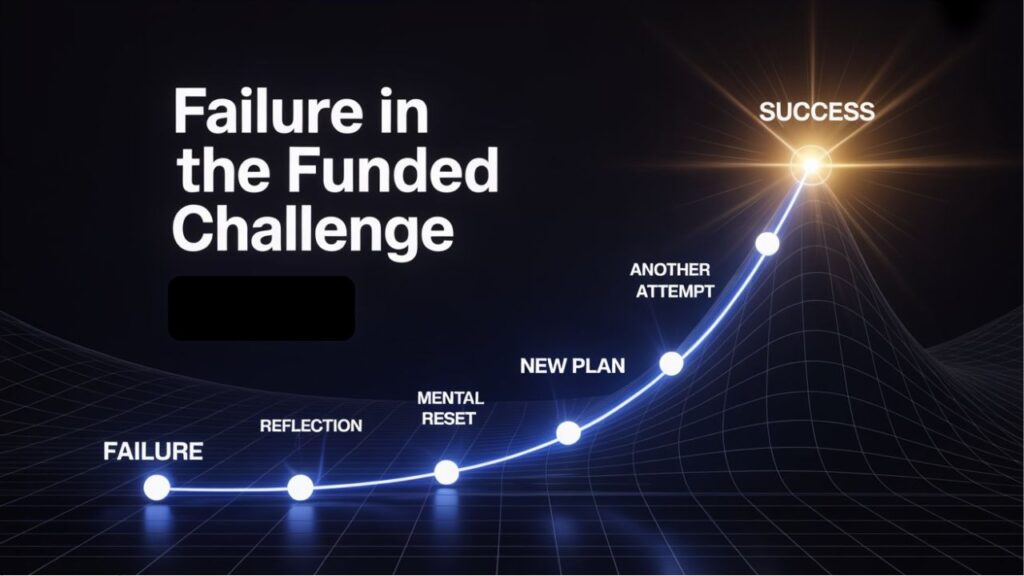

Funded account failure isn’t about strategy, it’s about psychology. Research shows 80% of funded traders fail within 90 days due to ego-driven behaviors like overconfidence, loss aversion, and revenge trading. This article reveals how Tim Gallwey’s Inner Game theory explains why experienced traders self-sabotage and provides systematic defenses to protect your capital.
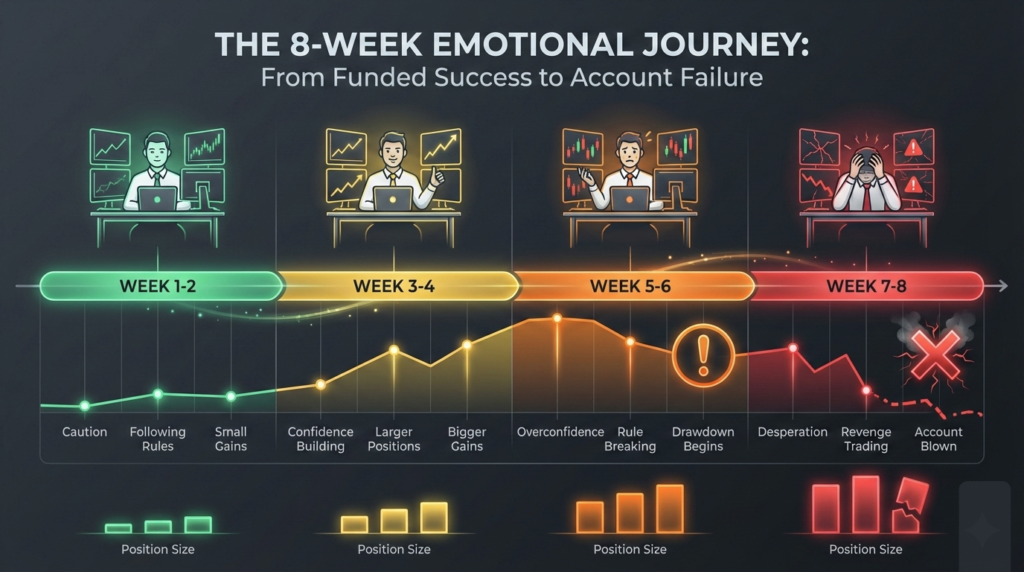
I’ve watched hundreds of traders pass their funded account evaluations with flying colors, only to blow up within sixty days.
Not because they forgot how to trade, not because the market suddenly became impossible. But because something shifted inside their heads the moment real capital appeared in their account.
Trading ego is the silent killer nobody talks about in prop firm circles, yet it destroys more funded accounts than any strategy failure ever will.
You know the pattern. You grind through the evaluation phase with discipline that would make a monk jealous. Every stop-loss is honored. Every risk management rule followed to the letter. Position sizes stay conservative. The trading journal gets filled out religiously.
Then you get funded. And suddenly, that same discipline evaporates like morning fog. Position size balloon, stop-losses become “suggestions” you override with market predictions. The trading psychology that carried you through evaluation becomes a distant memory.
I’m not talking about beginners here. I’m addressing you, the experienced trader who knows better but still finds yourself making these mistakes. Because knowing and doing are separated by the Grand Canyon of human psychology.
The Inner Game: Why Your Brain Sabotages Success
How Self 1 Hijacks Your Trading Performance
Tim Gallwey’s The Inner Game of Tennis introduced a concept that revolutionized sports psychology, but few traders understand its devastating relevance to funded account survival. Gallwey argued that performance equals potential minus interference.
In his formula: Performance = Potential – Interference.
The interference? That’s Self 1, the ego-driven voice that judges, criticizes and tries to control outcomes. Your Self 2 is the quiet competence that already knows how to trade well. It’s the part that passed your evaluation without overthinking every tick.
When you trade with a funded account, Self 1 goes into overdrive.
“This is real money now,” it whispers. “You need to prove you deserve this capital. One bad trade and they’ll take it away.” Every position becomes a referendum on your worth as a trader. Your emotional intelligence gets hijacked by performance anxiety you didn’t feel during evaluation.
Read this guide: Revenge Trading: The Hidden Habit That’s Blowing Up Your Account
Why Being “Right” Kills Your Account
The ego doesn’t want to just make money, it wants to be right. And that distinction kills accounts faster than any drawdown limit.
I’ve seen this play out in my own trading. During my second funded account (after blowing the first), I noticed myself checking P&L every fifteen minutes. Not to manage risk. To validate my intelligence. Each green candle whispered, “See? You’re smart.” Each red candle screamed, “You’re an imposter.”
That’s when I realized: I wasn’t trading the markets anymore. I was trading my self-esteem.
| Self 1 (Ego Mind) | Self 2 (Competent Mind) |
| Needs to be “right” on every trade | Accepts probabilistic outcomes |
| Judges performance constantly | Executes system mechanically |
| Fears losses as personal failure | Views losses as statistical cost |
| Overrides rules with “analysis” | Trusts predetermined strategy |
| Trading becomes identity validation | Trading is professional execution |
Read this guide: The Dark Side of Trading Addiction
The Loss Aversion Trap That Ruins Professionals
The 2:1 Emotional Ratio That Distorts Every Decision
Here’s what experienced traders often miss about loss aversion: it’s not the same as risk aversion.
You already manage risk. You know your maximum daily loss. You understand position sizing, but psychological research by Kahneman and Tversky shows we feel the pain of losses roughly twice as intensely as equivalent gains. That 2:1 emotional ratio doesn’t care about your risk management spreadsheet.
Why You Hold Losers and Cut Winners
This asymmetry creates behaviors you’d never tolerate in newer traders: You take profits at 1.5R instead of your planned 3R because the fear of watching gains evaporate overpowers your system. Meanwhile, that losing position you’re nursing? You’re giving it “room to breathe” because admitting the loss feels like ripping off a bandage attached to your identity.
The math says cut it. The ego says hold it.
Someone said it perfectly: “The market doesn’t know you exist. It doesn’t care about your mortgage, your dreams, or your ego. But your ego cares deeply about being right, and that’s the problem.”
Your process-oriented trading mindset from the evaluation phase gets replaced by outcome-based thinking the moment real capital enters the picture. Instead of asking “Did I follow my rules?” you start asking “Did I make money?” Those are fundamentally different questions that lead to fundamentally different behaviors.
Overconfidence: The Professional’s Curse
The Data That Should Terrify Every Funded Trader
Behavioral finance research reveals something counterintuitive: overconfidence bias actually increases with experience in complex domains like trading.
You’re not immune because you passed an evaluation. You’re more vulnerable because you proved something to yourself.
Studies by Barber and Odean (2000) show overconfident traders generate trading volumes approximately 45% higher than optimal, eroding annual returns by 1-3%. That’s not guesswork, that’s quantified research from landmark investor behavior studies.
Read this guide: Funded Trader Mindset: Why They Master the Markets
The Three Faces of Trading Overconfidence
The three manifestations of trading overconfidence I see most:
Overestimating predictive ability: You start believing you can “read” the market because you had a good week. Five winning trades become evidence of mastery rather than statistical variance. Your edge isn’t what you think it is, it’s your risk management and consistency, not your ability to predict price action.
Illusion of control: You forget that market movements are probabilistic, not controllable. The moment you think “I can make this trade work,” you’ve already lost. You can’t force the market to comply with your analysis, yet that’s exactly what revenge trading attempts to do.
Miscalibration: The gap between your confidence and your actual skill widens without you noticing. You’re 80% confident about directional calls that history shows are barely better than coin flips. This miscalibration leads to position sizes that don’t match reality.
I learned this lesson painfully. After three consecutive winning months on my funded account, I doubled my position size “because I was in the zone.” That’s not confidence, that’s delusion dressed in a successful track record. The market corrected my hubris within two weeks.
The Imposter Syndrome Paradox
When Self-Doubt Destroys as Much as Overconfidence
Here’s the twist nobody expects: some of you reading this don’t suffer from overconfidence. You suffer from its opposite, imposter syndrome and it’s equally destructive.
You passed the evaluation, you got funded. But a voice keeps saying “You got lucky. You don’t actually deserve this capital. Real traders are better than you.”
Research on imposter syndrome and self-sabotage connects it directly to unconscious failure-seeking behaviors. When you don’t believe you deserve success, you unconsciously create failure to align reality with that belief.
The Four Self-Sabotage Patterns in Funded Trading
Watch for these patterns:
Taking unnecessary risks to “prove” you belong. Trading too conservatively because you’re terrified of confirming your inadequacy. Breaking winning strategies during hot streaks because success feels uncomfortable. Closing positions prematurely because “this can’t last.”
Your brain is trying to resolve cognitive dissonance, the uncomfortable gap between “I’m funded” and “I’m not good enough.” The easiest resolution? Blow the account and confirm your secret suspicion.
Ray Dalio’s equation applies here: “Pain + Reflection = Progress.” The pain of imposter feelings only becomes progress when you reflect on what’s actually happening rather than letting it dictate your actions.
Confirmation Bias: Your Selective Reality Filter
Every experienced trader knows about confirmation bias, yet we all fall victim to it with funded accounts.
The mechanism works like this: your brain actively filters information to support existing positions and dismisses contradictory signals. It’s not conscious. You literally don’t see evidence that conflicts with what you want to believe.
That long position you entered? Suddenly every bullish signal gets amplified. Every bearish development gets rationalized away as “temporary noise.” The stop-loss you set becomes negotiable because you “know” the market will turn.
This cognitive bias creates a feedback loop that amplifies trading excesses. You find exactly what you’re looking for, which confirms your brilliance, which makes you look even harder for confirming evidence.
The solution isn’t trying to eliminate bias, that’s impossible. The solution is systematic rules that function regardless of what you believe:
Your stop-loss isn’t a prediction about where the market should turn. It’s a predetermined exit based on capital preservation. The market doesn’t care about your analysis, and your rules shouldn’t either.
The Professional Mindset: Process Over Outcomes
What Separates Consistent Funded Traders from Account Cyclers
Here’s what separates consistently funded traders from those who cycle through accounts:
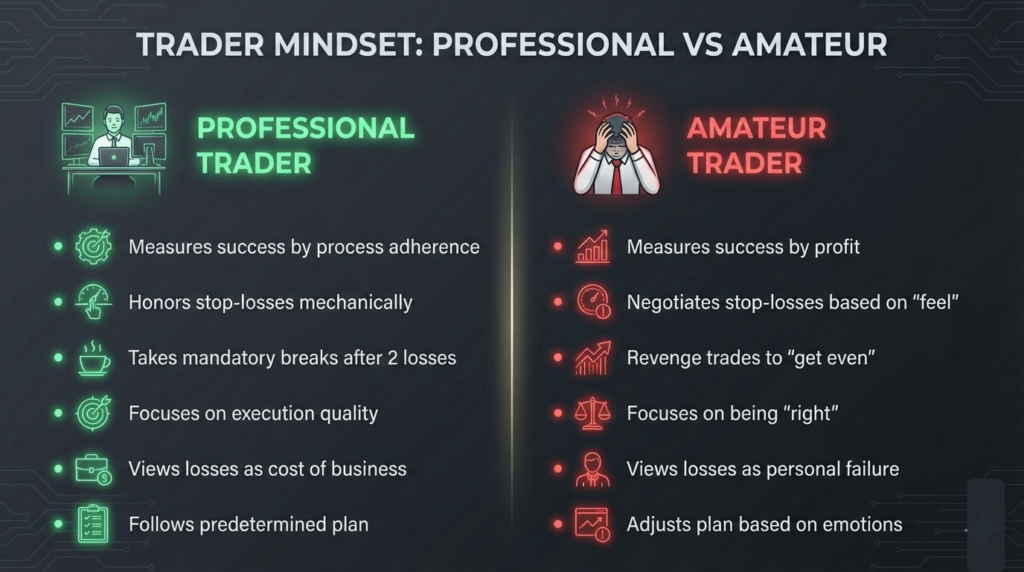
They measure success by process adherence, not profit.
This isn’t motivational fluff. This is practical psychology. When you define success as “I followed my system perfectly today,” you remove the emotional volatility that comes from market randomness. Some days the market gives. Some days it takes. You can’t control that.
You can control whether you honor your stops. Whether you followed your risk management rules. Whether you took breaks after losses. Whether your position sizing matched your system.
Where Your Real Edge Lives
The funded traders I respect most talk about their edge differently. They don’t claim to predict markets better than others. They claim to manage themselves better than others. Their edge is emotional regulation, not analysis.
Jack Schwager observed: “The most common way traders destroy themselves isn’t through lack of knowledge but through inability to accept losses.”
You already know how to trade, you passed the evaluation. The question isn’t whether you have a working system. The question is whether you can follow it when money gets real and ego gets loud.
The Practical Framework: Systems Over Willpower
Building Mechanical Defenses Against Your Own Psychology
Gallwey’s Inner Game provides our blueprint: quieting Self 1 so Self 2 can perform.
You can’t white-knuckle your way through ego management. Willpower fails under stress, which funded accounts provide in abundance. You need mechanical systems that function when you’re emotional:
Circuit Breaker Rules (Non-Negotiable)
Stop trading after two losing trades in one day. No exceptions. No “but this next setup is perfect.” The rule exists precisely for moments when you feel most certain you should break it.
Take a mandatory 30-minute break after any loss, regardless of size. This interrupts the physiological stress response before revenge trading starts. Step away from screens. Move your body. Reset your nervous system.
Implement daily loss limits (typically 1-2% of the account). When hit, you’re done for the day. No rationalizations about “getting it back.”
Arousal Regulation Techniques
Box breathing: Four seconds in, four seconds hold, four seconds out, four seconds hold. This isn’t meditation nonsense. It’s neuroscience. You’re activating your parasympathetic nervous system to counter the cortisol and adrenaline flooding your system after a loss.
Physical reset protocols: Push-ups, walk around the block, cold water on face. Anything that breaks the pattern and gives your prefrontal cortex time to come back online.
Pre-Mortem Analysis (Before Every Trade)
Before entering any trade, write down three reasons it could fail. This simple act neutralizes the dopamine rush that makes you overweight in favorable scenarios. It forces confrontation with potential loss before attachment forms.
Pre-Trade Ego Check:
- ☐ Have I written 3 reasons this trade could fail?
- ☐ Is my position size within system rules?
- ☐ Am I trading to prove something or follow my edge?
- ☐ Have I checked my emotional state (1-10 scale)?
- ☐ Can I accept this loss without revenge trading?
Journal Your Psychology, Not Just Your Trades
Your trading journal should track emotional state as rigorously as technical setups. “How did I feel entering this trade?” matters as much as “Where was my entry?” The patterns in your emotions predict account destruction better than patterns in price charts.
Read this: The Role of Journaling in Trading Psychology
The Identity Separation You Need
Detaching Self-Worth from Trading Results
Your analysis is not your identity. This sentence needs to become your mantra.
When trading results equal self-worth, every drawdown becomes an existential crisis. Every winning streak becomes a fragile house of cards you’re terrified to disturb. You’re not trading markets anymore, you’re trading your sense of adequacy.
The shift requires brutal honesty: the market doesn’t validate or invalidate you as a person. A losing trade is data. A winning trade is data. Neither defines your worth.
I repeat before every trading session: “I follow the market, not my ego.” It sounds simple, but that sentence reframes every decision. When you’re following the market, you accept what it gives. When you’re following your ego, you demand what you think you deserve.
Probabilistic thinking replaces prediction: “Based on conditions, I’m speculating price moves higher” is radically different from “I know price will move higher.” One acknowledges uncertainty. The other sets up ego investment in an outcome you can’t control.
Read this: Trader’s Identity Crisis: Why Your Life Shapes Your Trades
Your 7-Day Ego Detox Protocol
Day 1-2: Audit Your Trading Journal Review your last 50 trades. Circle every instance of ego-driven language: “I knew it,” “I should have,” “The market was wrong,” “I’m so stupid.” Count them. That’s your interference score.
Day 3-4: Implement Circuit Breakers Write your circuit breaker rules on a notepad next to your trading station. Two losses = done for the day. No exceptions. Test it. The first time you want to break the rule is when it matters most.
Day 5-6: Practice Box Breathing Before every trade entry, one minute of box breathing. Before reviewing any losing trade, one minute of box breathing. Make it automatic by checking your risk-reward ratio.
Day 7: Define Process-Based Success Metrics What does a “perfect trading day” look like? Not in profit terms, in execution terms. Did you follow every rule? Did you stick to your plan? Did you manage your emotional state? That’s your new scoreboard.
Key Takeaways
- Performance = Potential – Interference (Gallwey’s formula for funded trading success)
- Stop trading after 2 losses, circuit breakers protect against ego-driven revenge trading
- Measure success by process adherence, not profit, professionals focus on execution quality
- Loss aversion makes you feel losses 2x more intensely than gains, this distorts every decision
- Your analysis is not your identity, detach self-worth from trading results to survive long-term
- Box breathing resets your nervous system, use it before trades and after losses
- Pre-mortem analysis neutralizes overconfidence, write 3 failure scenarios before every entry
The Path Forward
You’re reading this because you’ve felt the gap between knowing what to do and actually doing it. Every experienced trader has.
The funded account failure rate isn’t a reflection of trading competence. It’s a measurement of psychological preparedness. Your strategy works, you proved that during evaluation. Your discipline works, you demonstrated it under evaluation pressure.
What fails is the transition from proving yourself to sustaining yourself.
Gallwey’s insight applies perfectly: your potential is already there. You’ve already demonstrated it. The interference, Self 1, ego, the need to be right, is what stands between you and consistent funded account success.
The solution isn’t learning more technical analysis or finding a better strategy. You need systems that protect you from yourself when capital gets real and emotions get loud.
Start here: define success by process metrics for the next thirty days. Not profit. Not win rate. Process adherence. Did you follow every rule today? That’s success. Did you break even one rule? That’s failure, regardless of P&L.
Watch what happens when you remove outcome-based validation. Watch Self 1 quiet down. Watch Self 2, your actual competence, start performing again like it did during evaluation.
Your edge as a funded trader isn’t superior analysis. It’s superior self-awareness combined with systematic defenses against your own psychology. Build those defenses now, before your next account becomes another statistic.
Because the market doesn’t kill funded accounts, your ego does.
You passed the evaluation. You know how to trade. So why does discipline vanish when real capital appears?
The Reborn Trader delivers weekly psychological frameworks, systematic defenses, and peak performance protocols built specifically for funded traders who refuse to be another statistic. Join 12,000+ traders who’ve stopped cycling through accounts and started building sustainable prop firm careers.
Subscriber here, free weekly edge delivered every Sunday
FAQ
Why do most funded traders fail within 60-90 days after passing evaluations?
The transition from evaluation to live trading triggers psychological changes that destroy discipline. During evaluations, traders focus on process and rule adherence. Once funded, ego takes over, position sizes increase, stop-losses become negotiable, and the need to “prove” worthiness overrides systematic execution. According to prop firm data, approximately 80% of failures are psychological, not strategic. The same confidence that helped you pass becomes your liability when managing real capital.
What is the single biggest psychological mistake funded traders make?
Measuring success by profit instead of process adherence. When your self-worth becomes tied to P&L, every loss feels like personal failure and every win provides temporary validation. This creates an emotional rollercoaster that leads to revenge trading, premature profit-taking, and holding losers too long. Professional traders measure success by how well they followed their system, the money becomes a byproduct of flawless execution, not the goal itself.
How can I prevent ego from destroying my funded account?
Implement three mechanical defenses: (1) Circuit breakers, stop trading after two losses in a day with no exceptions. (2) Pre-trade checklists, write down three reasons every trade could fail before entering. (3) Process-based journaling, track your emotional state and rule adherence, not just profit. These systems work because they remove willpower from the equation. Rules function regardless of how confident or desperate you feel in the moment.
How do I know if I’m experiencing imposter syndrome as a funded trader?
Watch for these patterns: (1) Taking excessive risks to “prove” you deserve the capital. (2) Trading too conservatively despite having a proven system. (3) Breaking rules during winning streaks because success feels uncomfortable. (4) Attributing wins to “luck” while blaming losses on your inadequacy. If you passed a funded evaluation but constantly question whether you “really” deserve it, you’re experiencing imposter syndrome. This creates self-sabotage behaviors where you unconsciously destroy the account to align reality with your belief that you’re not “really” a professional trader.
What’s the best way to handle a losing trade without revenge trading?
Follow this exact protocol: (1) As soon as the stop-loss hits, close your trading platform immediately. (2) Do one minute of box breathing (4 seconds in, 4 hold, 4 out, 4 hold). (3) Physically leave your trading area for 30 minutes minimum walk, exercise, anything that moves your body. (4) Only after 30 minutes, review the trade in your journal focusing on execution, not outcome. (5) Ask one question: “Did I follow my system?” If yes, the trade was successful regardless of P&L. This protocol interrupts the neurological stress response that triggers revenge trading and gives your prefrontal cortex time to regain control from your amygdala.