
You start Monday with a plan. You wake up early, exercise, read a few pages, and finally work on the things you’ve been putting off. For a few days, everything feels different. You feel disciplined, focused, and proud of yourself.
Then life gets in the way. You miss a workout, skip a reading session, or spend an evening scrolling through your phone. One missed day becomes two. Before long, you’re back in the same routine you promised yourself you would change. And the worst part isn’t losing the habit. It’s beginning to wonder whether you can trust yourself to change at all.
I was watching a podcast by neuroscientist Andrew Huberman when I came across an explanation that made me think differently about this problem.
In his Huberman Lab episode, The Science of Making & Breaking Habits, he explains how habits develop through learning and repetition, and why the process varies from person to person. He discusses research showing that forming a habit can take anywhere from 18 to 254 days, depending on the individual and the behavior.
That range challenges the popular idea that you can build any habit in 21 days. But there’s another lesson worth taking from this: you shouldn’t expect lasting change to happen on the same timeline as your initial enthusiasm.
Starting a habit is one challenge. Learning to maintain it when life becomes difficult is another.
Why Do You Keep Falling Back Into Old Habits?
The problem often begins with how you approach change. When motivation is high, you create an ideal version of your routine. You decide to exercise for an hour, read 30 pages, wake up at 5 a.m., and work without distractions.
The plan looks impressive on paper. But it leaves little room for an ordinary day when you’re tired, busy, stressed or simply not in the mood. Then something interrupts your routine.
You miss your workout because work runs late. You skip reading because you’re exhausted. Instead of adjusting your expectations, you feel disappointed because you couldn’t follow the original plan. Eventually, you stop trying.
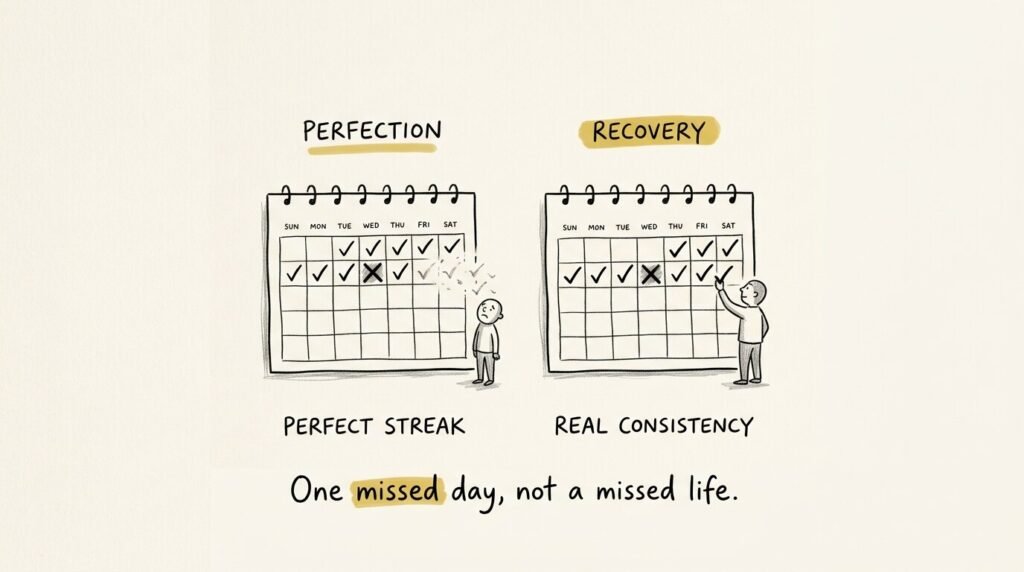
This is where a missed habit becomes a bigger problem than it needs to be. You don’t just interpret it as one incomplete action. You interpret it as evidence that you lack discipline.
Psychologists sometimes call this pattern all-or-nothing thinking: if you cannot do something perfectly, you begin to treat doing less as failure.
But missing one workout doesn’t erase the progress you’ve made. Reading two pages instead of ten doesn’t make the effort worthless. The mistake is treating consistency as a perfect streak rather than a pattern of returning to the behavior.
A habit becomes sustainable when your plan accounts for difficult days, not just good ones.
You don’t need a routine that works only when life goes according to plan. You need one that can survive interruptions.
The Real Meaning of Consistency
Think about someone who wants to develop a daily reading habit. During the first week, they read for 30 minutes every evening. Then a demanding day leaves them with only five minutes before bed.
They have two choices. They can skip reading because five minutes feels insignificant compared with their original goal. Or they can read a page or two and continue the next day.
The second person may accomplish less that evening, but they preserve the connection between their intention and their behavior.
This illustrates an important distinction: consistency is not doing the same amount every day. It is continuing to make room for the behavior.
A 2009 study by Phillippa Lally and her colleagues found that building a habit takes time, with the process varying from person to person. Participants took between 18 and 254 days to reach peak automaticity, depending on the behavior and individual.
The practical lesson isn’t that you should lower every standard or settle for minimal effort. It’s that repetition matters, and an imperfect repetition can be more useful than abandoning the behavior entirely. You still need challenging sessions, meaningful effort, and a clear direction. But you also need a plan for the days when your usual routine isn’t possible.
That’s where a simple framework can help.
The Minimum, Standard, Recovery Framework
Instead of creating one rigid version of a habit, create three versions: Minimum, Standard, and Recovery.
This is a practical framework for applying the principles of habit formation. It isn’t a clinical protocol or a named system from Huberman.
Minimum: Define the Smallest Useful Version
Your minimum is the version of a habit you can reasonably complete on a difficult day.
If your goal is to exercise, your minimum might be five minutes of movement. If you want to read more, it might be one page. If you’re trying to write consistently, it might be 100 words.
The point isn’t to convince yourself that five minutes is always enough. It’s to prevent a difficult day from automatically becoming a day of complete avoidance.
Imagine you planned to write 500 words for your article, but unexpected responsibilities consume most of your afternoon. You have two options: abandon the task or write 100 words. Those 100 words may not finish the article, but they keep you connected to the work.
One important distinction: your minimum should be genuinely useful and appropriate for your circumstances. For some habits, especially those involving health or physical rehabilitation, the right minimum should follow professional guidance.
Standard: Decide What a Normal Day Looks Like
Your standard is the version you aim to complete when circumstances are reasonably favorable.
For example:
- Reading: 10 pages.
- Writing: 500 focused words.
- Exercise: A planned 30-minute session.
- Learning: 20 minutes of deliberate practice.
Notice that the standard is specific. You know what completing the habit looks like before you begin. This matters because vague intentions create unnecessary decisions. If you tell yourself you’ll write sometime today, you have to decide when to start, how much to do, and whether you feel ready.
Instead, connect the habit to a reliable cue. For example: after breakfast, I will sit at my desk and write for 30 minutes.
Huberman discusses a related idea in his podcast: mentally rehearsing the steps of a habit and establishing consistent cues around its beginning and completion can make the behavior easier to initiate.
Before your next session, visualize the actual sequence. Sit down, open your document, review your last paragraph, and begin writing. Don’t just imagine the finished result. Rehearse the actions that get you there.
Recovery: Decide What You’ll Do After Missing a Day
This is the part most habit plans overlook. People often decide what they’ll do when everything goes well. They rarely decide how they’ll respond when they fall behind. As a result, a missed day becomes a negotiation with themselves. They feel guilty, promise to do better tomorrow, and wait until they feel motivated again.
Instead, establish your recovery rule before you need it. For example:
If I miss a writing session, I will return to my next planned session and write at least 100 words. I won’t double my workload to compensate.
- For exercise, your rule might be to resume your next scheduled workout rather than trying to make up every missed session.
- For reading, it might be to pick up the book at the next available opportunity without trying to read twice as much.
The purpose is to remove the drama from restarting. You don’t need to punish yourself for missing a day. You need to make the next useful action obvious. And if you repeatedly miss the same habit, investigate why. Perhaps the time is unrealistic, the task is too demanding, or your environment makes it difficult to begin. Adjust the plan rather than repeatedly blaming your character.
How to Stay Consistent When Motivation Disappears
The framework becomes more effective when you use it to design your environment, not just your intentions.
Here are three ways to put it into practice.
Make starting easier. Keep your book beside your bed, prepare your workout clothes in advance, or leave your writing document open. Reduce the number of decisions between you and the habit.
Track returns, not just streaks. A streak records uninterrupted performance. But if your goal is lasting change, also notice how quickly you return after an interruption. A missed day followed by a return is different from a missed day followed by three weeks of avoidance.
Review the pattern once a week. Ask yourself three questions: What helped me follow through? What interrupted my routine? What can I change to make next week easier?
Keep the answers practical. If late-night fatigue repeatedly prevents you from reading, try reading earlier. If your workout plan keeps collapsing on busy days, shorten the session or adjust the schedule.
The goal is not to make excuses. It’s to identify the actual obstacle so you can solve it.
This is also how you begin rebuilding self-trust. Every time you follow through on a realistic commitment, you create evidence that your intentions can lead to action. And every time you return after a setback, you reinforce the idea that one difficult day doesn’t have to determine what happens next.
If you’ve struggled with this deeper cycle of self-doubt, you may also find my related articles on rebuilding self-trust and rebuilding confidence after failure useful. These topics connect because sustainable change requires more than a plan; it requires learning how to respond when the plan breaks down.
Conclusion: Build a Habit You Can Return To
You don’t need to become the person who never misses a day. You need to become someone who knows what to do when a day doesn’t go as planned.
Start with one habit today. Define your minimum, your standard, and your recovery rule. Write them down, and decide what you’ll do the next time your routine gets interrupted. Then stop measuring your progress only by how long you can maintain a perfect streak. Measure it by whether you can return.
A sustainable habit isn’t one you never interrupt. It’s one you know how to return to.
What habit have you repeatedly tried to build, and what usually causes you to abandon it? I’d love to hear your experience.
If you want practical ideas on rebuilding your habits, confidence, and direction after setbacks, subscribe to my newsletter. I share clear, actionable lessons to help you make meaningful comebacks, one decision at a time. You can also follow me on social media for more reflections on discipline, identity, and personal growth.
Why do I keep falling back into old habits?
You may be relying on motivation instead of building a routine that works on difficult days. Old habits are familiar and often easier to repeat. Start with smaller actions, identify what interrupts your progress, and create a clear plan for returning after a setback.
How do you stay consistent with habits when motivation fades?
Make your habit specific, connect it to a regular daily cue, and define a minimum version for busy days. For example, read one page when you cannot manage ten. Focus on repeating the behavior rather than waiting until you feel motivated.
How long does it take to build a new habit?
Habit formation varies depending on the person, the behavior, and the circumstances. Instead of focusing on an exact number of days, prioritize regular repetition and make adjustments when your routine becomes difficult to maintain. Missing a day doesn’t mean you have to start over.