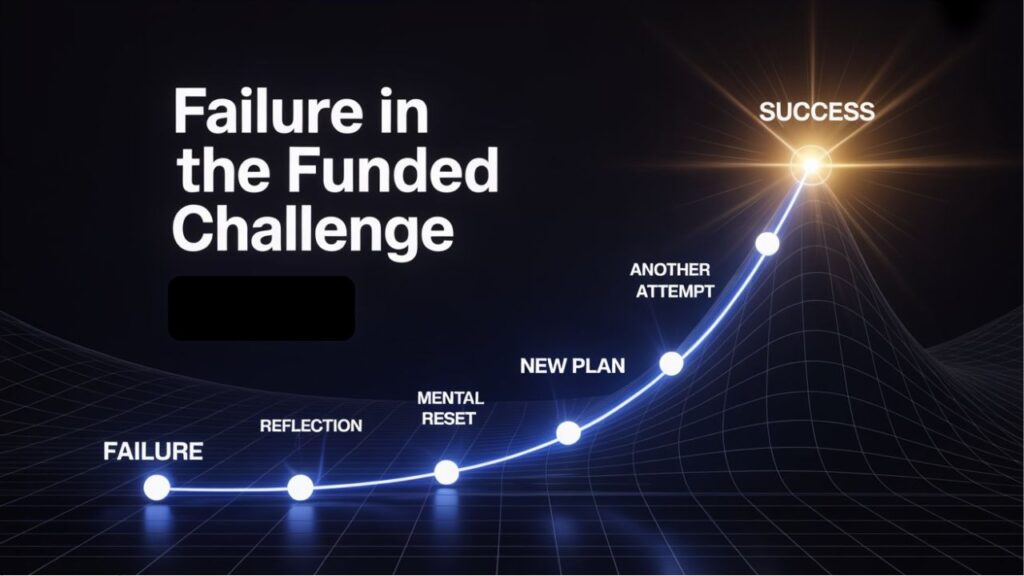
You passed the challenge. The capital is live. And suddenly you freeze on a trade that would have been automatic last week.
That is not a strategy problem. That is a funded trading psychology problem.
In this article I am going to walk you through exactly what happens inside the mind of a funded trader and how you can stop letting your emotions write the ending to a story your skills have already earned. Whether you are brand new to prop firm trading or you have blown three challenges and are starting again, this guide is built for you.
Why Funded Trading Feels Psychologically Different from Personal Trading
Most traders assume the hardest part of funded account trading is passing the challenge. But honestly, the real psychological war begins after you receive the capital. The moment you move from a personal account to a prop firm funded account, something invisible but powerful shifts inside your mind. The charts look identical. Your strategy has not changed. But everything feels heavier, slower, and more fragile than it ever did before.
That shift is real. It has a name. And understanding it is the first step toward mastering it.
When you trade your own money, a loss stings but it does not threaten your professional identity. With a funded trading account, every decision now carries real weight. There are drawdown limits, mandatory profit targets, and strict firm rules observing every position you open. The psychological pressure is not imagined. It is structural. And it changes how your brain processes risk at a fundamental level.
Here is a comparison to make this crystal clear for you:
| Personal Account | Funded Account |
| Loss recovers naturally over time | Loss can violate firm rules instantly |
| No external performance pressure | Mandatory profit targets enforced |
| Full freedom with your own capital | Strict risk management rules apply |
| No professional consequence for mistakes | Funded status is always at risk |
The good news is this: once you understand the psychology of prop firm trading, the pressure becomes manageable. Not eliminated but managed.
The 5 Biggest Psychological Mistakes That Blow Funded Accounts
Before we get into solutions, let us talk about the exact mental mistakes that destroy funded trader performance. Most trading educators will teach you entries, exits, and ratios. Very few will sit you down and say: here are the psychological errors that will end your funded career before your strategy ever gets a fair chance.
So let me do that for you right now. Because knowing the mistake is half the cure.
Revenge Trading After a Loss in a Funded Account
You take a loss. Your chest tightens. And before your rational mind can intervene, you are already in another trade with bigger size and a shaky setup, chasing the money back. That is revenge trading, and inside a funded account environment it is career-ending behavior. The fix is non-negotiable: after any loss that hits more than 50 percent of your daily limit, you close the platform completely. No exceptions. No “just one more.”
Read this: The Psychology Behind Revenge Trading
Performance Anxiety Around Profit Targets
Interestingly enough, profit targets which are supposed to motivate you often do the exact opposite. When you are close to hitting your funded account profit target, your brain shifts from execution mode into protection mode. You start second-guessing valid setups. You hesitate on clean entries. The reframe that works here is powerful: your job is to execute the process, not to chase the number. The number is simply a by-product of disciplined execution.
Overtrading to Meet Consistency Requirements
Some traders manufacture trades to look consistent during their prop firm challenge. That is not consistent. That is desperation dressed in discipline clothing. Overtrading is one of the leading causes of funded account failure. Fewer high-quality trades with proper risk management in funded trading will always outperform high-frequency emotional trading.
Imposter Syndrome After Receiving Your Funded Account
Nobody discusses this one enough, and I think that is a serious gap in the industry. You receive your funded account, you log in, and instead of feeling accomplished, you feel like a fraud. Like the firm made a mistake selecting you. That is imposter syndrome in trading, and it is more common among funded traders than any firm will publicly admit. Here is the truth: the challenge tested your process objectively. You belong there because your execution proved it. Own that fully.
Related article: Why profitable traders still doubt themselves (Imposter syndrome explained)
Freezing Near Daily Loss Limits
As your P and L approaches the daily loss limit, your entries slow down, your stops widen, and you become so focused on avoiding the limit that you forget how to trade properly. This is the prop firm drawdown anxiety paradox. The more you try to avoid the limit, the more likely you are to hit it. The solution is pre-commitment: decide before the session exactly what action you will take if you reach 75 percent of your limit.
How to Build a Professional Trading Mindset with Probability Thinking
Now that you understand the mistakes, let us talk about the transformation. And this is truly where everything changes for you as a funded trader.
The single biggest mental shift between an amateur and a professional is not about strategy. It is about how they interpret results at the most basic cognitive level. Amateurs think one losing trade means their strategy is broken. Professionals understand that one trade is a single data point inside a hundred-trade sample. Their trading edge remains intact regardless of any individual result.
“If you personalize losses, you cannot trade.” That quote from Bruce Kovner has never been more relevant than in a funded account context.
Thinking in probabilities means you detach your personal identity from individual trade outcomes completely. You are not your last trade. You are your process, executed consistently across dozens of opportunities over time. This shift from outcome thinking to probability-based trading mindset is what separates the five percent of traders who sustain funded accounts from the ninety-five percent who burn through them emotionally.
Here is one practical exercise to build this thinking. After every session, instead of asking whether you made money, ask whether you followed your process. That single question rewires how your brain evaluates performance over time. And it builds the kind of emotional discipline in trading that prop firms genuinely pay for.
Building a Pre-Trading Ritual That Protects Your Funded Account
Discipline is not a personality trait you either have or do not have. Discipline is a system you build deliberately. And one of the highest-leverage systems available to any funded trader is a pre-market ritual that shifts your brain from reactive mode into professional execution mode before a single position is opened.
This is the framework I personally teach and use.
Review Your Risk Parameters Before Touching Charts
Before you look at a single chart, confirm your current balance, your daily loss limit, and your available trading runway. This is professionalism, not pessimism. It takes sixty seconds and removes the most dangerous form of trading: unconscious risk exposure.
Emotional State Check on a 1 to 10 Scale
Ask yourself honestly: how calm and focused am I right now on a scale of one to ten? If your answer is genuinely below a six, do not trade today. The market will be there tomorrow. Your funded account may not survive an emotionally compromised session.
Read Your Firm Rules Out Loud
Read your core trading rules out loud before every session. This is a proven cognitive priming technique that activates the prefrontal cortex, the part of your brain responsible for rule-based trading decisions, before the emotional limbic system takes over when real money starts moving.
Set One Process Goal for the Session
Not a profit goal. A process goal. Something like: today I will only take setups matching my A-plan criteria. One clean intention. This is how professional trader habits are genuinely built, one intentional session at a time.
The Psychology of Scaling Funded Accounts Past Fear
Eventually, if you execute the above consistently, you will face a new and completely different kind of anxiety. Not the fear of failing a challenge. The fear of managing multiple funded accounts simultaneously. Scaling funded accounts creates a distinct psychological load that single-account traders never experience, and almost no trading educator prepares you for it.
Where single-account anxiety is about outcome uncertainty around one trade, scaling anxiety is about complexity and perceived loss of control across many accounts at once. Fortunately, there is a reframe that changes everything here. At the portfolio level, adding accounts actually reduces your overall risk rather than increasing it. A bad week on one account affects ten percent of a ten-account portfolio. That same bad week wipes out a single-account trader entirely. Scaling prop firm accounts properly with proportionate sizing makes your operation more stable over time, not more fragile.
The Reborn Trader Identity: Change at the Level of Who You Are
Here is what separates everything above from the standard “control your emotions” advice you have read a hundred times before. Most trading psychology content treats the mind like a broken engine: something to suppress, fix, or override when it misbehaves. But the real transformation is not about control at all.
It is about identity.
You do not follow your funded account trading rules because you are forcing yourself. You follow them because that is who you are as a trader. You are not a retail trader white-knuckling your way through a prop firm challenge. You are a professional whose identity includes process-first thinking, long-term discipline, and the emotional maturity to execute cleanly under pressure.
“The trader you become is more important than the trades you take.” That is the foundation of the reborn trader mindset. It is not a technique or a tip. It is a transformation at the deepest level of how you see yourself in the market.
When you internalize discipline as identity rather than effort, everything changes naturally. Your pre-trading rituals stop feeling like obligations and become second nature. Your risk management habits stop feeling restrictive and start feeling protective. And your funded trading performance stops depending on your daily mood and starts depending on your daily system.
Final Thoughts: From Reactive Trader to Funded Professional
You already have the strategy. You already have the skill. What you need now is the psychological architecture to let both of those things actually show up, consistently, session after session, through drawdowns and winning streaks alike.
Start with one ritual. Build one identity-based habit. Replace one emotional reaction with one pre-committed response.
That is how funded trading psychology is genuinely mastered. Not in one breakthrough moment. But in thousands of small disciplined decisions that nobody sees except you.
The market does not reward the most talented trader. It rewards the most consistent one. And consistency, at its deepest level, is always a trading mindset game.
Every week inside The Reborn Trader newsletter, I break down the exact mindset shifts, psychological frameworks, and funded trader strategies that most educators never teach you. If you are serious about keeping your funded account and scaling it like a professional, this is the one newsletter you cannot afford to skip. Join thousands of traders who are rebuilding their psychology and their performance from the inside out.
FAQ
Why do funded traders fail even with a profitable strategy?
Because strategy alone cannot override emotional decision-making under pressure. Funded trading psychology determines whether your strategy actually gets executed cleanly or gets sabotaged by fear, revenge trading, and inconsistency.
How do I stop revenge trading in a funded account?
Pre-commit to a rule before the session: if you hit 50 percent of your daily loss limit, you close the platform. Rules made in calm always beat decisions made in emotional states.
What is the biggest psychological difference between personal and funded trading?
In personal trading, losses affect your wallet. In funded account trading, losses can affect your professional status and your access to capital entirely.
How do I overcome imposter syndrome after getting funded?
Remind yourself that the prop firm challenge is an objective test. Your results earned the account, not luck. Build your identity around your process, not your feelings about deserving it.
Can trading psychology be learned or is it natural talent?
It is entirely learnable. Professional trader mindset is built through deliberate habits, structured rituals, and consistent self-reflection over time.