Let me be honest with you. I didn’t want to write this article. Not because the story isn’t worth telling but because telling it means going back to the version of me who sat in front of those charts, watching a challenge account drain in real time, feeling like the market was personally coming for me.
But here’s the thing. That version of me? He’s exactly who you might be right now. So let’s talk about it.
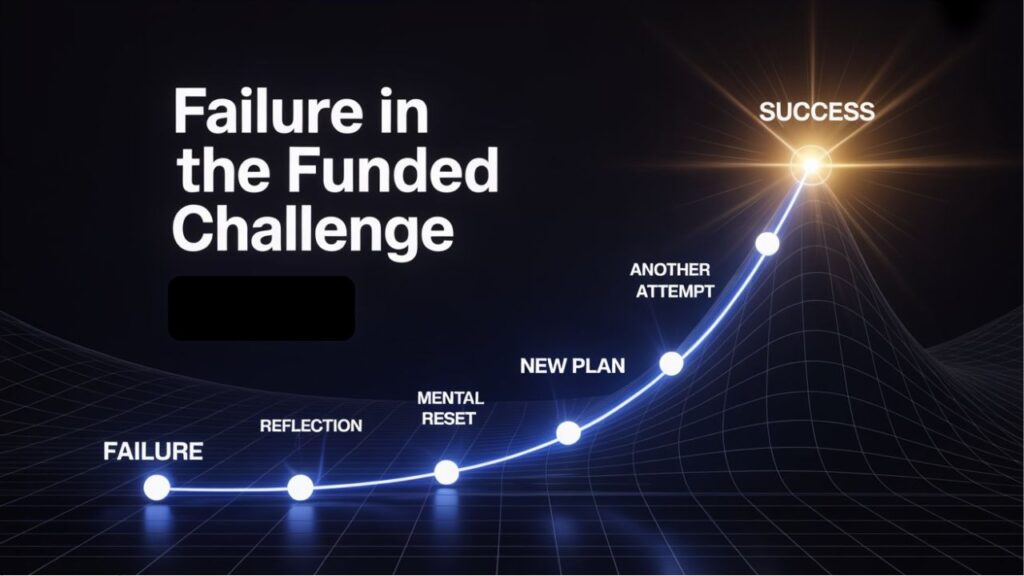
In this article, I share the raw, unfiltered story of failing three prop firm challenges before one critical mindset shift changed everything. From revenge trading spirals and identity crises to lessons borrowed from spinal cord recovery, this is the honest breakdown of what’s really happening inside a trader’s head when the pressure is on and exactly what it takes to finally pass.
The Three Failures That Almost Made Me Quit Prop Firm Trading For Good
Most traders won’t tell you about their failures. They’ll show you the funded account screenshot. The profit split. The victory lap.
I’m going to tell you about the three times I got knocked flat on my face and more importantly, the prop firm challenge mindset shift that changed everything after the third one.
Because if you’re sitting there right now with a failed challenge behind you, wondering whether you’re cut out for this, you need to read what I’m about to say.
Challenge 1: When I Thought Trading Strategy Was Everything
I went into my first challenge with what I genuinely believed was a bulletproof plan. I had backtested the setup. I had the risk parameters memorized. I was ready.
What I wasn’t ready for was the psychological pressure that shows up the moment real evaluation rules are on the line.
The first three days went beautifully. I was up. I felt invincible.
And that right there, that early confidence, was the trap.
I started sizing up. Taking setups that were “almost” my criteria. Telling myself I was just capitalizing on momentum.
What I was actually doing? I was letting overconfidence bias run the account.
By day six, I’d wiped out five days of gains in two sessions. Not because my strategy failed. Because I stopped following it the moment things felt good.
“Your strategy doesn’t fail you in a prop firm challenge. You fail your strategy the moment you stop trusting it.” Shahzaib Khan
What I learned from Challenge 1: The market doesn’t care about your winning streak. And neither does your drawdown limit.
Challenge 2: The Revenge Trading Spiral
The second time around, I thought I had it figured out.
I told myself: Just be more disciplined. Don’t oversize. Stick to the plan.
And I did. For a while. Then came one bad session. One legitimate losing trade, a setup that was clean, execution that was proper, and an outcome that just didn’t go my way.
Normal. Expected. Part of the process.
Except my brain didn’t see it that way. My brain saw a threat. And the moment it did, the amygdala hijack kicked in.
Here’s what’s actually happening neurologically when you take that revenge trade, when you immediately jump back into the market after a loss to “make it back.” Your amygdala, the brain’s fear center, floods your system with cortisol and adrenaline. Your prefrontal cortex, the part responsible for rational decision-making, gets effectively shut out.
You’re not thinking like a trader anymore. You’re in survival mode.
I placed three trades in 40 minutes after that initial loss. All outside my plan. All emotional. All losers.
Challenge 2 was done by lunchtime.
And I sat there, genuinely asking myself: Is there something wrong with me? Why can’t I just control this?
The answer, I’d later understand, wasn’t about willpower. It was about trading psychology and how completely unprepared most traders are for the emotional architecture of a challenge account.
“The prop firm challenge isn’t testing your strategy. It’s testing whether you can stay human while operating like a machine.” Shahzaib Khan
Challenge 3: The Breaking Point
By the third challenge, something darker was happening. I wasn’t just failing trades. I was starting to question my entire identity as a trader.
I’d built a narrative, that I was someone who understood the market, who had the edge, who was this close to making it. And every failed challenge was a direct attack on that story.
This is what psychologists call a trader identity crisis, when your sense of self becomes so entangled with your performance that a losing trade doesn’t just hurt your account, it hurts you.
I pushed through the early stages of Challenge 3 with white-knuckle discipline. I was so focused on not repeating my past mistakes that I developed a different problem entirely. I froze. I missed setups. I hesitated on entries I’d taken a hundred times in backtesting.
Fear of failure has replaced emotional discipline. And when that happens, the account bleeds slowly instead of quickly, but it bleeds all the same.
Challenge 3 failed, and I walked away from my screen for three days.
Read this guide: Trader’s Identity Crisis: Why Your Life Shapes Your Trades
What Spinal Cord Recovery Taught Me About Losing
Here’s something I don’t talk about enough publicly. A few years before I ever heard of prop firm challenges, I was going through spinal cord rehabilitation.
I want to be careful here. I’m not going to compare a failed trading challenge to the severity of physical trauma. But what I will say is that the resilience after adversity I built during that recovery period became the foundation for everything that came after in my trading life.
In rehab, you don’t get frustrated that yesterday’s progress was reversed today. You don’t get to revenge-trade your recovery by pushing too hard and re-injuring yourself.
You learn, deeply, viscerally, that process over outcome isn’t just a motivational poster phrase. It’s the only way forward.
Researchers at the University of Michigan studied over 450 spinal cord injury survivors and found that psychological factors, specifically how people viewed themselves and what they believed was possible, were more predictive of flourishing than the actual severity of injury.
Read that again. What you believe about yourself matters more than what happened to you.
That finding didn’t just apply to my physical recovery. It rewired how I approached the fourth challenge.
The Mindset Shift: What Actually Changed
Let me give you the honest version of what shifted. It wasn’t a single revelation. There was no one book, one video, one mentor who unlocked everything. What changed was a gradual, deliberate trading mindset transformation built on three core shifts.
Shift 1: I Decoupled My Identity From My Results
This is the hardest one. And the most important.
Carol Dweck’s research at Stanford on fixed mindset vs growth mindset showed something that fundamentally changed how I saw my failures. People with a fixed mindset interpret failure as evidence of who they are. People with a growth mindset interpret failure as data about what needs adjusting.
Every time I failed a challenge, I was running fixed-mindset software. The failure wasn’t just a result, it was a verdict.
I had to consciously practice what Dweck calls the power of yet. I hadn’t passed a challenge yet. That word alone reframes everything.
Shift 2: I Started Treating My Emotional State As Data
One of the most practical things I ever did was build a trading journal psychology practice and I mean a real one, not just entry/exit logs.
Before every session, I rated my emotional state on a scale of 1 to 10. I logged what I was feeling and why. After every trade, I noted whether my decision came from my plan or from an emotion.
Over time, patterns emerged. I could see exactly when I was most likely to revenge trade. I could see the setups I consistently hesitated on. I could see the days my cognitive biases were running hot.
The journal didn’t just improve my trading. It gave me back a sense of agency. I wasn’t just a passenger in my own emotional reactions anymore.
“Most traders journal their trades. The ones who pass challenges journal their minds.” Shahzaib Khan
Shift 3: I Started Thinking Like a Portfolio Manager, Not a Gambler
This one came directly from neuroscience. Research published in the Proceedings of the National Academy of Sciences showed that adopting a “trader perspective,” viewing your decisions as part of a broader portfolio of outcomes rather than isolated events, physically reduces loss aversion in the brain. It actually changes your arousal response to loss.
I stopped asking “did I win this trade?” and started asking “did I execute this trade according to my process?”
Those are entirely different questions. And they produce entirely different emotional responses.
A winning trade executed poorly is a problem. A losing trade executed correctly is evidence of a functioning system. When you genuinely internalize that, not just understand it intellectually but feel it, the prop firm drawdown psychology shifts completely.
The Pass And What It Felt Like
I won’t tell you the fourth challenge was easy. But I will tell you it felt different from the very first session.
The fear was still there. The emotional discipline required to sit out a day when conditions weren’t right was still hard. There were moments of doubt, missed setups, one drawdown period that had me back in old patterns for about four hours before I caught it.
What was different was the recovery speed. Instead of spiraling, I came back to my process. I opened my journal, identified the emotional trigger, reset my risk parameters, and stepped away from the screen.
The same sequence I’d practiced. And I passed.
What This Means For You | Trading Mindset
If you’re on challenge one, two, or three right now, if you’ve failed before or you’re mid-challenge reading this looking for a lifeline, here’s what I want you to take from this.
The prop firm challenge tips you find most places focus on strategy. Entry criteria. Risk ratios. Session times.
All of that matters. But none of it will save you if your trading psychology is running the show from the shadows.
You need to know what your emotional triggers are before you’re in a live evaluation. You need a journal that captures your mind, not just your trades. You need to decouple your worth as a human being from your P&L for the day.
The market will test you in ways that have nothing to do with charts. The traders who pass are the ones who’ve already done the inner work. That’s not inspiration. That’s just how I’ve lived. And now you know the shift.
The Reborn Trader Weekly Newsletter, Your edge is not your strategy. It’s your mind.
Every week, we sends one focused issue covering real trading psychology breakdowns, funded trader mindset tools, and the raw lessons most prop traders never talk about publicly. No generic tips. Just the inner work that actually moves the needle.
Join here free and get the first issue this week.
FAQs
Why do most traders fail prop firm challenges?
Most traders fail not because of a broken strategy but because of unmanaged trading psychology. Overconfidence after early wins, revenge trading after losses, and fear-driven hesitation are the three most common psychological failure patterns in prop firm evaluations.
How does mindset affect passing a prop firm challenge?
Your mindset directly controls how you respond to drawdowns, losses, and pressure. Traders with a process-focused, growth-oriented mindset recover faster from bad sessions, stick to their trading plan, and maintain the emotional discipline required to pass evaluation rules consistently.
What is revenge trading and how does it fail prop firm accounts?
Revenge trading happens when your brain enters survival mode after a loss, triggering an amygdala hijack that shuts down rational thinking. You place impulsive trades to recover losses quickly, break risk rules, and blow the challenge, often within the same session as the original loss.
How do I build the right mindset before a prop firm challenge?
Start with a trading journal that logs your emotional state before and after every trade, not just entries and exits. Identify your personal psychological triggers, set a hard daily loss limit, and practice decoupling your self-worth from your daily P&L before the challenge goes live.
Can you pass a prop firm challenge after multiple failures?
Absolutely. Multiple failures are actually the most common path to a funded account. The key is treating each failure as psychological data rather than a personal verdict. Most traders who eventually pass have failed two to four challenges first and used those failures to rebuild their approach from the inside out.