
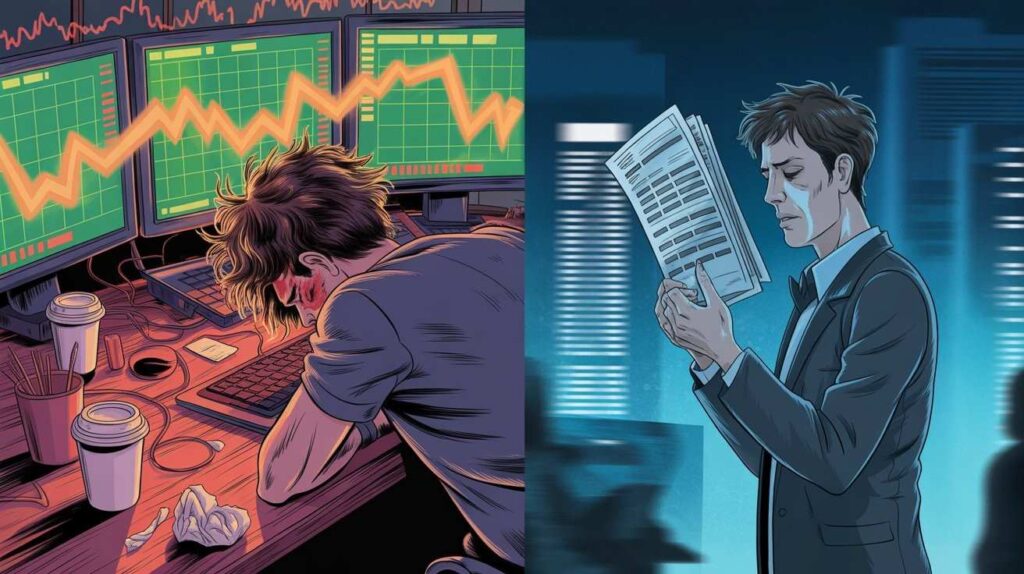
Mental toughness in trading means executing your plan during drawdowns by quieting mental interference, trusting your trained intuition, and implementing systematic risk controls. This guide reveals how to build psychological resilience using Tim Gallwey’s Inner Game theory, professional recovery protocols, and neuroscience-backed techniques that protect both your capital and mental health during losing streaks.
I’ve watched countless traders blow up their accounts during market downturns. And honestly? It was never about their technical analysis. It was always about their mental toughness.
When Bitcoin drops 30% in a week or the S&P 500 enters correction territory, your ability to stay psychologically grounded becomes your most valuable trading asset. The difference between traders who survive drawdowns and those who don’t isn’t found in their charts, it’s found in their minds.
Throughout my years developing trading psychology frameworks, I’ve discovered one uncomfortable truth: mental resilience during losing streaks separates consistent performers from those who keep starting over. That’s exactly what The Reborn Trader is built on, the psychology of coming back after you’ve been broken.
This guide gives you the exact framework, backed by neuroscience and professional recovery protocols, to build that mental fortress.
What Is Mental Toughness in Trading?
Mental toughness in trading is the ability to execute your strategy consistently during drawdowns, by quieting internal interference, trusting your trained judgment, and applying systematic risk controls, regardless of emotional pressure.
It is not fearlessness. It is not ignoring losses. It is the disciplined practice of separating your identity from your P&L and continuing to act on process rather than panic.
What mental toughness is NOT:
- Forcing yourself to feel nothing after a loss
- Blindly holding losing positions to “prove” you’re tough
- Trading through emotional pain to show discipline
- Ignoring your body’s stress signals
What mental toughness IS:
- Executing your pre-defined rules even when it’s uncomfortable
- Reducing risk when your confidence is compromised
- Recovering from losses faster with each passing month
- Building habits that make disciplined decisions automatic
Understanding the Real Cost of Drawdowns
Let me be straight with you, drawdowns aren’t just numbers on your screen.
They’re psychological warfare. When you’re down 15% on your trading account, you’re not just dealing with lost capital. According to behavioral finance research, you’re experiencing emotional pain that’s roughly twice as intense as the pleasure you’d feel from an equivalent gain. This is called loss aversion, and it’s hardwired into your brain through millions of years of evolution. I remember my first significant drawdown trading gold futures, watching my account shrink felt like physical pain, and that’s not an exaggeration. Your amygdala, the fear center of your brain, literally activates the same neural pathways whether you’re facing a physical threat or watching your positions bleed red.
I once heard this on Words of Rizdom, and it stuck with me because it explains drawdowns better than any chart ever could:
Pressure doesn’t reveal skill. It reveals what you default to when control slips. Most people don’t fail because they lack knowledge, they fail because they haven’t trained their nervous system for uncertainty.
Here’s the mathematical reality that most traders ignore:
| Account Drawdown | Recovery Gain Needed | Psychological Impact |
| 10% | 11.1% | Manageable stress |
| 20% | 25% | Moderate anxiety |
| 50% | 100% | Severe – Often unrecoverable |
The recovery mathematics are brutally unforgiving, which is exactly why your psychological approach to managing drawdowns determines your entire trading career trajectory.
Why Most Traders Fail Psychologically
Over 90% of retail traders fail within the first few years. The technical reasons are many, but the psychological reasons cluster around three core failures.
Overconfidence Bias
After a winning streak, especially in a bull market traders start believing they’ve cracked the code. Position sizes increase, risk management rules get bent, and then the market delivers a humbling correction.
Signs you’re in overconfidence territory:
- You’ve stopped following your position sizing rules
- You feel “certain” about a trade before entering
- You’ve increased leverage after a winning streak
- You’ve stopped journaling because “it’s going well”
The hardest part of overconfidence bias is that it feels exactly like earned confidence from the inside. It isn’t.
The Sunk Cost Fallacy
You hold onto a losing position because you’ve already invested time, money, and ego into it. You tell yourself the market will eventually prove you right.
How the sunk cost trap plays out:
- The loss grows from -5% to -15% while you “wait for a bounce”
- You add to a losing position to “average down”
- You justify the trade based on how much time you spent analyzing it
- You finally exit at the worst possible moment after capitulating
Meanwhile your mental capital evaporates alongside your financial capital and that combination is what ends trading careers.
Revenge Trading
After taking losses, you feel an intense urge to “get your money back” immediately. Your logical brain shuts down, emotional regulation fails, and you take trades based on anger rather than analysis.
The revenge trading cycle:
Loss triggers emotional pain → urgency to recover → impulsive entry → larger loss → deeper emotional pain → repeat
This isn’t trading anymore, it’s gambling driven by ego. Understanding why you fail psychologically is the first step to overcoming fear of trading loss for good.
The Inner Game: Your Greatest Trading Opponent Is Inside You
Before building your resilience framework, you need to understand a concept that changed my entire approach to trading psychology: Tim Gallwey’s Inner Game theory.
The premise is elegant: Performance = Potential − Interference.
In trading terms, your actual results equal your potential ability minus the mental interference you create through self-doubt, fear, and overthinking. Gallwey identified two internal selves operating within every performer:
- Self 1: the conscious critic. The voice that second-guesses your entries, judges every loss, and creates anxiety around every decision.
- Self 2: the trained intuitive self. The part that actually executes well when you let it.
How Self 1 sabotages your trading:
- Overrides your exit rules at the worst moment
- Creates hesitation on valid A-grade setups
- Generates the “one more trade” impulse after a loss
- Replays losing trades on loop, destroying confidence
How to strengthen Self 2:
- Follow your rules mechanically on small position sizes until execution becomes automatic
- Practice observing your emotions without reacting to them
- Replace judgment (“I’m an idiot”) with observation (“I notice I’m feeling anxious”)
- Trust your backtested edge even when the current trade feels uncomfortable
That single shift from judgment to observation, is the foundation of trading composure under pressure.
The 5 Pillars of Mental Toughness in Trading
These pillars emerged not from theory alone but from real conversations with traders who have been through significant losses and came back. They apply whether you’re in forex, crypto, stocks, or futures.
Resilience: Learning to Fall Forward
Resilience is the ability to recover from losses quickly and use your mistakes as learning opportunities rather than identity-confirming evidence that you “can’t trade.”
How resilient traders think differently:
- They separate trade outcomes from personal worth
- They ask “what did this teach me?” rather than “why does this always happen to me?”
- They expect drawdowns as part of the process, not as signs of failure
- They measure success by process adherence, not P&L
Action step: After every losing trade, write one sentence: “What this trade taught me is…” Not to relive the pain, but to extract value from it.
Focus: Blocking Out the Market Noise
The markets are a constant whirlwind of information, opinion, and noise. Staying focused means zoning in on your trading plan and blocking out everything that doesn’t belong to your strategy.
Common focus killers for traders:
- Checking multiple analyst opinions before entering a trade
- Monitoring your P&L in real time instead of your strategy signals
- Following too many social media trading accounts
- Trading during periods of personal stress or sleep deprivation
Action step: Establish a pre-market ritual, 10 minutes of reviewing your plan and defining your “A-grade” setups for the day. Only trade those. Nothing else.
Self-Belief: Trusting Your Trained Edge
Without self-belief in your system, hesitation creeps in. Missed entries. Early exits. The constant second-guessing that turns a profitable edge into a losing one through poor execution.
How to build evidence-based self-belief:
- Back-test your strategy across at least 100 trades
- Track your rule-following rate, not just your win rate
- Review past trades that went well when you followed your rules exactly
- Set a statistical anchor: “My system has a 58% win rate over 200 trades. This is trade 47.”
Action step: Review 20–30 past trades that followed your rules exactly. What was your win rate? Your average R? Let the math be the foundation of your confidence, not recent results.
Composure: Staying Level When the Market Tests You
Composure is what keeps you rational when your instincts are screaming. It’s the difference between closing a position because your analysis says to and closing it because you can’t stand looking at the red anymore.
Signs your composure is breaking down:
- You’re refreshing your broker app every 30 seconds
- You’ve moved your stop loss to “give it more room”
- You’re thinking about the dollar amount rather than the % risk
- You feel physical tension, tightness, racing thoughts around open positions
Action step: Create a physical trigger for composure. When you feel emotional heat rising during a trade, close your laptop for 90 seconds and take 5 deep, slow breaths. Controlled breathing activates your parasympathetic nervous system and measurably reduces cortisol.
Motivation: Your “Why” Outlasts Any Losing Streak
What keeps you going when the results don’t show up for weeks? Not market knowledge. Not technical skill. Motivation, a clear, specific connection to why you’re doing this.
What sustainable trading motivation looks like:
- Tied to a specific life goal, not just “making money”
- Strong enough to outlast a 3-month drawdown period
- Connected to who you want to become, not just what you want to have
- Reviewed regularly so it stays emotionally vivid and real
Action step: Write down, in one paragraph, exactly what successfully trading means to you beyond money. Read it every morning before the market opens.
Also read this: Morning Routine for Day Traders
How to Build Trading Discipline
Discipline isn’t a personality trait, it’s a daily system. The core pillars:
- Meditate 5–10 minutes before the open builds the mental gap between emotional trigger and impulsive action
- Cap risk at 2% per trade keeps losing streaks survivable without psychological collapse
- Set a hard daily loss limit of 2–3% automate it so emotion can’t override logic at the worst moment
- Journal every trade record your emotional state, not just your entry price; patterns that leak money become visible fast
- Lock in sleep and exercise cognitive performance degrades sharply without them; this is infrastructure, not optional
- Define your A-grade setups in writing if it’s not on the list before the session starts, you don’t trade it
How to Build Trading Discipline: The Complete System. Full daily routine, rule templates, position sizing framework, and habit-building protocol, all in one guide. And also read, The Psychology of Risk and Leverage in Trading.
How to Recover from a Big Trading Loss: The Reborn Trader Protocol
Most trading psychology articles skip this entirely. Here’s the exact 5-step process, short and practical, no fluff.
1: Stop trading immediately: Your instinct says “trade your way out.” That’s exactly how small losses become catastrophic ones.
- Close your platform for 24–48 hours, no charts, no news, no social feeds
- Do something physical to reset your nervous system
- Do not calculate how you’ll “get it back”
Related: Why emotional trading destroys accounts
2: Run an honest post-mortem: Clarity converts a loss from a wound into a lesson. Ask three questions:
- Bad luck, bad execution, or a flawed strategy?
- Which trades broke your rules and why did you take them?
- What was your emotional state before the worst trades?
Related: How to keep a trading journal that actually improves your results
3: Accept the loss completely: Fighting reality depletes the mental capital you need to rebuild. Acceptance is the starting line not the finish line.
- The money is gone, stop replaying how you could have kept it
- The market owes you nothing
- Resistance drains the energy you need to come back
4: Rebuild at 25% position size: You’re not trying to recover fast. You’re rebuilding confidence and rhythm.
- Trade at one quarter of normal risk for two weeks minimum
- Only take A-grade setups nothing borderline
- Don’t size back up until you’ve recovered at least half the drawdown
5: Treat the comeback as the real test: Anyone can trade well in a bull market. The traders who last come back with more discipline, not more desperation.
- Does your edge hold under real pressure or was it luck?
- Are your rules strong enough when everything is on the line?
- Have you genuinely learned or just survived?
Read full guide: How to Rebuild Trading Confidence After a Loss
Maintaining Physical Health for Mental Performance
Your physical state is your mental state. There is no separation.
Sleep (7–8 hours minimum) Research shows being awake for 18 hours produces cognitive impairment equivalent to a 0.05% blood alcohol level. In trading terms: sleep deprivation means you see setups that aren’t there, ignore risk signals, and make emotional decisions. Your brain consolidates learning and restores executive function during sleep, skip it and your edge disappears before the market even opens.
Exercise (30 minutes before the market) Physical activity reduces cortisol, boosts dopamine and serotonin, and directly improves your brain’s stress tolerance. Weight training, cardio, a brisk walk, it doesn’t matter. What matters is this: when you’re tired or stressed, Self 1’s critical voice gets louder and harder to quiet. Exercise is how you silence it before it costs you money.
The non-negotiables at a glance:
- 7–8 hours of sleep, non-negotiable, not a suggestion
- 30 minutes of movement before trading
- No trading hungry or immediately after a heavy meal
- Limit caffeine after midday, it amplifies anxiety under market stress
Related: How to Trade Like an Athlete Train Focus and Mental Toughness Under Pressure
The Long Game: This Is How You Survive
Mental toughness isn’t built in a day. It’s built through consistent practice over months and years.
What the long game actually looks like:
- Weeks where you follow every rule and still lose and you keep going
- Moments where you close a losing trade cleanly, without revenge, and feel genuinely proud of your discipline
- A trading journal grown from 10 entries to 300, showing you’ve become a different person
- A drawdown that would have broken you two years ago, now handled calmly and systematically
The goal isn’t to avoid drawdowns, they are inevitable in this business. The goal is to manage them professionally when they arrive, protect your capital when your edge is cold, and trust your system enough to stay in the game long enough for the edge to express itself.
Markets test your strategy. Drawdowns test you. And every trader who has ever come back from a significant loss knows: the comeback is built before the crisis. It’s built in the daily habits, the quiet mornings with the journal, the meditation sessions nobody sees, the position you didn’t take because your rules said no. That’s the reborn trader. Not someone who never falls. Someone who knows exactly how to get back up.
Each week, The Reborn Trader newsletter breaks down trading psychology, resilience, and decision-making under pressure. If you’re serious about lasting in the markets, this is where you belong.
FAQ
How do I control my emotions while trading?
Name the emotion first: fear, anger, urgency then pause for 60–90 seconds before acting. Mindfulness trains your brain to create space between emotion and reaction, turning an impulsive response into a deliberate one. The goal isn’t to eliminate emotions; it’s to stop them from making your decisions.
Why do most traders fail psychologically?
Emotional decision-making, revenge trading after a loss, oversizing during a winning streak, freezing at critical entry points, accounts for the majority of retail failures, far outweighing technical incompetence. The market is built to exploit impatience, overconfidence, and the desperate need to be right.
What is revenge trading and how do I stop it?
Revenge trading is entering a new position immediately after a loss to “get your money back” driven by anger, not analysis. There is no worse trade than a revenge trade; the moment you feel the urge to jump straight back in after a loss, consult your trading journal and step away instead. A mandatory 30-minute break after any emotionally charged loss is the most effective circuit breaker.
Does physical health actually affect trading performance?
Yes, directly and measurably. Fear is one of the most common emotions traders face, and it intensifies significantly when your body is already under stress from sleep deprivation, poor nutrition, or physical tension. Exercise before the market, consistent sleep, and avoiding trading while hungry are performance decisions, not lifestyle ones.
How long does it take to build mental toughness as a trader?
Small sequential wins build the habit, consistency compounds over months, not days, and skipping ahead derails the process. Most traders need 6–18 months of deliberate practice, journaling, meditating, reviewing trades honestly before disciplined execution becomes truly automatic under pressure.
What is the mental side of trading?
The mental side of trading is managing your emotions, beliefs, and reactions under uncertainty. It’s the ability to follow your plan when fear, greed, or ego want control. Charts show opportunities. Your mind decides whether you execute or self-sabotage.