
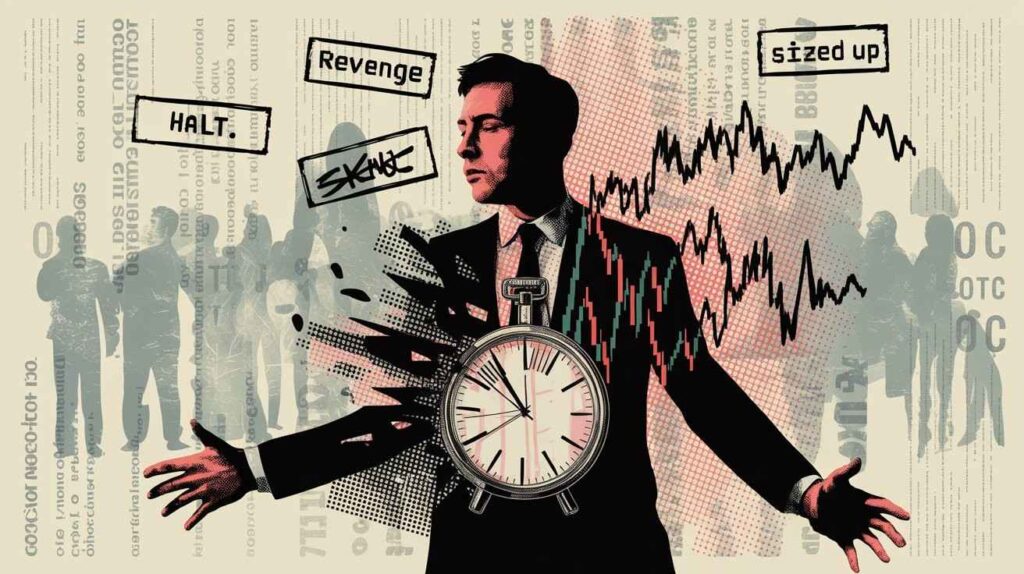
Let me be brutally honest with you before we go any further. The market didn’t blow your account. Your emotions did.
Not your strategy. Not your indicators. Not the broker, not the spread, not the news event that “came out of nowhere.” The real culprit was sitting in the chair the entire time, making decisions that your trading plan never approved, chasing moves your rules never permitted, holding losses your system told you to cut an hour ago.
I know this because I was that trader. And if you’re reading this, there’s a good chance you recognise yourself in that description too.
Fear and greed in trading are not occasional problems. They are the permanent, underlying current beneath every impulsive trade, every blown stop, every revenge session that turned a bad Tuesday into a catastrophic one. And the reason most traders never fix them is because most articles on this topic give you motivational advice dressed up as strategy.
This is not that article. What you’re about to read is the complete picture, the psychological roots, the market mechanics, the self-diagnosis tools, the real strategies, and the transformation framework that the competing articles consistently leave out.
Why Fear and Greed Are the #1 Enemy of Every Trader
Most people treat trading psychology like a bonus chapter, something you read after you’ve learned the “real” stuff like chart patterns and indicators. That thinking is precisely why most retail traders lose money consistently.
The truth is uncomfortable: your strategy is probably fine. Your execution is where everything falls apart. And execution is a psychological problem, not a technical one.
When you enter a live trade, your brain cannot distinguish between a financial threat and a physical one. A position moving against you triggers the same cortisol stress response as genuine danger, heart rate rises, thinking narrows, the urge to act right now becomes overwhelming. When a trade runs in your favour, dopamine floods your system, the same neurochemical behind gambling addiction and compulsive behaviour.
You are not weak for feeling this. You are human. But understanding it is what separates the traders who survive from the ones who eventually quit.
“The investor’s chief problem and even his worst enemy is likely to be himself.” Benjamin Graham
Professionals feel fear and greed too. The difference is they built a system that acts despite those feelings, not a system that waits until the feelings go away, because they never do.
Understanding Fear in Trading: The 4 Forms That Kill Profits
Fear in trading is a shapeshifter. It rarely shows up as obvious panic. More often it hides behind caution, patience, and “waiting for one more confirmation.” Here are the four specific forms you need to learn to recognise, because you cannot overcome what you cannot name.
Loss Aversion: Fear of Losing Money
Nobel Prize-winning research by Kahneman and Tversky established that the psychological pain of losing money is roughly twice as powerful as the pleasure of gaining the same amount. This loss aversion in trading creates a devastating pattern most traders never even notice they’re trapped in.
You cut winners early because the profit feels fragile and you’re afraid of losing it. You hold losers long because closing them makes the pain real and permanent.
The result is a portfolio of small wins and large losses, a mathematically guaranteed road to a depleted account, regardless of how good your entry signals are.
FOMO: Fear of Missing Out
FOMO in trading, is what happens when watching a move unfold without you feeling worse than taking a bad trade. The candle is already extended. The breakout already happened twenty minutes ago. But the urgency feels unbearable.
So you chase it. And the moment you do, it reverses. Because FOMO trading is not a decision, it is a reaction. And reactive traders are the liquidity that disciplined traders feed on. Every time you chase a move out of fear of missing it, somewhere on the other side of that trade is a patient trader taking profit into your panic-driven entry.
The Fear of Being Wrong
Here is the one that hides behind the most convincing disguise. Your trade thesis is broken. Price has moved through your invalidation level. By every honest measure, the setup no longer exists. But you can’t close it, because closing it means admitting you were wrong.
This behavioural bias in trading, you are not holding because the trade is still valid. You are holding because closing it means admitting you were wrong. And that one decision is how small losses become big ones.. The market does not care whether you were right. It only moves. Your job is to respond to what is happening, not defend what you predicted.
Fear After a Losing Streak
Five consecutive losses. A sixth trade appears, textbook setup, clean structure, everything your system requires. Your hands hesitate over the mouse.
This is trading psychology at its most painful. The losing streak hasn’t just taken capital. It has hollowed out your belief in your own system. And a trader who has stopped trusting their plan is not trading anymore, they are guessing, and losing the psychological edge that the plan was designed to provide.
Read this: Emotional Biases That Affect Stock Traders and How to Overcome Them
Understanding Greed in Trading: The 5 Ways It Burns You When You’re Winning
If fear is the enemy of bad days, greed in trading is the enemy of good ones. It arrives precisely when your guard is lowest, after a winning trade, during a hot streak, in the moments when confidence tips quietly into overconfidence.
Overtrading
A profitable week whispers a dangerous lie: that more activity means more money. Overtrading is the result, forcing setups that barely qualify, staying at the screen long after your edge has expired, taking trades that exist only because you feel like you should be doing something.
More trades do not produce more profit. They produce more decisions. And more decisions under emotional conditions produce more mistakes.
Moving Your Stop Loss
You placed a stop loss. It was rational when you placed it. Then price approached it and you moved it, “just a little more room,” you told yourself.
That is not flexibility. That is emotional trading wearing the costume of patience. Your stop defines the exact price at which your trade idea is proven wrong. The moment you move it because of how you feel, you have handed the decision-making over to your emotions and they have a terrible track record.
Revenge Trading
This one deserves more space than anything else in this article, because it is the fastest way to turn a bad day into an account-ending one. You took a real loss. The kind that sits in your chest. And within fifteen minutes you are back in a position, not because a setup appeared, but because you want your money back immediately.
Revenge trading psychology operates on a simple and catastrophic loop: one loss becomes two, two becomes four, a manageable drawdown becomes something that takes weeks to recover from, if recovery comes at all. The market you are trying to get your money back from has no idea you exist. It will not cooperate. It never does.
Read this: Revenge Trading: The Hidden Habit That’s Blowing Up Your Account
Overconfidence Bias
Five winning trades in a row feels like mastery. Overconfidence bias in trading is when that feeling causes position sizes to balloon, entry rules to relax, and risk parameters to quietly expand, because surely the next trade will work too.
Markets are specifically engineered, through the random distribution of wins and losses, to punish overconfidence at exactly its peak. The winning streak ends. The oversized position takes the hit. And what took two weeks to build gets erased in two sessions.
Not Taking Profits
Your target was 6%. The position is at 8%. The greedy voice says hold it, it’s going higher.
Then it reverses. You exit at breakeven, or worse, at a loss, from a trade that had been squarely in profit. Greed in investing destroys exits just as reliably as it destroys entries. Your take-profit level was set with a clear head. Honor what your rational self decided before your emotional self got involved.
“The stock market is a device for transferring money from the impatient to the patient.” — Warren Buffett
How to Measure Fear and Greed in the Market Right Now
Fear and greed are not only internal psychological states, they are externally measurable in real time, and learning to read them gives you a significant edge in understanding the environment you are trading in.
The CNN Fear & Greed Index operates on a 0 to 100 scale. Below 20 represents extreme fear, historically associated with market bottoms, oversold conditions, and sharp reversals upward. Above 80 represents extreme greed, historically associated with overextended rallies, complacency, and conditions ripe for sharp corrections.
The VIX fear index, Wall Street’s volatility gauge measures the market’s expected turbulence over the next 30 days. A spiking VIX means fear is rising fast. A historically low VIX means complacency, arguably a more dangerous condition, because it precedes volatility rather than following it.
Use both of these as morning context, not as trade signals. They tell you the emotional climate of the market before you place a single order. Your trading plan tells you what to do inside that climate.
What Nobody Tells You About Trading in Volatile Markets
Volatile markets are not the problem. Unprepared emotions in volatile markets are.
When price is swinging 3% in minutes, when major news is dropping every hour, when every trading group you follow is split between calling a crash and calling the trade of the decade, that is the exact moment your psychological preparation either holds or collapses.
Most traders treat volatile sessions like normal sessions with bigger candles. They keep the same position size, the same timeframe, the same emotional approach. And they get systematically destroyed.
Here is what you actually do differently.
Shrink your position size before anything else. When volatility expands, price ranges expand with it. Your standard stop distance no longer reflects the true breathing room the trade needs. Rather than widening the stop and keeping the size, which dramatically increases your risk, you reduce the size and maintain your fixed percentage risk. Smaller positions mean smaller emotional responses to each tick. That alone keeps you rational when the market is not.
Slow down when the market speeds up. This is counterintuitive and it is correct. The faster price moves, the slower your decision-making needs to become. Switch to a higher timeframe than your usual. The 5-minute chart in a volatile session is noise. The 1-hour chart shows you the actual move. The market’s urgency is manufactured. Yours does not have to be.
Pre-define your walk-away number before the session opens. Before any major news event, central bank decision, or earnings release, write down the maximum loss that will close your platform for the day. Not a guideline, a rule with no exceptions and no negotiations. Emotional discipline in trading collapses fastest when consecutive losses keep getting met with “one more trade to recover.” The walk-away number eliminates that conversation entirely.
Stay off social media and trading communities during live sessions. Volatile markets turn online trading spaces into real-time amplifiers of panic and euphoria simultaneously. Someone is calling the end of the bull market. Someone else is leveraging up for the trade of their life. Both are emotional, and both will compromise your thinking if you allow them access. Close the tabs. Your plan speaks louder than a thousand panicking strangers, but only if you let it.
Breathe before you click. Four seconds in, four seconds hold, four seconds out. This is not soft advice. This is neuroscience. That deliberate breath activates your parasympathetic nervous system, reduces the cortisol response that volatile markets trigger, and physically restores your capacity for rational thought. Before every entry in a high-volatility session, one conscious breath. It takes four seconds and has saved more accounts than any indicator ever invented.
“In investing, what is comfortable is rarely profitable.” — Robert Arnott
Strategies to Control Emotions During Volatile Market Movements
Beyond the immediate session tactics, there are broader emotional trading strategies that need to be embedded into your overall approach, not just activated when things get chaotic, but practiced consistently so they are automatic when you need them most.
Maintain a pre-session routine. Before the market opens, your mental state should be as deliberate as your technical preparation. Review your watchlist, yes, but also check in with yourself.
Are you calm? Are you carrying residual anger or anxiety from yesterday’s session? Did you sleep?
These questions are not optional. A compromised trader executing a perfect strategy still loses.
Use a session time limit. One of the most underused tools in trading psychology is simply deciding in advance how long you will trade. Two hours, three hours, whatever is appropriate for your style. When the time is up, the platform closes. This prevents the slow cognitive erosion that comes from sitting in front of charts for six hours, where your decision quality degrades with every passing hour regardless of how the session is going.
Review volatile sessions differently. After a high-volatility session, your journal review should focus on emotional decision points more than technical ones. Ask: where did I deviate from my plan? What triggered that deviation, a loss, a missed move, external noise? What was my emotional state at that exact moment? The answers to those questions, tracked over weeks, reveal your specific psychological vulnerabilities with a precision that general advice never can.
The 7 Strategies to Master Fear and Greed
These are not motivational principles. These are mechanical structures built in your calm, rational state to protect you from your emotional, reactive one.
1- A rules-based trading plan. If it is not written down, it is not a plan. It is an intention. And intentions evaporate the moment the market moves against you. Your plan defines entry criteria, exit criteria, position sizing, and maximum daily loss before a single market opens. No plan, no trade, that rule alone eliminates a significant portion of the worst trades most retail traders take.
2- Pre-set stops and take-profits, placed before entry. Once they are set, they do not move. The moment you adjust levels mid-trade based on how you feel, you have exited your system and entered emotional trading territory. Your pre-trade self made those decisions clearly. Trust that version of yourself over the one currently staring at a moving chart.
3- Position sizing based on fixed risk percentage. The 1–2% rule is unsexy and it works. It keeps you in the game long enough to develop genuine skill. Never risk more on a single trade than you can lose without it affecting the quality of your thinking on the next one. Risk management in trading is the only edge that survives every market condition.
4- A trading journal that tracks emotional states. Record what you felt before entering the trade, during it, and after exiting. After 30 days of honest entries, your patterns will emerge with uncomfortable clarity, specific times of day where your discipline weakens, specific emotional triggers that precede your worst trades. That data is the most personalised trading education available to you and it costs nothing but honesty.
5- The 5-minute rule for reactive urges. Any trade impulse triggered by an emotional event, a loss, a fast-moving candle, a headline, gets a mandatory five-minute pause. Set a timer. Step away. Return. If the setup still meets your criteria, take it. If it was emotion, the urge will be gone and so will the bad trade it would have produced.
6- The pre-trade self-check. Three questions before every session: Am I calm? Am I trading from a place of revenge, anxiety, or FOMO? Did I take proper care of myself today? A red flag on any of these means you watch the market today. You do not participate in it. Trader discipline begins before the first candle of the session prints.
7- Use market sentiment as environmental context. Check the Fear & Greed Index and VIX each morning. Understand the emotional climate. Then let your trading plan, not the sentiment reading, govern every decision you make inside that climate.
Are You Trading on Fear or Greed Right Now? (Self-Diagnosis)
A way for you to actually diagnose your own emotional pattern rather than just read about it in the abstract.
Answer these questions honestly.
Do you check your open P&L more than five times during a single live trade?
Have you ever moved a stop loss after entering a position?
Have you entered a trade primarily because you didn’t want to miss the move?
Have you held a losing position past your original exit because you were convinced it would come back?
Have you taken a new trade within fifteen minutes of closing a losing one, without waiting for a clean, criteria-meeting setup?
If you answered yes to three or more of these, your trading mindset is currently being governed by emotion more than strategy. That is not a character flaw. It is a diagnosis. And every diagnosis has a treatment, which is exactly what this article has been building toward.
The Reborn Trader Story From Emotional Wreck to Disciplined Trader
The Reborn Trader didn’t come from a success story. It came from a Tuesday afternoon where I sat staring at a screen, having just wiped out three weeks of gains in a single session.
Not because the market was unfair. Not because the setup failed.
Because I revenge traded after one loss, doubled down after the second, and abandoned my plan entirely by the third trade. I wasn’t trading by that point. I was reacting emotionally, desperately, and expensively.
The turning point wasn’t a course or a mentor. It was a journal entry on a Wednesday morning that read: “I have no idea why I took half of yesterday’s trades.”
That honest admission changed everything.
Because once you can see your emotional trading patterns with that kind of clarity, once you can point to the exact sentence in your journal where fear or greed made the decision instead of your strategy, you can build walls around those moments. Rules that the emotional version of you simply cannot override, because the rational version of you already wrote them down and committed to them.
“The most important investment you can make is in yourself.” — Warren Buffett
The transformation from emotional wreck to disciplined trader is not a personality change. You don’t become a different person. You become a person with a better system. One where your calm, rational, plan-writing self permanently protects you from your stressed, reactive, revenge-trading self. That is what being reborn in trading actually looks like.
A turning point. A journal entry. A decision to stop negotiating with your own rules.
Conclusion: The Reborn Trader Mindset
Disciplined trading is supposed to feel boring. Not exciting. Not like the trading montages in financial films. Boring, in the best possible way. You follow your plan. The trade works or it doesn’t. You don’t negotiate with the result. You move to the next setup with the exact same emotional neutrality you brought to the previous one.
The traders who blow accounts are almost always chasing stimulation as much as profit. The trade is entertainment. The win is validation. The loss is a personal attack that demands immediate retaliation. That relationship with trading is the one that costs everything.
The trading mindset shift, the real one, the lasting one is the moment you stop needing the market to validate you, excite you or make you feel smart. The moment you can sit in front of a session, find no qualifying setups, and close the platform without frustration, that is when you know the psychology has shifted. The market will always carry fear and greed. It is built from them.
The question is whether you carry them too or whether you become the trader on the other side of someone else’s emotional mistake, calmly executing your plan while the crowd either panics or chases around you. That trader exists. You can become them. And it starts with the very next trade you decide not to take, because the emotion was there but the setup wasn’t.
If you want weekly insights that sharpen your mindset, cut through emotional noise, and help you trade with clarity, join The Reborn Trader Newsletter. I share premium lessons, mental frameworks, and behind-the-scenes breakdowns, all for free.
It’s the fastest way to level up your discipline, emotional control, and consistency.
Subscribe here and get the next issue delivered straight to your inbox.
FAQ
What is the Fear and Greed Index and how do I use it?
The Fear and Greed Index is a 0–100 scale that measures the overall emotional temperature of the market, below 20 signals extreme fear, above 80 signals extreme greed. You use it as context, not a trigger, it tells you the environment you’re trading in, not what trade to take. When it’s at extremes, tighten your risk management and pay closer attention to your position sizing.
Is FOMO always bad in trading?
Not always, sometimes FOMO is pointing you toward genuine momentum and a real opportunity you assessed correctly but hesitated on. The problem is when FOMO makes you skip your entry criteria, chase an already-extended move, or size up beyond your risk rules just to feel part of the action. If the setup still meets your plan’s criteria, it’s a trade; if it doesn’t, it’s FOMO and you sit it out.
How to Control Fear in Trading?
Fear usually shows up as hesitation, early exits, or skipping valid setups. What this really means is your brain is trying to protect you from uncertainty, not from bad strategy. The solution isn’t “be brave.” It’s reducing uncertainty through:
– Predefined risk per trade
– Backtested edge
– Position sizing you’re emotionally comfortable with
– A written trade plan
Fear shrinks when risk is controlled and rules are clear.
How Greed Affects Trading Decisions?
Greed doesn’t look like excitement. It looks like:
– Over leveraging
– Moving stop losses
– Adding to losing trades
– Ignoring risk rules after a winning streak
Greed destroys risk management. And once risk management collapses, accounts follow. The antidote?
Predefined profit targets. Fixed risk parameters. And stepping away after hitting daily profit goals.