
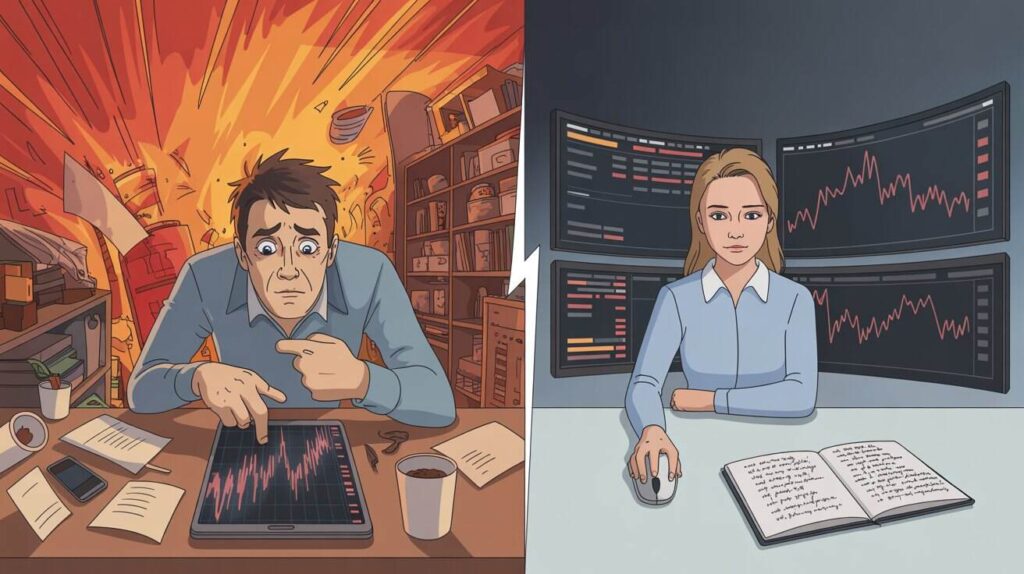
After experiencing a trading loss on EUR/USD, S&P 500, or any market, your brain enters a compromised emotional state that severely impairs rational decision-making and can lead to devastating revenge trading spirals. This comprehensive guide provides a neurologically-proven recovery protocol combining behavioral psychology, risk management frameworks, and mindfulness techniques to restore mental clarity within 48 hours. Follow these evidence-based strategies to protect your capital, rebuild confidence through disciplined position sizing, and transform losses into learning opportunities that make you a consistently profitable trader.
You know that sinking feeling when you watch your EUR/USD position move against you, and suddenly your carefully planned trade turns into a disaster? I’ve been there, and honestly, it’s one of the most brutal experiences in trading. The moment you realize that loss is real, your mind starts racing, your heart pounds, and every logical thought you had just vanishes into thin air. But here’s what separates consistently profitable traders from those who blow up their accounts: it’s not about avoiding losses altogether, it’s about how you handle your mind after they happen.
Trading psychology isn’t just some fluffy concept that sounds good in theory. Actually, it’s the difference between you making rational decisions and you revenge trading your way into a margin call. When I work with traders struggling after significant losses on NASDAQ 100 or S&P 500 positions, the first thing I notice is how their thinking becomes clouded, reactive, and completely detached from their original strategy.
Read this article: Why Your Life Shapes Your Trades
Why Your Brain Betrays You After Losses
Let me explain something fascinating about your brain that most traders don’t understand. Research on loss aversion shows that you psychologically feel losses about twice as intensely as equivalent gains. So when you lose $1,000 on a USD/JPY trade, your brain processes that pain as if you lost $2,000. Consequently, this creates an emotional response that completely hijacks your logical decision-making process.
Your amygdala, the part of your brain responsible for emotional responses, literally takes over from your prefrontal cortex, which handles rational thinking. Therefore, you’re no longer making calculated trading decisions based on probability and risk management. Instead, you’re operating from a place of fear, anger, and desperation. This is what neuroscientists call the fight-or-flight response, and it’s absolutely terrible for trading.
As legendary trader Mark Douglas once said:
“The consistency you seek is in your mind, not in the markets.”
Essentially, until you fix your internal state, no external strategy will save you.
Read this article: The Skill That Saves You During Drawdowns
The Immediate Steps: Your Emergency Protocol
Right after you take a significant loss, you need a structured protocol, not hope, not motivation, but a concrete system. First and foremost, you must stop trading immediately. I don’t care if you see what looks like the “perfect setup” on US30, your judgment is impaired, and that’s a fact, not an opinion.
Here’s your emergency recovery protocol that has helped hundreds of my clients regain their mental clarity:
1: Physical Disconnection: Close your trading platform and literally walk away from your screens. Moreover, I want you to do something physical: go for a walk, do twenty push-ups, or practice deep breathing for five minutes. This isn’t about feeling better emotionally; it’s about giving your neurological pathways time to reset from that stress response.
2: Accept Reality Without Judgment: The money is gone, and fighting that reality in your mind only makes things worse. Paradoxically, acceptance is what allows you to move forward strategically. You can’t change what happened, but you absolutely can control what happens next.
Document Everything: Open your trading journal and write down exactly what happened without emotion. What was your entry? What was your exit plan? Where did you deviate from your strategy? This isn’t about beating yourself up, it’s about collecting data.
Identifying the Cognitive Traps That Keep You Stuck
Now that you’ve got some distance from the loss, let’s talk about the mental traps that prevent clear thinking. Recency bias is probably destroying your judgment right now without you even realizing it. You’re putting too much weight on your recent losses, which makes you either too cautious (missing good setups) or too aggressive (trying to force winners that aren’t there).
Additionally, the sunk cost fallacy convinces you to keep throwing money at bad positions because you’ve already lost so much. I see this constantly with traders holding onto losing S&P 500 positions way past their stop loss, thinking “it has to come back eventually.”
Overconfidence bias is another silent killer. After you’ve been right a few times, your brain tricks you into thinking you’ve “figured out” the market. Then when reality hits with a loss, you experience cognitive dissonance, your belief that you’re a good trader clashes with the evidence of your loss.
Here’s a brutal truth: behavioral finance research shows that traders attribute wins to skill but losses to bad luck. This self-attribution bias prevents you from learning from mistakes because you’re not taking responsibility for them.
Paul Tudor Jones put it perfectly:
“Don’t focus on making money, focus on protecting what you have.”
This mindset shift is everything when recovering from losses.
Building Your Mental Recovery Framework
Recovery isn’t about bouncing back to who you were before the loss, it’s about evolving into a more resilient trader. The framework I teach starts with what I call the “Quarter Position Reset.” After any significant drawdown, you immediately reduce your position size to 25% of normal. Yes, this means if you usually trade one standard lot on EUR/USD, you’re now trading 0.25 lots.
This isn’t punishment; it’s strategic risk management. By trading smaller, you’re giving your mind space to rebuild confidence through small wins without the pressure of needing big returns. Furthermore, you’re protecting your remaining capital while your decision-making normalizes.
The 1-2% rule becomes non-negotiable during recovery. You should never risk more than 1-2% of your total capital on any single trade, period. If you’re trading NASDAQ 100 futures, this means calculating your position size based on your account size and the distance to your stop loss, not based on how confident you feel about the trade.
Next, implement what I call “The Three-Trade Rule.” You’re only allowed to take three trades per day maximum during recovery. Why? Because overtrading is a symptom of emotional dysregulation, not strategy. When you limit yourself, you’re forced to be selective, which naturally improves your trade quality.
The Power of Mindfulness in Trading Recovery
I used to think mindfulness and meditation were just wellness buzzwords until I saw the neurological research. Studies show that consistent meditation literally rewires your brain, strengthening the connections in your prefrontal cortex (rational thinking) while reducing the reactivity of your amygdala (emotional responses).
Start with just five minutes per day. Seriously, that’s it. Sit quietly, focus on your breath, and when your mind wanders to your losses or the market, gently bring your attention back to your breathing. This practice builds what’s called “emotional regulation” the ability to feel strong emotions without letting them control your actions.
One technique that works incredibly well for traders is the “RAIN” method: Recognize the emotion, Allow it to be present, Investigate it with curiosity, and Nurture yourself with compassion. When you feel the urge to revenge trade, pause and run through RAIN. You’ll be amazed how often the urge dissipates when you actually acknowledge it rather than acting on it impulsively.
Your Trading Journal: The Non-Negotiable Tool
Listen, I know journaling sounds boring, but your trading journal is the single most powerful tool for recovery and long-term success. However, most traders journal completely wrong, they just record entries, exits, and P&L. That’s not nearly enough.
You need to track your emotional state before, during, and after each trade. Were you anxious? Overconfident? Frustrated from a previous loss? When you analyze your journal after a month, you’ll see patterns that are invisible in real-time. Perhaps you always overtrade after winning streaks, or maybe you hesitate on valid USD/JPY setups when you’re scared from recent losses.
“The best traders are continuous learners who turn experience into expertise.”
Also read this: The Role of Journaling in Trading Psychology
The Mathematics of Recovery: Why Position Sizing Matters
Here’s a sobering reality check about drawdown recovery: if you lose 50% of your account, you need a 100% gain just to break even. Lose 75%? You need a 300% gain. This mathematical reality is why capital preservation must be your primary focus after losses, not aggressive recovery attempts.
Trading Recovery Success Rates by Method
- Traders who journal losses: 73% recovery within 60 days
- Traders who reduce position size: 81% avoid further drawdown
- Traders who revenge trade: Only 12% recover within 90 days
When you’re down, every dollar you have left becomes exponentially more valuable. Therefore, your position sizing strategy needs to adjust dynamically with your account balance. I use a system where for every 10% my account drops from its peak, I reduce my position size by 20%.
Furthermore, implement what I call “Recovery Milestones.” Set small, achievable goals like “three consecutive profitable days” or “five trades in a row where I followed my plan perfectly.” Notice these aren’t focused on dollar amounts, they’re focused on process.
Check this out: Forex Position Size Calculator
Preventing the Revenge Trading Death Spiral
Revenge trading is the number one account killer I see, bar none. It happens when you abandon your predetermined risk levels and start trading from a place of emotional desperation.
The warning signs are crystal clear: you’re entering multiple trades back-to-back without waiting for your setups, you’re ignoring your stop losses, you’re increasing position sizes after losses, and you’re trading instruments you normally don’t trade (jumping from EUR/USD to crypto just because you see movement).
Create what I call a “Trading Pause Rule”: any time you lose more than two trades in a row, or lose more than 2% of your account in a single day, you must stop trading for a minimum of 30 minutes. No exceptions.
Jesse Livermore, one of the greatest traders who ever lived, warned us:
There is nothing new in Wall Street. There can’t be because speculation is as old as the hills. Whatever happens in the stock market today has happened before and will happen again.
Conclusion: Transform Losses Into Long-Term Trading Success
Recovering from trading losses isn’t about bouncing back to who you were before, it’s about evolving into a fundamentally stronger, more resilient trader who views setbacks as data rather than disasters. The protocols outlined in this guide, the emergency pause, position size reduction, journaling, mindfulness practice, and cognitive bias awareness, aren’t temporary fixes. They’re the foundation of a sustainable trading career that can weather inevitable drawdowns without psychological collapse.
The mathematics of trading guarantees you’ll experience losses. The quality of your trading career depends entirely on how you respond to those losses. Traders who implement the Quarter Position Reset, honor the Trading Pause Rule, and maintain rigorous journals don’t just recover faster, they emerge with deeper self-awareness and stronger discipline than before the loss occurred.
Your next steps are simple but non-negotiable: If you’re currently dealing with a loss, close your platform right now and implement the three-step emergency protocol. Start your trading journal today if you haven’t already. Commit to five minutes of daily meditation. Most importantly, reduce your position size before your next trade on EUR/USD, S&P 500, NASDAQ 100, or whatever instrument you trade.
Remember Mark Douglas’s wisdom: the consistency you seek is in your mind, not in the markets. Paul Tudor Jones reminds us to protect what we have before chasing what we want. And Jesse Livermore showed us that the patterns of emotional destruction repeat endlessly unless we consciously break the cycle.
The market will be here tomorrow, next month, and next year. Your capital and mental health won’t survive repeated emotional trading. Choose discipline over desperation, process over profits, and long-term growth over short-term recovery. That’s how you think clearly after trading losses, and that’s how you build a trading career that lasts.
Build the mindset that survives drawdowns and compounds under pressure. Join The Reborn Trader Premium newsletter for weekly psychology frameworks used by disciplined traders and high performers.
FAQ
Why do I feel so emotional after a trading loss?
Losses trigger loss aversion in the brain, making pain feel stronger than equivalent gains. That emotional reaction can hijack logic and push you into reactive decisions rather than strategic ones.
How long should I wait before trading again after a significant loss?
Your emotional state needs time to normalize. Short losses (under 2%) may only need a brief pause, but larger drawdowns often require 24–72 hours of cooling off before trading again with clarity.
What is revenge trading and how do I avoid it?
Revenge trading is the urge to recover losses immediately by taking impulsive trades. It’s driven by fear and the desire to feel in control, and nearly always leads to bigger drawdowns. Stop trading and reset your mindset before you execute again.
How much should I risk per trade after a losing streak?
After a loss, reduce risk to conservative levels (usually below normal thresholds) so you protect capital and rebuild confidence. Lower risk reduces emotional pressure and keeps decisions rational.
Does journaling help with recovering from trading losses?
Yes. Journaling lets you track not just trade details but emotional states and biases, which makes patterns visible and prevents the same mistakes repeating.
Should I change my trading strategy after a drawdown?
Not immediately. Most traders mistake execution flaws for strategy flaws. Review 30–50 past trades to see if losses were behavioral or strategic before pivoting your approach.
How do cognitive biases affect my trading decisions after losses?
Biases like loss aversion, sunk cost fallacy, and overconfidence distort judgment after losses. They can make you hold onto bad trades, abandon rules, or overtrade. Awareness helps mitigate their impact.
How do professional traders handle losses differently?
Pros outperform by accepting losses as part of probabilistic systems, sticking to fixed risk limits, and maintaining emotional neutrality, treating outcomes as data, not personal failure.
Can mindfulness or meditation improve trading performance?
Practices that strengthen emotional regulation help you detach from fear and reactive impulses, improving clarity and enabling disciplined decisions after losses.