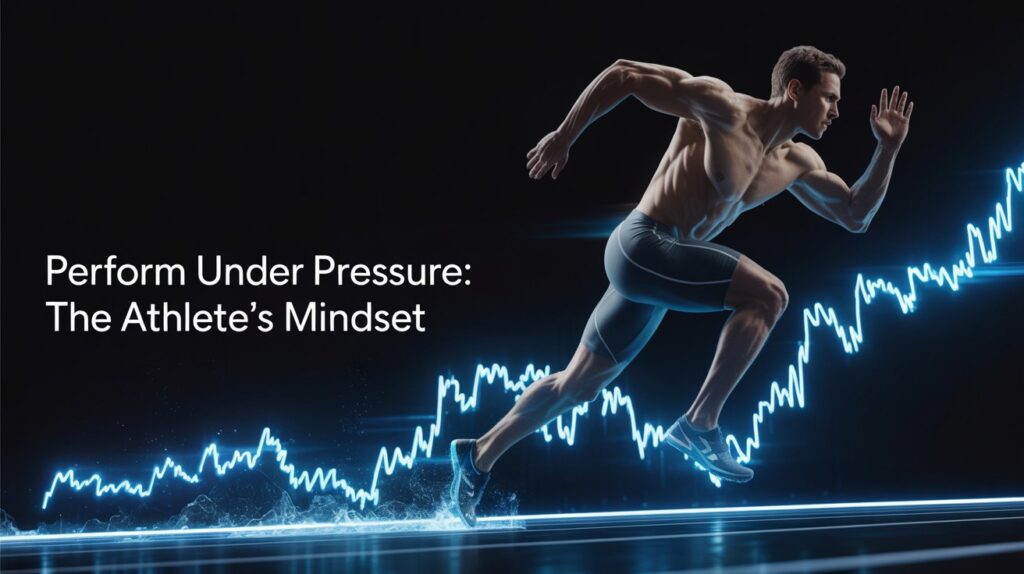
When you watch elite athletes perform, what you’re really seeing isn’t just skill. It’s focus trained under chaos. The same thing traders need when markets get wild.
Here’s the truth: most traders don’t fail because of bad strategy, they fail because they choke under pressure. They freeze, overthink, or act out of fear. And that’s exactly what athletes train to overcome.
If you want to trade like a pro, you’ve got to start training your mind like one.
Let’s break it down.
The Mental Game: Focus Is a Muscle
An athlete doesn’t just show up on game day and hope to perform. They build focus repetition by repetition. In sports psychology, this is called mental conditioning, the process of building focus, emotional control, and decision-making under stress.
As traders, our version of the “game” is live market pressure. Every tick, candle, and price move is like the opponent testing our patience.
Focus isn’t natural. It’s trained.
Here’s how elite performers build it:
- Deliberate practice.
They don’t just perform; they simulate pressure. A tennis player practices serves with a crowd noise simulator. A boxer spars under fatigue.
Traders can do the same. Backtest trades under time constraints. Simulate drawdowns. Practice journaling right after losses. - Mental resets.
Between plays, an athlete resets, a quick breath, a visual cue, a self-command like “next point.”
You can do that mid-trade. When your heart rate spikes, say “next setup” out loud. It’s a psychological reset, a reminder that your edge comes from clarity, not chaos. - Pre-performance routines.
Serena Williams bounces the ball five times before a serve. Michael Phelps visualized every lap before races.
What’s your trading version of that? A breathing sequence before you hit “Buy”? A self-talk cue before checking charts?
Focus under pressure is never spontaneous. It’s trained through structured repetition.
Pressure Training: Turning Stress Into Strength
Here’s the thing: pressure doesn’t build character; it reveals your preparation.
Most traders misread pressure. They see it as something to avoid, but in truth, it’s the training ground.
Sports science calls this stress inoculation, exposing yourself to controlled stress until it no longer hijacks your focus.
If you’ve ever seen a quarterback keep calm with 300-pound defenders running at him, that’s stress inoculation at work.
As traders, we can build it too:
- Simulate stress intentionally.
Do mock trading sessions with time limits. Restrict yourself to 2 trades a day. Track your emotions.
The goal isn’t to win, it’s to see how your body reacts when you can’t control the market. - Train recovery.
After an intense session, athletes don’t just rest, they recover. Ice baths, reflection, mindset resets.
Your version? Step away from charts. Write in your journal what triggered you. Note what thought patterns repeated. - Reflect with brutal honesty.
Most traders “review” trades, but few analyze their mental game.
What caused the panic? What belief surfaced when you lost money?
Pressure exposes weak mental habits, use it as a diagnostic tool, not a punishment.
The Flow State: Where Focus Becomes Effortless
Athletes call it “being in the zone.” Traders call it flow, when you’re deeply tuned in, every decision feels natural, and the outside noise fades away.
Psychologist Mihaly Csikszentmihalyi, who coined the term Flow, found that it happens when your skill level matches your challenge level.
Too easy = boredom.
Too hard = anxiety.
Your job as a trader is to find that balance.
How to trigger flow during trading:
- Set process goals, not profit goals.
Athletes don’t think “I must win”; they think “I must execute.”
Focus on executing your playbook, not making money. - Cut noise.
No news feeds. No second opinions. Just your system and the present moment.
Flow hates clutter. - Create a pre-flow ritual.
Simple example: 2 minutes of deep breathing before you open charts. It signals your brain that performance mode is on. - Respect the recovery cycle.
Flow isn’t sustainable 24/7. You must oscillate between deep focus and complete rest.
If you trade fatigued, you’ll start reacting instead of responding, that’s the mental equivalent of an athlete playing injured.
Body Drives the Mind: Physical Fitness for Mental Stamina
Let’s be real, trading is a mental sport, but it’s powered by the body.
A sluggish body equals a foggy mind. Period.
Studies on exercise and cognitive performance show that regular movement improves decision-making, memory, and focus, all essential for trading.
So if you want to trade like an athlete, stop treating your body like an afterthought.
Start small:
- Train your breathing. Slow, diaphragmatic breathing regulates your nervous system and keeps your prefrontal cortex (your decision-making HQ) online.
- Move daily. Even 20 minutes of cardio sharpens your focus window.
- Hydrate and fuel well. Blood sugar crashes cause impulsive decisions. Eat like you’re preparing for a match, because you are.
The brain doesn’t perform well when your body’s stressed, dehydrated, or under-slept. Treat your physiology as part of your trading edge.
Emotional Regulation: The Athlete’s Secret Weapon
Here’s what separates pros from amateurs, emotional control.
An athlete misses a shot, resets instantly. A trader misses a trade and spirals. Same event, different recovery speed.
The key difference is how they process emotion.
Athletes use cognitive reframing, the ability to reinterpret failure as feedback.
When they lose, they don’t say, “I’m bad.” They say, “That didn’t work; let’s adjust.”
You can do the same:
- Name the emotion. Don’t say “I’m angry.” Say “I feel frustrated because I broke my rule.” Naming emotions activates rational thought.
- Reframe losses as data. Losses aren’t punishments; they’re insights.
- Build emotional range. Learn to stay neutral in both euphoria and panic.
Think of emotions as weights in the gym, the more you train with them, the stronger your emotional muscle becomes.
Athlete-Inspired Focus Drills for Traders
You can’t think your way into better focus, you have to train it into your nervous system.
These five drills are designed to hardwire calm, sharpen attention, and keep your execution crisp under pressure.
- The “One Candle” Drill (Precision Under Chaos): Train visual focus like an athlete’s eye. Pick one candle on your chart, follow it without distraction for a minute. It builds attentional control.
- Heart Rate Reset: Use breathing to bring your nervous system back to neutral. Inhale 4, hold 4, exhale 6. Do this before trading or after losses.
- One Mistake Rule: You get one emotional mistake per day. After that, you execute only by your system. Builds discipline and recovery speed.
- Pre-Game Visualization: Before charts, visualize calm execution and emotional control. This primes your brain for performance.
- Cold Exposure Drill: End your shower with 30 seconds of cold water to train calm under discomfort, the same response needed during drawdowns.
Trading Is a Mental Sport
When I coach traders, I tell them this
You don’t need more strategy. You need stronger focus under stress.
Trading isn’t about predicting markets; it’s about performing when uncertainty hits.
And that’s exactly what athletes master.
So start training like one.
Treat each trading day like game day.
Your charts are your field.
Your emotions are your opponent.
And your mindset, that’s your weapon.
Stay Mentally Fit
If this resonated with you, join The Reborn Trader Newsletter, it’s where I share weekly insights and mindset frameworks to help you stay calm, consistent, and confident under pressure.
Or, if you’re ready to train your mind like an athlete and build emotional mastery in trading, explore 1:1 mindset performance coaching, it’s not about motivation; it’s about transformation.
FAQs
How do traders build focus like athletes?
What is the best way to stay calm under trading pressure?
Why is focus training important for traders?
What are practical focus exercises for traders?
Breathing drills: 4-7-8 breathing between trades to regulate focus and heart rate.
Journaling: Record emotional states and triggers after sessions to build awareness.
Micro-recovery: Step away after intense trades to reset before re-entering the market.