
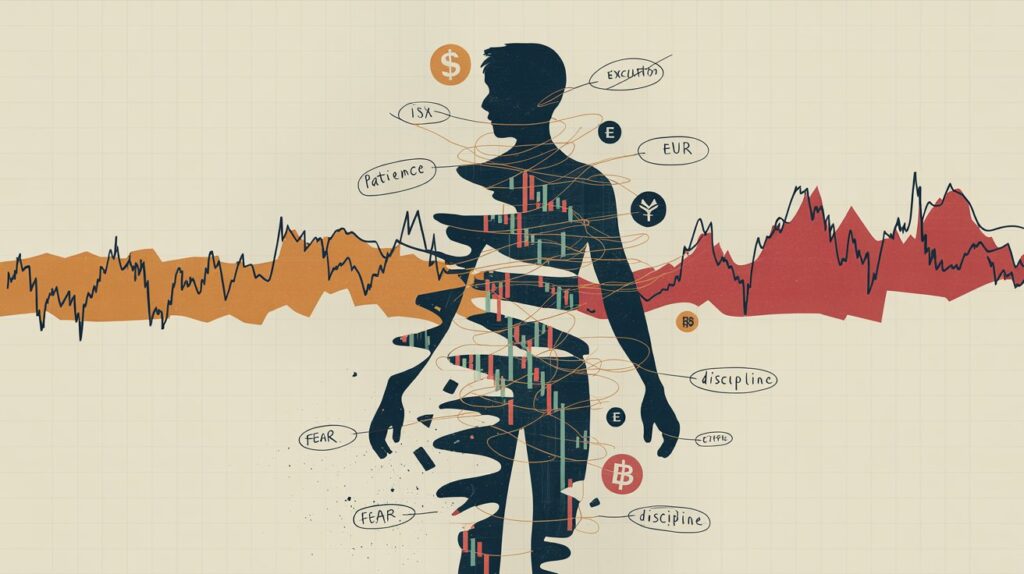
The market does not beat you, your mind does. Let me be straight with you. Most traders do not lose because their strategy is broken. They lose because their emotional discipline in trading completely falls apart the moment real money is on the line. I have seen it happen over and over again. Brilliant setups. Solid entries. And then one bad candle triggers a spiral that wipes out three weeks of gains in a single afternoon.
Here is the thing nobody tells you when you are starting out: trading psychology is not a soft skill. It is the hardest, most technically demanding part of this entire craft. And if you do not understand how your mind behaves differently in swing trading vs day trading, you will keep paying the market tuition long after you have graduated.
Why Your Trading Style Shapes Your Emotional Reality
The trading style you choose does not just affect your charts or your schedule. It rewires the entire psychological environment you operate in.
Day trading is high-paced and provides plenty of opportunities with instant feedback, but it demands utter concentration and robust emotional control. Swing trading is more flexible, has fewer trades, and is not as stressful on a daily basis, which can also make it more viable in the long run.
That gap right there? That is the gap where most traders fall. Not in the strategy. In the psychology underneath it.
“The market is a mirror. What you see in it is almost always a reflection of your own emotional state, not the truth of price.” — Shahzaib Khan
Understanding a trader mindset means understanding that each style carries its own emotional fingerprint. Let us break both of them down.
The Emotional Architecture of Day Trading
A Sprint That Punishes Every Emotional Lapse
When you step into day trading, you are stepping into one of the most psychologically demanding environments that exists in any profession anywhere on earth. No exaggeration.
The constant stream of real-time data, rapid price fluctuations, and the need to make split-second decisions create an intensely stressful environment. Fear and greed drive much of the behavior, a duo that can lead even the most intelligent individuals to make irrational decisions.
Fear and greed in trading hit hardest in this compressed, fast-moving format. And here is what that actually looks like in real life.
FOMO in day trading drags you into a trade just as the momentum is reversing. You see a stock running 8% and your brain screams you are missing it. So you buy at the absolute top, right before it rolls over. That is not a strategy failure. That is your amygdala hijacking your prefrontal cortex.
Revenge trading psychology kicks in after a loss. You went down $300 in the morning session and now you are sizing up aggressively in the afternoon trying to claw it back. You are not trading anymore. You are gambling with your ego.
Emotional decision-making costs retail traders an average of 1.5% to 3% in annual returns compared to systematic, rule-based approaches. That is not theoretical. That is documented underperformance caused purely by psychological reactions.
Decision Fatigue Is Silently Draining You
Here is something I want you to sit with for a second.
Every decision you make during a trading session depletes your cognitive resources. The tenth trade decision of the day is being made by a worse version of your brain than the first one. This is decision fatigue in trading and it is why so many day traders blow up in the afternoon session, not the morning.
The high-frequency, high-stakes nature of day trading means your emotional control in trading is being tested not once, but dozens of times per session. Most people are not built for that. And that is not a weakness. That is neuroscience.
The Emotional Architecture of Swing Trading
A Marathon That Demands a Different Kind of Toughness
Swing trading looks calmer from the outside.
And in some ways, it is. But do not let the slower pace fool you into thinking the swing trading mindset is any easier to master. The stresses are not as acute or immediate as those faced by a day trader, but they are more prolonged. The swing trader’s battle is a marathon, not a sprint, and it requires a different kind of mental fortitude.
When you are in a swing trading position, you are not just managing a trade. You are managing three, four, sometimes five days of your own internal narrative about that trade. Did I enter too early? Should I take this partial profit now? What if it gaps down overnight?
Many traders underestimate the mental challenge of watching a position fluctuate multiple percentage points overnight, which is exactly what happens when you swing trade.
Patience Is Not Passive. It Is the Work.
I want to reframe something for you. Most new swing traders think patience means sitting still and doing nothing. That is wrong.
Patience applies to all stages of a trading plan: before you place a trade, managing risk on open positions, and knowing the best exit points after a certain period. The natural human instinct for instant gratification makes this genuinely hard. Your brain wants resolution. It wants certainty. And the market gives you neither.
The swing trading patience and discipline required to hold through minor pullbacks without second-guessing your entire thesis is a skill. It has to be deliberately built. It does not come naturally to anyone.
“Patience in swing trading is not about waiting. It is about trusting your process when the market tests your conviction.” Shahzaib Khan
The Four Horsemen of Trading Emotion
Fear, Greed, Hope, and Regret Hit Both Styles
Whether you are a day trader or swing trader, these four emotions are the ones that will end your account if left unmanaged.
Fear in trading shows up as hesitation on a valid setup, panic-exiting a trade that has not violated its stop, or freezing completely during volatility.
Greed in trading pushes you past your target because you want just a little more.
Hope in trading keeps you in a losing trade well past its stop loss because you believe it will come back.
And regret trading behavior, possibly the most dangerous of the four, drives you to chase the very next setup aggressively just to make up for what you missed.
Studies show traders feel losses 2.5x more intensely than gains, as established by Kahneman and Tversky (1979). This asymmetry means your brain is wired to hold losers too long and exit winners too early.
Understanding this is not pessimistic. It is empowering. Because when you know the mechanism, you can build defenses against it.
Cognitive Biases That Are Quietly Destroying Your PnL
The Invisible Enemies Inside Your Analysis
Beyond raw emotion, cognitive biases in trading are systematically distorting every decision you make. And the dangerous part? They feel completely rational in the moment.
Loss aversion in trading causes you to hold that losing position three times longer than your original plan because the pain of locking in the loss feels unbearable.
Confirmation bias in stock trading leads you to only read the bullish analysis on a stock you are already long on, dismissing every warning sign.
Recency bias in trading has you doubling down on a strategy that worked the last two weeks, ignoring that market conditions just shifted completely.
Odean (1998) found traders are 1.5x more likely to sell winners than losers. Barber and Odean (2000) showed overconfident traders underperform by 6.5% annually.
These are not random statistics. They are predictable, measurable consequences of cognitive bias in trader behavior operating unchecked inside your decision-making process.
The herd mentality in financial markets is another trap that catches even experienced traders. When everyone is buying, the FOMO signal gets so loud that you override your own analysis and follow the crowd, right into a distribution top.
Common Trading Biases and Their Antidotes
Loss Aversion: Use hard, automated stop losses so the decision is never emotional.
Confirmation Bias: Actively seek the bearish case before every entry. If you cannot argue the other side, your thesis is incomplete.
Recency Bias: Evaluate your strategy over a minimum sample of 50 to 100 trades, not the last two weeks.
Gambler’s Fallacy: Accept that each trade is statistically independent. A losing streak does not make the next trade more likely to win.
Anchoring Bias: Your entry price is not a market level. The price does not matter where you bought it.
The Neuroscience Underneath It All
Your Brain Was Not Built for This
Here is the uncomfortable truth I want you to genuinely absorb.
Your brain evolved over millions of years to survive in an uncertain, physically threatening world. It is wired to seek certainty, avoid ambiguity, and protect resources at all costs. And then you sat it down in front of a trading screen, which is a pure engine of uncertainty, and told it to make rational, probabilistic decisions under financial pressure.
The thinking, logical brain simply gets blown out of the water consistently by primitive emotional responses to the stress of trading. Yet few acknowledge the power that emotion and trading psychology have on achieving their potential in trading.
Kahneman’s dual-process theory of trading cognition explains this perfectly.
System 1, fast, emotional, and reactive, takes over the moment volatility spikes or a trade goes against you.
System 2, slow, analytical, and deliberate, is the part that designed your trading plan.
Under stress, System 1 will override System 2 every single time unless you have built structural protections that do not require willpower at the moment. This is why rules-based systems are not just helpful. They are neurologically necessary.
How to Actually Manage Your Emotions, Style by Style
Practical Emotional Management Strategies That Work in 2026
This is where it gets actionable. Because awareness without a system is just philosophy.
For Day Traders
The most powerful thing you can do is build your pre-session ritual. A 10 to 15 minute mindfulness practice for traders before the session literally reduces cortisol and activates your prefrontal cortex before the chaos begins.
A 2025 ScienceDirect study found that a brief mindfulness intervention increased testosterone and decreased cortisol levels in professional traders, a hormonal profile directly associated with improved financial performance.
Implement the 1% risk management rule without exception. When your maximum loss on any single trade is predefined and automated, your stop loss discipline psychology stops being a willpower battle and becomes a structural protection.
Never trade within 30 minutes of waking. Cortisol levels peak upon waking and measurably impair the quality of financial decision-making.
Apply the One Loss Rule: no new trades after two consecutive losses without a written reassessment of your bias and emotional state in that session.
For Swing Traders
The key is journaling with psychological depth. Not just “bought XYZ at $42.” Document your emotional state at entry. Document what narrative you were telling yourself about the trade. Then review that journal when you are flat and ask honestly: was that a plan, or was that hope?
Tag every trade with a trading psychology label: Planned, FOMO, Revenge, or Impulsive. Over 30 to 60 days, the patterns become undeniable.
Journaling helps manage emotions like fear and greed, promoting a more disciplined trading approach and building confidence by tracking progress and reinforcing positive behaviors.
Define complete trade plans before placing any trade. Entry, stop, target, and the specific conditions that would invalidate your thesis. This is your evidence, not your entry price. It is also your psychological anchor during the hard moments.
For Both Styles
Build a rules-based trading system that removes discretion from the moments when emotion is highest. Pre-define entry and exit criteria. Automate your stops. Set position size limits before the session, not during it.
The question is never “should I exit this trade right now?” That question should already have a predetermined answer sitting in your plan.
The Edge You Are Not Using Yet
Managing emotions in trading is not a personality trait you are either born with or without.
It is a trainable skill. One that the most consistently profitable traders on earth have systematically built through journaling, mindfulness for trading performance, structured rules, and ruthless self-awareness.
Whether you are navigating the lightning-fast decisions of day trading emotional control or holding your nerve through the multi-day tension of swing trading discipline, your psychological architecture is either your greatest competitive edge or your most expensive liability.
The market will expose every unresolved emotional pattern you carry. That is not a threat. That is an invitation to evolve. Build the mind first, the profits will follow.
Tired of watching your emotions wreck perfectly good trades? Join The Reborn Trader newsletter and get battle-tested trading psychology strategies, weekly mindset breakdowns, and real talk on mastering your emotions in every market condition, delivered straight to your inbox, free. Subscribe Here
FAQ
What is trading psychology and why does it matter?
Trading psychology refers to the emotional and mental factors that influence every trading decision you make. It matters because even a profitable strategy will fail consistently if fear, greed, or cognitive biases in trading override your execution and risk management.
Is day trading or swing trading better for emotional control?
Neither is objectively better, but they demand different emotional strengths. Day trading emotional control requires rapid recovery and decisive action under pressure. Swing trading discipline requires patience and the ability to hold through uncertainty over days or weeks without interfering.
What is the biggest psychological mistake traders make?
Revenge trading is arguably the single most destructive pattern. After a loss, traders abandon their plan, increase position size impulsively, and attempt to recover losses immediately, turning a manageable drawdown into an account-threatening situation.
How does loss aversion affect trading performance?
Research by Kahneman and Tversky established that traders feel the pain of losses approximately 2.5 times more intensely than equivalent gains. This loss aversion in trading directly causes the disposition effect, holding losing trades too long while cutting winning trades too early, which measurably destroys returns over time.
How can I stop FOMO from ruining my trades?
Build a pre-defined entry checklist and commit to only entering trades that meet every criterion. When FOMO in trading strikes, the checklist becomes your rational anchor. Pair this with a trading journal that tracks every FOMO entry and its outcome, the data will condition your behavior faster than willpower alone ever could.
Does mindfulness actually improve trading performance?
Yes, and the evidence is scientific. A 2025 ScienceDirect study on professional traders found that a brief mindfulness practice for traders measurably increased testosterone, decreased cortisol, and produced a hormonal profile directly associated with better financial performance and more disciplined decision-making.
What is the disposition effect in trading?
The disposition effect is the documented behavioral tendency to sell winning trades too early and hold losing trades too long. It is rooted in prospect theory behavioral finance and loss aversion, and research estimates it costs the average investor between 3.2% and 5.7% in annual returns.
How many trades should a swing trader take per month?
A disciplined swing trader typically executes no more than 8 to 12 trades per month, depending on market conditions and strategy. The swing trading patience and discipline required to wait for only high-probability setups is itself a core psychological skill that separates consistent traders from emotional ones.