

Have you ever looked at your life and thought, I should be much further ahead by now?
Maybe you wasted years in the wrong relationship. Maybe fear stopped you from pursuing opportunities, or maybe life took an unexpected turn, and you’re still trying to figure out how to move forward.
Now you’re older, your plans have changed and you feel everyone else is moving ahead while you’re starting from zero.
Here’s the problem: you cannot recover the years you’ve lost. But you can spend the next year punishing yourself for them or you can start building something different.
You cannot change your past, but you can stop letting it decide your future.
What J.K. Rowling’s story teaches us about starting over
In 2008, J.K. Rowling spoke at Harvard University about a period when she was unemployed, a single parent and struggling financially. Her marriage had ended and by conventional standards, she felt she had failed.
In her, Harvard commencement speech, Rowling described how that difficult period helped her recognize what mattered and focus her energy on finishing the work she believed in.
She didn’t pretend failure was enjoyable. She explained how facing it changed her priorities.
That’s an important distinction.
Starting over doesn’t mean pretending your past never happened. It means understanding what happened and deciding what deserves your attention now.
You don’t need a dramatic comeback story. You need a reason to take the next step.
Why regret keeps you stuck
When you feel you’ve wasted years, your mind often returns to the same questions.
What if I’d started earlier? What if I’d made a different decision? What if I hadn’t wasted so much time?
Psychologists study this pattern through a concept called counterfactual thinking, which involves imagining how things might have turned out differently.
Research suggests these thoughts can help us learn from mistakes and improve future decisions. The problem arises when we keep replaying the past without using what we’ve learned.
Imagine someone who spent five years avoiding a career change because they feared failure. At 30, they decide it’s too late to begin. Now, fear has cost them time twice: first through avoidance, and again by convincing them not to try.
Regret becomes useful when it changes your next decision. Otherwise, it becomes another reason to remain stuck.
Ask yourself: What can my past teach me that will change what I do today?
That’s where rebuilding begins.
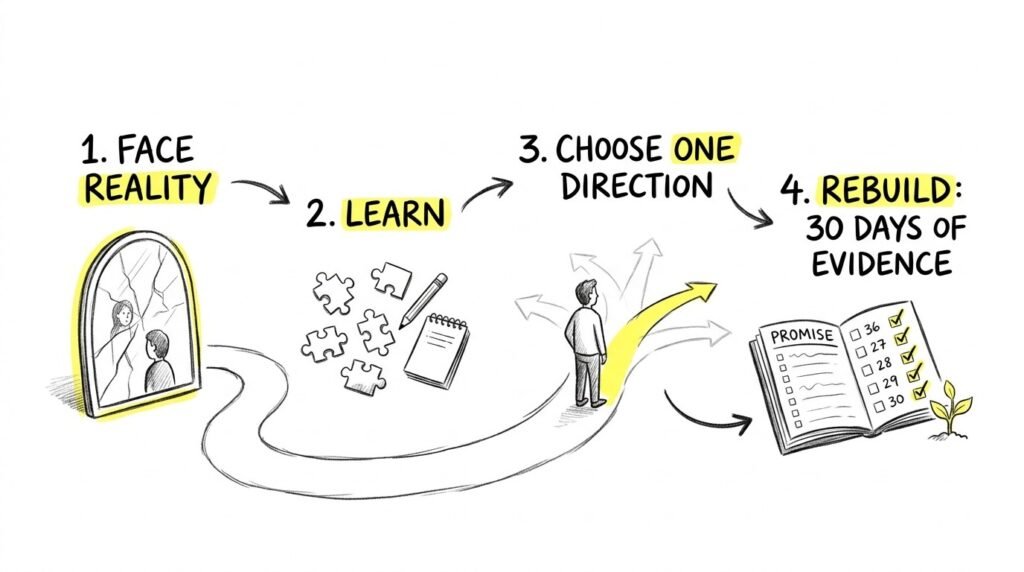
The four-part restart method
You don’t need to fix your entire life this week. You need a clear picture of where you are and a practical way to move forward.
Here’s a four-step framework you can start using today.
Face reality without attacking yourself
Write down what you believe you’ve lost. Perhaps it’s time, money, confidence, a relationship, or opportunities you wish you’d pursued.
Then separate the facts from the judgments.
“I spent three years avoiding difficult decisions” describes a behavior you can change.
“I’m a failure who always ruins everything” turns that behavior into an identity.
One helps you understand the problem. The other makes you feel like the problem is who you are.
Be honest about your mistakes, but don’t use them to define your entire life.
Start by asking: What is actually true about my situation today?
Separate what you can change from what you cannot
Not every loss can be repaired. Some things can be rebuilt, some can teach you valuable lessons, and others must be accepted.
Make three lists:
- Repair: What can I realistically improve or restore?
- Learn: What mistake or pattern should I understand?
- Release: What can I no longer change?
You might be able to rebuild a skill, improve your finances, or develop healthier relationships. You cannot relive your twenties or guarantee that a past relationship will return.
The purpose isn’t to forget what happened. It’s to stop treating every part of your past as an unfinished problem. You can regret a decision without spending the rest of your life regretting it.
Choose one direction for 30 days
When people decide to rebuild their lives, they often try to change everything at once. They want better health, more money, stronger relationships, confidence, and discipline immediately.
That urgency is understandable. But trying to fix ten things at once can leave you overwhelmed and inconsistent. Choose one area that would make the biggest difference in your life right now.
- If you’ve neglected your health, establish a realistic routine that suits your abilities.
- If your career feels stagnant, spend 20 minutes each day learning a valuable skill.
- If you’ve lost confidence in yourself, make one small commitment every day and keep it.
You can work on other areas later. For now, give your attention to one direction. The goal isn’t to transform your entire life in 30 days. It’s to stop drifting and start moving deliberately.
Create 30 days of evidence
Here’s where the real work begins.
You might have spent years telling yourself you’re lazy, inconsistent or incapable of change. Repeating positive statements won’t necessarily change those beliefs.
You need experiences that give you a reason to question them. Choose a small action connected to your priority. Repeat it daily, record your progress, and review what you’ve learned each week.
This idea connects with the approach James Clear describes in Atomic Habits: small, repeated actions can help reinforce the identity you’re trying to build.
Don’t focus only on the outcome. Focus on becoming someone who follows through.
Some days you’ll do less than planned. Adjust when necessary and continue rather than treating one difficult day as proof that you’ve failed again. Thirty days won’t solve every problem. But it can give you recent evidence that you’re capable of making different choices.
What my spinal cord injury taught me about rebuilding
Seven years ago, a spinal cord injury changed my life in ways I never expected. I went from taking my physical independence for granted to hearing that I might never walk again. My life required a different kind of rebuilding.
Progress came through rehabilitation, repetition, and continuing to work toward what was possible. Today, I can stand for longer periods and walk with a walker.
My recovery is personal, and everyone’s circumstances are different. But it taught me a lesson I apply beyond rehabilitation:
You don’t need to control the entire outcome to take responsibility for your next step.
You may not be able to recover the opportunities you’ve lost. You may not know how long rebuilding will take. But you can decide what to do with the day in front of you.
That’s also why I believe identity changes through repeated behavior, not simply through wanting to become someone different. You begin building confidence when your actions give you reasons to trust yourself again.
You don’t have to catch up with everyone else
One of the biggest mistakes you can make when starting over is using someone else’s life as your deadline. You see a former classmate building a business, getting married, or buying a house. Suddenly, your own progress feels insignificant.
But their timeline doesn’t tell you what your next step should be. Starting over isn’t a race to recover every opportunity you missed. It’s about building a life that makes sense for the person you’re becoming.
You can begin again at 25, 35, 45, or later. Your circumstances will influence what is possible, but feeling behind doesn’t mean you have no options.
You don’t need to make up for every lost year. You need to stop losing new years to the belief that the old ones ruined you.
Start with one decision today
If you feel you’ve wasted years, you don’t have to pretend those years didn’t matter.
- Face what happened.
- Learn what you can.
- Choose one direction and spend the next 30 days taking small, consistent actions.
You cannot recover every lost year, but you can stop making regret responsible for the next one.
Try this today: Write down one thing you regret, one lesson it taught you, and one action you can take within the next 24 hours. Then take that action.
I write about mindset, habits, and identity. Subscribe to my newsletter and follow me on Instagram and Facebook.
One question before you go: If you stopped trying to make up for your past and focused on building your future, what would you change first?
How do you stop regretting years you’ve wasted?
Accept that you cannot change the past, but you can learn from it. Identify what your regrets have taught you, then focus on one action that makes your present life better.
Is it too late to start over in your 30s or 40s?
No. You may have different responsibilities and fewer options in some areas, but you can still develop skills, build relationships, and change direction. Focus on the opportunities available to you now rather than comparing your timeline with someone else’s.
How do you rebuild your life when you feel completely lost?
Start by choosing one area that needs attention, such as your health, career, or relationships. Set one small daily goal and repeat it consistently. You don’t need your entire future figured out to take your first step.

Wish you happiness. This is especially helpful for identity rebuilding and personal growth.
A very informative and practical guide for anyone wondering how to rebuild yourself emotionally after a difficult life phase. The advice on rebuilding self-confidence, changing negative thought patterns, and developing healthy daily habits makes this blog especially valuable for personal growth and self-improvement.
This is a truly insightful and valuable blog on how to rebuild yourself after withdrawal. The practical self-improvement tips, mindset shifts, and strategies for personal growth make it a must-read for anyone looking to rebuild their identity and develop a stronger mindset.
Good a blog toper, mindset related.