
There is a particular kind of silence that comes after failure. You stop talking about what you want to do. You hesitate before trying again. Even simple decisions feel heavier because your mind keeps reminding you of the last time things went wrong.
I understand something about that feeling. After my spinal cord injury, I had to rebuild my life from a place I never expected to be. Things I once took for granted became difficult. Recovery demanded patience, repetition, and the willingness to keep working when progress was painfully slow.
At first, even standing for a few seconds was an achievement. Over time, through consistent effort, I progressed to standing for longer periods and walking with a walker.
That experience taught me something I now apply to almost every area of life:
You don’t always need confidence to begin again. Sometimes, you need to begin again to develop confidence.
Whether you’ve failed in business, lost an opportunity, or repeatedly struggled to keep a promise to yourself, the challenge is often the same. You no longer trust your ability to get a different result.
So, how do you rebuild confidence after failure without pretending the failure didn’t hurt? You stop treating your past outcome as a permanent prediction of your future.
Why Failure Destroys Your Confidence
Failure hurts for two reasons. First, you lose something you wanted. Second, you start questioning what the failure says about you. You don’t simply think, “That didn’t work.” You think, “Maybe I’m not good enough.”
This is where a disappointing experience becomes a problem of identity.
Psychologist Carol Dweck’s research on mindsets explores how people respond to setbacks depending on how they view their abilities. When you believe your abilities cannot change much, failure can feel like proof that you lack what it takes. When you believe you can develop, failure becomes information you can use.
This doesn’t mean every failure is a blessing. Some mistakes have serious consequences. But a failed attempt and a failed identity are two different things.
You may have made a bad decision without being a bad decision-maker. You may lack a skill without being incapable of learning it. The goal isn’t to convince yourself that you’re good at everything. It’s to stop making permanent judgments about yourself from a single experience.
Confidence Is Built Through Evidence, Not Positive Thinking
We often wait to feel confident before taking action. We tell ourselves we’ll try again when the fear disappears or when we finally believe in ourselves. But confidence doesn’t always work that way.
Think about learning to ride a bicycle. You don’t develop confidence by repeating, “I’m a great cyclist.” You develop it by practising, losing your balance, adjusting, and discovering that you can stay upright a little longer.
The same principle applies to rebuilding confidence after a setback.
When something goes wrong, your mind remembers the experience. Trying again can feel risky, even when the next attempt is different. Avoiding the situation brings temporary relief, but it also prevents you from gathering new evidence about your abilities.
This creates a cycle: failure leads to doubt, doubt leads to avoidance, and avoidance keeps the doubt alive.
To break this cycle, you need manageable experiences that show you what you can do now.
James Clear’s in Atomic Habits explores how repeated actions can reinforce the identity you’re building. Applied to confidence, every small attempt becomes an opportunity to prove that your previous failure doesn’t have to determine your next action.
You don’t need to feel fearless. You need a step small enough to take while you’re still afraid.
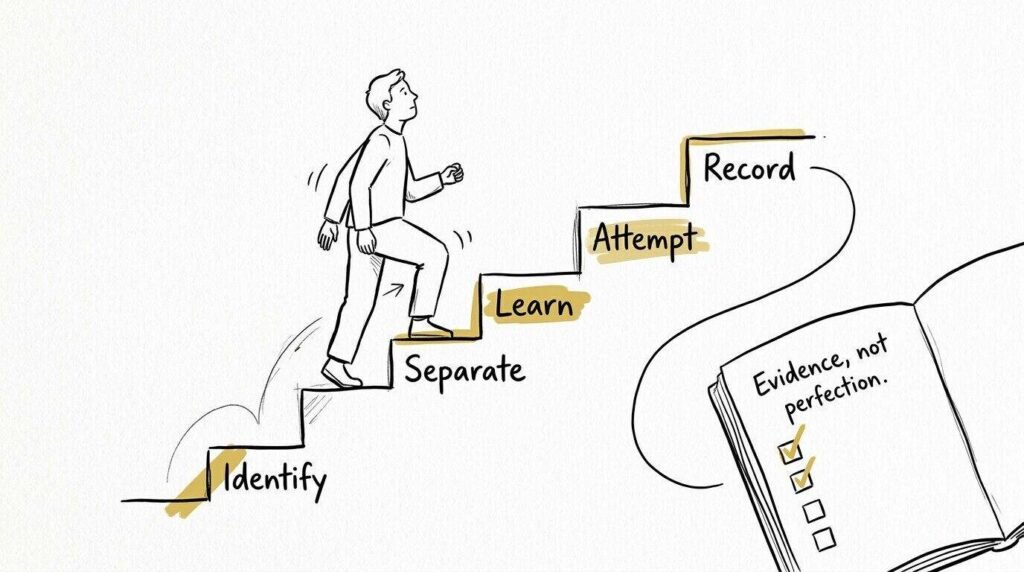
The Confidence Evidence Loop: Five Steps to Rebuild Confidence
Identify Where Your Confidence Fell
Start by identifying exactly what you no longer trust yourself to do.
Are you afraid of making decisions after a business failure? Have you lost confidence in your professional skills? Or do you doubt yourself because you’ve repeatedly abandoned your habits?
These are different problems.
For example, if your business failed, you might conclude that you’re not capable of running one. But perhaps your marketing was weak, your costs were too high, or you didn’t understand your customers.
Write down: “After what happened, I no longer trust myself to ______.”
Complete that sentence honestly. You’re not rebuilding your entire personality. You’re identifying one specific area where confidence needs work.
Separate the Outcome From Your Worth
This is the uncomfortable part. You must acknowledge what happened without turning it into a definition of who you are.
If you failed an exam, you failed an exam. If your business lost money, the business lost money. Neither outcome automatically proves that you’re incapable of changing.
Morgan Housel’s writing often explores uncertainty, behaviour, and the limits of what outcomes can tell us. A useful lesson from this perspective is that results don’t tell the whole story. A reasonable decision can produce a poor outcome, just as a careless decision can sometimes succeed.
Ask yourself: What was within my control? What did I misunderstand? What would I change?
Take responsibility without turning it into self-punishment. You can admit that you made a mistake and still believe you’re capable of making a better decision next time.
Extract One Lesson From the Failure
Failure becomes especially damaging when you experience the pain but learn nothing specific from it. You remember the disappointment, yet you don’t know what to do differently.
Ask yourself three questions:
- What specifically went wrong?
- What did this experience teach me?
- What will I change next time?
Keep your answers practical.
If you couldn’t maintain a daily writing habit, perhaps your goal was too ambitious. If a business failed because you spent too much before testing demand, your next attempt could begin with a smaller experiment.
The point isn’t to find an excuse. It’s to turn an unpleasant experience into useful information.
A failure you examine can become a lesson. A failure you only replay can become a fear.
Choose a Smaller, Lower-Risk Attempt
Don’t make your first attempt at rebuilding confidence another enormous test of your worth.
If you fear public speaking after an embarrassing presentation, practise in front of one trusted person. If you’ve lost confidence in your professional abilities, complete a small project using the skill you doubt.
Make the next step small enough that you can focus on learning instead of protecting your ego.
My rehabilitation taught me that progress doesn’t come from demanding everything from yourself immediately. It comes from working with what is possible, repeating the effort, and gradually building from there.
I couldn’t control every outcome, but I could participate in the process.
Your situation may be different from mine, but the principle remains the same: start where you are, not where you think you should already be.
Record Your Progress and Increase the Challenge
We often remember our failures in detail while overlooking the small things we handle well afterward.
Keep a simple record after every attempt:
- What did I do?
- What did I learn?
- What will I improve next time?
Imagine you’ve lost your job and are struggling to regain confidence. You apply for a role, receive a rejection, and realise your interview answers need work. You practise those answers and apply again.
Even before receiving an offer, you’ve gathered new evidence. You can take action despite disappointment, identify a weakness, and improve your approach.
As your ability develops, gradually increase the challenge. Start small, repeat the effort, and move to the next level when you’re ready. The goal isn’t to guarantee success. It’s to become someone who can face uncertainty without automatically retreating.
What Neville Goddard Can Teach Us About Self-Doubt
Neville Goddard, known for his teachings on imagination and belief, emphasised how the assumptions we hold about ourselves can influence the way we approach life.
One of his well-known ideas is expressed in the phrase, “Assume the feeling of the wish fulfilled.”
Applied practically, this invites you to examine the identity you’re rehearsing in your mind.
After failure, you might repeatedly imagine yourself making another mistake or proving that you’re not good enough. Those expectations can influence what you’re willing to attempt.
Instead, imagine yourself responding differently. Picture yourself preparing carefully, accepting feedback, and trying again without treating the outcome as a judgment of your worth.
But imagination alone doesn’t guarantee success. You still need preparation, skill, and action.
Use imagination to rehearse a better response, then support that belief with real behaviour. You don’t need to believe that failure is impossible. You need to believe that you can face disappointment, learn from it, and continue building.
Rebuild Confidence Without Waiting to Feel Ready
The goal isn’t necessarily to return to the person you were before failure. Sometimes, that earlier confidence depended on things going well. Now you know what disappointment feels like. You can use that experience to become more thoughtful, better prepared, and less dependent on perfect outcomes.
Confidence, identity, and self-trust are connected, but they grow through specific actions rather than waiting for the right feeling. You can explore this further in my articles on rebuilding your identity after losing yourself, building self-trust after breaking promises to yourself, and getting your life together when everything feels overwhelming.
Here’s what I want you to do today: identify one situation where failure damaged your confidence. Write down what went wrong, one lesson you learned, and one smaller attempt you can make within the next 24 hours. Then take that step.
You might still feel nervous. That’s fine. You don’t have to erase the past before acting differently in the present.
You rebuild confidence by giving yourself new evidence that your past failure is not the end of your ability to grow.
You don’t have to go back to who you were. You can build someone wiser from what you’ve learned.
Now tell me, what is one thing you’ve stopped trying because of a past failure, and what’s one small step you could take to begin again?
Subscribe to my newsletter for practical insights on identity, habits, mindset, and rebuilding your life. Follow me on social media for more honest conversations about discipline, personal growth, and becoming someone new.
How do you regain confidence after failure?
Start by identifying what went wrong without judging your entire ability. Learn one lesson from the experience, take a small manageable action, and use each attempt as evidence that you can improve.
How do I believe in myself again after a major setback?
Stop treating one outcome as a permanent judgment about your worth. Set a realistic goal, follow through on small commitments, and gradually rebuild trust in your ability to make progress.
How do you overcome the fear of trying again after failure?
Reduce the risk of your next attempt. Practise in a manageable situation, prepare for possible difficulties, and focus on what you can learn rather than demanding immediate success.
What should you do when you keep failing at the same thing?
Look for a recurring pattern instead of simply trying harder. Identify the skill, decision, or habit that needs to change, adjust your approach, and test the improvement through a smaller attempt.