I recently finished reading Who Moved My Cheese? by Spencer Johnson, and I wanted to share one of its most valuable lessons with you. This short book changed the way I think about change, fear, and the moments when life doesn’t go the way we expected. I’m writing this article for anyone who feels stuck in life, whether you’re struggling in your business, feeling lost in your career, or holding on to a relationship that no longer feels the same. Sometimes, we know we need to change, but we don’t know where to start. Through the lessons in this book, I want to share a few practical ideas that might help you see your situation differently and take your next step. And if this article resonates with you or helps you in some way, I’d love to hear your thoughts in the comments.
Sometimes, the hardest part of moving forward is accepting that the life you planned is no longer the life you’re living.
You keep working at the same business, hoping sales will return. You stay in a job that no longer offers growth because it once felt secure. You hold on to a relationship because of what it used to be, even when the present tells a different story. You know something has changed, but a part of you keeps waiting for things to return to normal.
That is what makes Who Moved My Cheese? by Spencer Johnson such a useful book. It teaches a simple lesson about change, fear, and the cost of refusing to adapt.
The book doesn’t promise that every change will lead to something better. It asks a more uncomfortable question: What if the thing you’re waiting to get back is never coming back?
What Is Who Moved My Cheese? About?
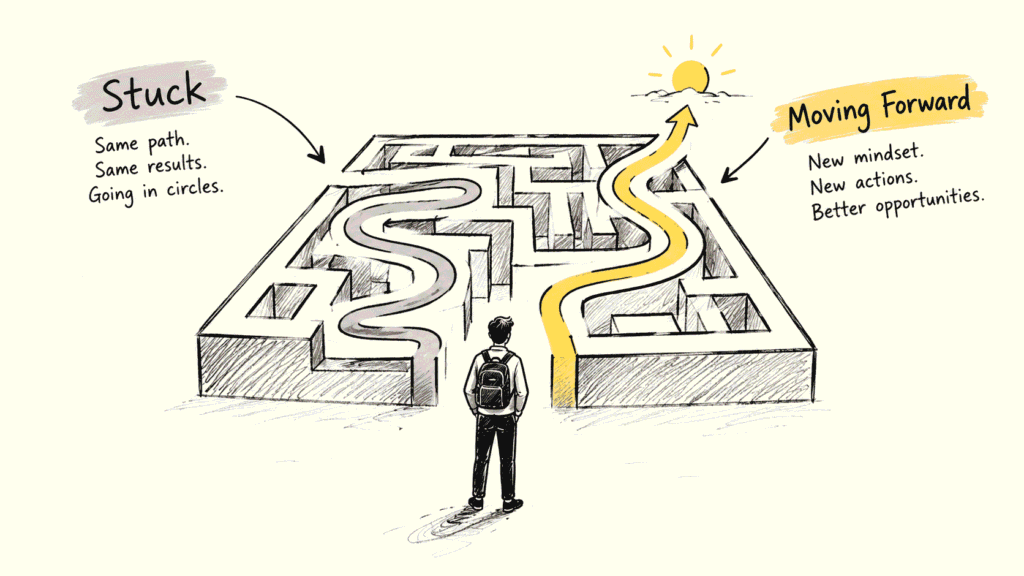
Published in 1998, Spencer Johnson’s Who Moved My Cheese? is a short story about four characters searching for cheese inside a maze. The cheese represents what they want from life: success, security, happiness, money, love or a sense of purpose. The maze represents the world in which they try to find it.
Two characters are mice named Sniff and Scurry. The other two are small humans named Hem and Haw.
Eventually, all four discover a place filled with cheese. They become comfortable. They return to the same location every day, believing their supply will always be there. Then one morning, the cheese disappears.
Sniff and Scurry don’t waste much time arguing. They accept the situation and begin exploring the maze again.
Hem reacts differently. He becomes angry and refuses to accept that the cheese is gone. He believes it should still be there.
Haw struggles, too. He feels afraid of leaving what he knows, but eventually realizes that waiting for the old cheese is keeping him hungry. He decides to move, even though he doesn’t know what lies ahead. The difference isn’t that Haw has no fear and he learns to move despite it.
That’s the heart of Johnson’s story. As the book’s official publisher description explains, its central theme is adapting to change in work and life. But how do you apply that lesson when your own life feels stuck?
Why You Feel Stuck Even When You Know Something Must Change
Here’s the problem: knowing you need to change and being emotionally ready to change are two different things.
Imagine you’ve spent five years building a business. You’ve invested your money, time, energy and identity into it. Recently, sales have dropped. Your old strategy no longer works, and customers are moving toward different solutions.
You know you need to adapt. But changing your business model feels like admitting that your previous efforts were wasted. So you keep doing what worked before, hoping the results will return.
Or imagine you’re in a career that no longer fits you. You feel underpaid, overlooked, and mentally exhausted. Yet you avoid learning a new skill or applying for another job because the familiar situation feels safer than an uncertain future.
In both cases, the problem isn’t necessarily a lack of information. It’s attachment.
You become attached to the money you’ve invested, the person you used to be, the career you imagined, or the relationship you thought would last forever.
Psychologists use the term status quo bias to describe our tendency to prefer existing circumstances over alternatives, sometimes even when change could benefit us.
That doesn’t mean every change is wise. Sometimes staying is the right decision. But when you keep choosing the familiar simply because it’s familiar, you may be protecting your comfort at the expense of your future.
You can spend years defending a situation that no longer serves you just because you remember when it did.
The first step toward getting unstuck is recognizing the difference between respecting your past and remaining trapped in it.
The Core Lesson: Stop Expecting Old Solutions to Solve New Problems
One of the most useful ideas in Who Moved My Cheese? is that circumstances change, and your response must change with them.
Think about your phone. A method of communication that worked twenty years ago might be inconvenient today. Technology changed, people’s expectations changed, and the way we communicate changed with them.
The same principle applies to work, business, and relationships.
A marketing strategy that brought customers to your business last year might not work this year. A skill that once made you valuable at work might need to be updated. A relationship that once felt healthy might require difficult conversations and new boundaries.
The mistake is assuming that because something worked before, it must continue working. James Clear discusses a similar lesson, letting go of familiar approaches can create room for learning and improvement.
My interpretation is simple: don’t confuse loyalty to your past with responsibility for your future.
You can appreciate what something gave you without demanding that it keep giving you the same thing forever. And you don’t have to abandon everything at once. Often, the next step is much smaller: test a new strategy, learn one skill, ask an honest question, or stop repeating a behavior that has stopped producing results.
The goal isn’t change for the sake of change. It’s learning to recognize when your current approach no longer matches your current reality.
The RESET Framework: A Practical Way to Get Unstuck
After reflecting on the book’s lessons, I developed the RESET framework to help you apply them to real situations. It’s my practical interpretation of the story, not a framework presented in Johnson’s original book.
You can use it when you’re stuck in a career, struggling with a business, repeating an unhelpful habit, or unsure what to do about a relationship.
Recognize what has changed
Stop judging your situation for a moment and describe it honestly.
Ask yourself:
- What used to work that no longer works?
- What evidence tells me the situation has changed?
- Am I responding to today’s reality or yesterday’s expectations?
If your business has fewer customers, examine your sales, customer feedback, and marketing results. If your career feels stagnant, look at your skills, responsibilities, and opportunities for growth.
If a relationship feels different, identify the specific patterns that concern you instead of relying only on memories of how things used to be.
You cannot make a useful decision while refusing to look at the situation clearly.
Examine what you’re afraid of losing
Sometimes, the fear of change isn’t really about the change itself. It’s about what you think the change says about you.
Leaving a job might feel like admitting you made the wrong career choice. Changing your business strategy might feel like admitting failure. Ending a relationship might feel like losing the future you imagined.
Write down what you’re afraid of losing. Then ask: Is holding on protecting something valuable, or am I avoiding the discomfort of starting again?
Be honest with yourself. You don’t need to make the answer sound impressive.
Separate your goal from your current method
This is where many people get stuck. They become so attached to a particular route that they forget what they were trying to achieve in the first place.
Perhaps your goal is financial independence, but you’re convinced it must come from one specific business. Maybe you want meaningful work, but you believe it must happen within your current company. Or perhaps you want a healthy relationship, but you’re trying to preserve a particular relationship at the expense of your emotional well-being.
Write down your real goal. Then list two or three different ways you might pursue it.
Your goal may still be worth pursuing, even when your original method no longer works.
Experiment before demanding certainty
You don’t need a complete life plan before taking the next step.
If your business is struggling, test a new offer with a small group of potential customers before rebuilding everything.
If your career feels stuck, spend 30 minutes learning a relevant skill or speak with someone already working in the field you’re considering.
If a relationship needs attention, initiate an honest conversation and observe whether both people are willing to work on the problem.
Treat these actions as experiments. Each one gives you information that you didn’t have before. You may discover a promising direction. You may discover that an idea doesn’t work. Both outcomes can help you make a better decision.
Track what you learn and adjust
Don’t judge a new direction after one uncomfortable day. Choose a reasonable period to test your next step. Record what you tried, what happened, and what you learned.
At the end of the week, ask yourself three questions:
- What did I do differently?
- What evidence did I gain?
- What should I change next week?
This turns change from a dramatic, emotional decision into a process of observation and action. You don’t have to get everything right. You need to stop repeating the same approach without learning from its results.
What My Rehabilitation Taught Me About Starting Again
My own experience with a spinal cord injury has made the idea of rebuilding especially meaningful to me.
After my injury, doctors told me I might never walk again. My recovery required continued physiotherapy and repeated effort. Over time, I progressed from standing for seconds to being able to stand for around 5 minutes. I now walk with a walker.
That progress didn’t happen because I could predict the outcome or guarantee that every attempt would work. It came through continuing to work on what I could control, even when progress was slow.
Rehabilitation also taught me something about identity. When your circumstances change dramatically, you may spend a long time comparing your present life with the person you remember being. But constantly measuring your present against your past can make it harder to recognize the progress you’re making now.
Sometimes, rebuilding means accepting that your route has changed without giving up on the things that still matter to you. This is where I connect with Haw’s journey in Who Moved My Cheese? He doesn’t discover a way to restore his old situation. He begins moving through the maze and learns as he goes.
I don’t see that as a guarantee that everything will work out. I see it as a reminder that you can still take meaningful action without knowing exactly how your story will end.
How to Apply Who Moved My Cheese? Today
You don’t need to change your entire life this week. Choose one area where you feel stuck: your business, career, habits, or relationship.
Write down what has changed, what you’re holding on to, and one small action you can take within the next 24 hours, then take that action. You might research a new opportunity, test a different business approach, ask for honest feedback or have a conversation you’ve been avoiding.
The point is not to move recklessly. It’s to stop letting uncertainty make every decision for you. And remember, adapting doesn’t mean accepting every situation or abandoning your values. It means responding intelligently to reality rather than expecting reality to obey your plans.
Final Thought
The lesson I took from Who Moved My Cheese? is that sometimes you don’t need more motivation. You need to recognize that the situation has changed and give yourself permission to respond differently.
Your old approach may have helped you reach where you are. That doesn’t mean it’s the right approach for where you want to go. You can respect the person you used to be while building a life that fits who you are becoming.
Ask yourself this today: What am I still waiting to get back that I may need to stop chasing in the same way?
Write down your answer. Then choose one action that moves you toward a better future.
If you want more practical ideas about rebuilding your identity, habits, confidence, and direction after setbacks, subscribe to my newsletter and follow me on social media.
What is the main lesson of Who Moved My Cheese?
The main lesson is to accept change instead of clinging to the past. When your circumstances change, learn to adapt and look for new ways forward.
How do you stop feeling stuck in life?
Identify what’s no longer working, examine what you’re afraid of changing, and take one small practical step toward a different outcome.
How can Who Moved My Cheese? help with your career or business?
It encourages you to recognize when old strategies stop working. Instead of repeating them blindly, explore new skills, opportunities, and approaches.
4. What does the cheese symbolize in Who Moved My Cheese?
The cheese represents what you want in life, such as success, money, security, happiness, or a fulfilling relationship. The maze represents the environment in which you pursue those things.