One fine evening, I was staring at a screen, watching months of work disappear in real time.
It wasn’t because I didn’t try or didn’t care. It was because the moment I felt the loss, I stopped thinking and acted on emotion. That single decision cost me more than the original loss ever could.
We’ve been told that the wrong response to failure is giving up too soon. So we built an identity around the opposite, push harder, no matter the situation, stay in the game and don’t quit.
But nobody told us about the other kind of failure, the one that looks exactly like resilience.
I’ve watched an entrepreneur pour his last savings into a business that stopped working months ago because walking away felt like betraying everyone who believed in him.
I’ve watched someone stay up all night repeating the same thing, not because it was helping, but because doing something felt better than facing what wasn’t working.
I’ve done both.
Here’s what I’ve learned, the worst decisions rarely come from people who don’t care enough. They come from people who care so much that standing still feels impossible.
A loss triggers something inside us. We feel the need to fix it. To act. To prove the setback wasn’t real. And in that state, almost every action feels productive.
Most of it isn’t.
Psychologists have studied something very similar in the way people make decisions under stress. Research suggests that acute stress can alter decision-making, increase reliance on faster or more habitual responses, and sometimes increase risk-taking. In other words, when you’re emotionally activated, the part of you that wants to act immediately can become louder than the part of you that wants to think carefully.
And there’s another psychological trap here: the hot-cold empathy gap. George Loewenstein’s work suggests that when we’re in an emotionally intense state, we can underestimate how differently we’ll think and behave once we’ve cooled down. What feels urgent in the moment can look completely different a few hours later.
That’s why the most dangerous moment after a loss isn’t when you want to quit. It’s when you’re desperate to make the pain disappear, and every action starts feeling like progress.
Here’s a raw thought I’ve been sitting with:
Sometimes the strongest thing you can do after a setback is nothing. Just giving yourself enough time to think clearly again.
— Shahzaib Khan
Practical Framework
I call this pattern The Recovery Trap. It shows up in four different forms. Learning to recognize them is the first step to escaping them.
1. The Panic Pivot
We were taught that if we’re not moving at rocket speed, we’re falling behind. So we mistake patience for weakness and panic for action.
The product didn’t work. The plan failed. So you change everything at once: the idea, the message, the strategy.
It feels like adaptability. Most of the time, it’s panic disguised as a plan.
The fix: Change one variable at a time. Give it two weeks. Then decide what needs to happen next.
2. The Effort Trap
People don’t burn out from lack of talent. They burn out from applying more force to a direction that no longer works.
More hours. More pressure. More output.
As if the setback happened because you weren’t trying hard enough, and working harder will somehow reverse it.
Ask yourself honestly: Is this a new approach, or am I just running the same strategy faster?
The fix: Before adding more effort, write down exactly what didn’t work. You need a diagnosis before you need a prescription.
This distinction matters because persistence itself isn’t always evidence that you’re moving forward. Under stress, people can fall back on familiar responses rather than deliberately choosing a better strategy.
Sometimes discipline means doing more and sometimes discipline means stopping long enough to realize that more is not the answer.
3. The Sunk Cost Spiral
Sometimes you’re not trapped by the investment you’ve made. You’re trapped by the story you’ll have to tell if you walk away.
Six months invested. Money spent. People told. Reputation involved.
So you keep going, not because the direction is right, but because admitting it’s wrong feels too painful. And the mind will do almost anything to avoid that feeling.
Psychologists Hal Arkes and Catherine Blumer documented this tendency as the sunk cost effect: once people have invested money, effort, or time into something, they become more likely to continue pursuing it, partly because abandoning it can feel wasteful.
The important question isn’t: “How much have I already invested?”
It’s: “Knowing what I know today, would I invest in this again?”
The fix: Once a month, ask yourself: “If I were starting today, knowing everything I know now, would I still choose this?”
If the answer is no, you already have your answer.
4. The Emotion Window
Modern culture celebrates emotional suppression as discipline. But a mind full of urgency rarely makes wise decisions.
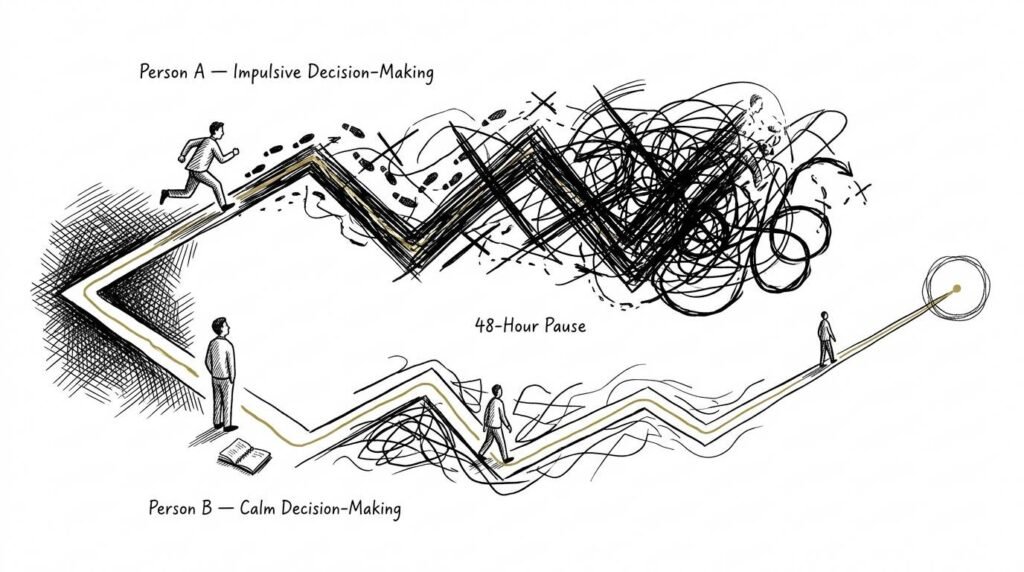
For the first 24 to 48 hours after a real loss, your mind is flooded with emotion.
Stress. Shame. Urgency.
Every decision made during this window is influenced by those emotions, not by clarity.
The fix: Create a hard rule.
No major decisions for 48 hours after a significant loss.
Write down what you’re feeling, what you want to do and then close the journal.
Come back in two days. The problem will still be there, but your emotions won’t be driving the wheel.
The 48-hour rule isn’t a universal psychological law. It’s a personal decision-making rule I use to create distance between the emotional event and the response. The research simply gives us a reason to take that distance seriously: stress can change how we evaluate risk, reward, and uncertainty.
“You can’t calm the storm, so stop trying. What you can do is calm yourself. The storm will pass.”
— Timber Hawkeye
I came back to this quote after a period where I responded to every setback by creating more noise. It reminded me that composure isn’t weakness, it’s the only thing that actually works when everything is falling apart.
The people who recover best from loss aren’t the ones who react fastest. They’re the ones who’ve learned that the pause after a loss is not weakness, it is the decision. Your next move either compounds the loss or begins the real recovery. There is almost no in between.
Think about the last time you lost something: a deal, a grade, a plan, a belief in yourself. What was the first thing you did in the hours after? Looking back now, was that move actually helping or was it just movement?
Have a question about mindset, habits or getting unstuck? Drop it below. I read every comment
If this helped you think differently about failure, don’t stop here.
Subscribe to Newsletter for practical ideas on how to deal with failure, rebuild your mindset, develop discipline, and keep moving forward when life doesn’t go as planned.
And if you want more thoughts on identity, habits, mindset, healing, discipline, and rebuilding your life, follow me on social media.