A person I know once told me something I couldn’t stop thinking about. He had goals, ideas, and plans he genuinely cared about. He knew what he wanted to do with his life, and he understood that delaying his work was costing him time.
But every day, he found a reason to put it off. He would sit down to work, open his laptop, and suddenly feel the need to check something else. Sometimes, he convinced himself he needed more research. Other times, he told himself he would start when he felt more focused.
By the end of the day, he had spent hours thinking about his goals without making much progress. The worst part wasn’t the unfinished work. It was how he started seeing himself. He questioned his discipline and wondered whether he was serious enough about his future.
When we talked about it, I asked him a simple question:
“When you sit down to do the work, what makes you want to walk away from it?”
He paused. He had spent so much time asking why he couldn’t be more disciplined that he had never examined what happened just before he avoided a task.
Was he afraid his work wouldn’t be good enough? Was he overwhelmed by the possibility of failing at something that mattered to him? Or did he simply not know where to begin?
We started looking at those moments differently. Instead of treating every delay as proof that something was wrong with him, he began looking for the actual obstacle. And that’s where we need to start when talking about procrastination.
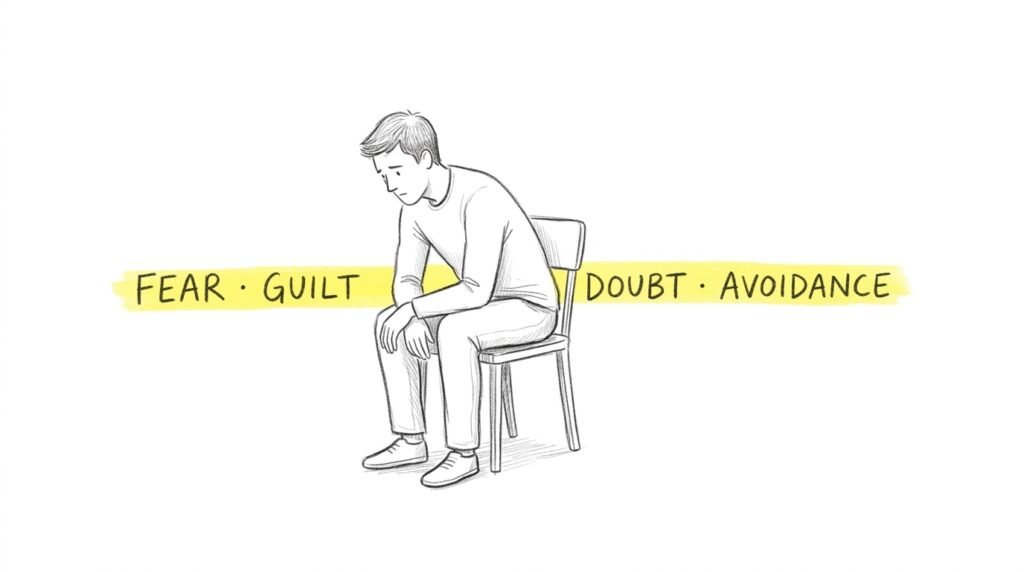
Sometimes, the problem isn’t that you don’t care enough about your goals. It’s that doing the work brings up a feeling you’d rather avoid.
Why you avoid the things that matter most
Imagine you want to start a business. You’ve researched the market, written down your ideas, and made several plans. But you haven’t contacted a single potential customer.
You tell yourself you need more research. You redesign your website, watch another tutorial, and organize your notes. All of these activities feel productive. Yet the one action that could move your business forward remains unfinished.
Why? Because planning feels safer than taking a risk. Researching doesn’t expose you to rejection. A finished website, however, cannot guarantee that anyone will buy from you.
Psychologists Fuschia Sirois and Timothy Pychyl explored this pattern in their 2013 paper, Procrastination and the Priority of Short-Term Mood Regulation. Their work helps explain how procrastination can provide temporary emotional relief. When a task creates anxiety, frustration, or uncertainty, avoiding it can make you feel better immediately.
The cycle looks like this:
You face an uncomfortable task. You avoid it. You feel temporary relief. Then the deadline approaches, guilt increases, and the task becomes even more stressful.
Eventually, you start working under pressure. You might even convince yourself that you work better at the last minute. But finishing under pressure doesn’t necessarily mean procrastination helped you. It may simply mean the anxiety finally became stronger than your desire to avoid the task.
Procrastination can reward you in the short term while costing you in the long term.
Understanding that difference is the first step toward changing the pattern.
Also read this: How to build self-trust after repeatedly breaking promises to yourself
The connection between procrastination and fear of failure
Not every delay comes from fear. Sometimes a task is boring, confusing, exhausting, or genuinely low priority. But procrastination and fear of failure often become connected when a task feels like a judgment of your identity.
Compare these two thoughts:
- “This article needs improvement.”
- “If this article is bad, maybe I’m not a good writer.”
The first identifies something you can work on. The second turns a piece of work into a judgment about who you are. Now, finishing the article feels risky. If you never publish it, you never have to discover how people will respond.
Perfectionism can make this worse. You wait until your skills improve, your plan becomes clearer, or your confidence increases. But there is always something else to prepare.
Sometimes, you aren’t protecting the quality of your work. You’re protecting your opinion of yourself. The solution isn’t to stop caring about quality. It’s to separate the quality of one attempt from your worth as a person.
Your first article can be imperfect without making you a bad writer. Your first business idea can fail without making you incapable of building a business. You need room to learn without turning every result into a verdict on your identity.
Why procrastination is harder in 2026
Today, avoiding an important task takes almost no effort.
You sit down to write, receive a notification, check your phone, and end up watching videos for 30 minutes. You return to your work feeling frustrated, then struggle to concentrate again. Digital distractions aren’t the only cause of procrastination, but they make escaping discomfort incredibly convenient. Your work requires attention and effort. Your phone offers immediate stimulation. That’s why telling yourself to focus harder isn’t always enough. You need to change the conditions around your work.
Put your phone in another room. Block distracting websites during a work session. Keep only the documents and tools you need open. If you use AI tools to help with writing or planning, give them a specific job. Ask for an outline or feedback on a paragraph, then return to the actual work. Don’t let endless preparation become another way to postpone execution.
The goal isn’t to eliminate every distraction. It’s to make starting easier than escaping.
The avoidance audit: Five steps to stop procrastinating
Instead of criticizing yourself the next time you procrastinate, try this five-step process.
Name the task
Just be specific. Don’t write, “I need to work on my future.”
Write, “I need to draft the first 200 words of my article.”
A clear action gives you somewhere to begin.
Identify the uncomfortable feeling
Pause for 30 seconds and ask yourself:
What am I trying not to feel right now?
Perhaps you’re afraid of failure, confused about the next step, or overwhelmed by the amount of work involved.
Name the feeling without judging yourself. “I’m anxious because I don’t know whether this will be good enough” gives you more useful information than “I’m lazy.”
Make the first step smaller
If writing an article feels overwhelming, write three rough sentences.
If you want to build a business, contact one potential customer.
If you’re struggling to restart a habit, choose a manageable action you can perform today.
You aren’t reducing the importance of your goal. You’re reducing the difficulty of beginning.
Commit to 10 minutes
Set a timer for 10 minutes and work on the task without checking your phone or evaluating your entire future. You don’t have to finish, you only have to engage with the work for that short period. When the timer ends, decide whether to continue or take a break. This gives you a practical way to start without waiting for motivation or confidence to arrive.
Review what actually happened
Afterward, ask yourself three questions:
- What did I expect would happen?
- What actually happened?
- What should I do next?
Maybe the task was easier than you expected. Maybe you discovered that you needed clearer instructions or perhaps the anxiety remained, but you managed to work anyway. Each outcome gives you information you can use next time.
The purpose isn’t to prove every task is easy. It’s to stop treating your fears as facts before you’ve even begun.
You don’t have to feel ready to begin
During my spinal cord injury rehabilitation, I learned that progress doesn’t always arrive in the form you expect. I had to work with the abilities I had rather than wait until I could do everything I wanted. Small efforts mattered, even when the results weren’t immediate.
That experience shaped how I think about discipline. You cannot always control how quickly you improve. You cannot guarantee that today’s effort will produce an obvious result. But you can focus on the next action available to you.
Research on emotion regulation and procrastination supports the idea that managing uncomfortable feelings can be part of the solution. It doesn’t mean one technique will work for everyone, but it reminds us that procrastination isn’t always just a time-management problem.
Sometimes, you need to learn how to act while uncertainty is still present. You don’t need perfect confidence to publish your work, start a project, or rebuild a habit. You need a practical way to move forward even when doubt comes along.
Start with one task today
If you’ve been asking yourself, “Why do I procrastinate so much, even when I care about my goals?” try asking a different question: What feeling am I avoiding, and what is the smallest useful action I can take right now?
Choose one task you’ve been postponing. Identify the discomfort behind the delay, put your phone away, and give the task 10 minutes, then review what happened.
You don’t have to transform your entire life today. You just need to stop allowing one uncomfortable feeling to make every decision for you.
What’s one important thing you’ve been avoiding, and what do you think is keeping you from starting? Share your answer in the comments.
If you’re rebuilding your identity, habits, mindset, and relationship with yourself, subscribe to my newsletter for practical ideas. Follow me on social media for more lessons on discipline, self-trust, and becoming someone new.
Why do I procrastinate even when I really want to succeed?
You may be avoiding the anxiety, uncertainty, boredom, or fear of failure associated with the task, rather than the task itself. Avoidance can bring temporary relief, making it easier to repeat the same pattern.
How do I stop procrastinating on important tasks?
Identify what makes starting uncomfortable, break the task into one small, specific action, and work on it for 10 minutes without distractions. Focus on beginning instead of waiting until you feel motivated or confident.
Is procrastination a sign of laziness or fear of failure?
Not necessarily. Procrastination can involve emotional avoidance, perfectionism, overwhelm, or difficulty getting started. If it persistently disrupts your daily life, consider speaking with a qualified professional to explore possible underlying causes.