Nowadays, everyone seems to be talking about the subconscious mind. People repeat affirmations, visualize success, and listen to positive messages before sleep. But many misunderstand the process. They expect positive thoughts alone to change their lives without changing how they behave.
Michael Phelps, the most decorated Olympian in history, offers a useful example. Before competitions, he mentally rehearsed his races, including situations in which things went wrong. During the 2008 Olympics, his goggles filled with water during the 200-meter butterfly final. He continued swimming and won gold, setting a world record.
His preparation had helped him practice responding when things did not go as planned. That is the real lesson:
Mental rehearsal becomes more powerful when you connect it to action.
What does it mean to reprogram your subconscious mind?
Reprogramming your subconscious mind means recognizing the beliefs, thought patterns, and automatic reactions that influence your daily behavior and gradually learning to respond differently. Many of these patterns develop through repeated experiences, habits, and the messages we tell ourselves.
For example, if you repeatedly believe you are not capable of handling challenges, you may start avoiding opportunities that could help you grow. Reprogramming begins when you question that belief, practice a more realistic perspective, and take small actions that support it. The goal is not to control every thought, but to change the patterns you repeatedly reinforce through your actions.
What Joseph Murphy teaches about the subconscious mind
In The Power of Your Subconscious Mind, Joseph Murphy explores how repeated thoughts and suggestions influence our expectations and behavior.
Chapter 2, “How Your Own Mind Works,” is particularly relevant. Murphy emphasizes the relationship between conscious thinking and subconscious patterns.
One idea I take from his work is the importance of paying attention to what we repeatedly tell ourselves. However, positive thinking alone cannot guarantee success. Our environment, actions, and experiences also shape our behavior.
For example, instead of repeatedly thinking, “I am not confident,” someone can practice a more useful belief: “I can take action even when I feel nervous.” They can then prepare for a meeting and speak up, even if they feel uncomfortable.
That is how a new belief begins connecting with real experience.
Why positive affirmations alone fail
Affirmations can help direct your attention, but repeating a statement does not automatically make it believable. If you say, “I am confident,” while avoiding every situation that challenges you, your behavior continues reinforcing the old pattern.
Research on behavior change suggests that connecting intentions to specific actions can help people follow through.
Instead of repeating “I never give up,” try: “When I feel like quitting, I will work for five more minutes.” The goal is not to pretend you have changed. It is to practice a different response.
Read this: How to rebuild yourself after losing your identity
The REBUILD framework
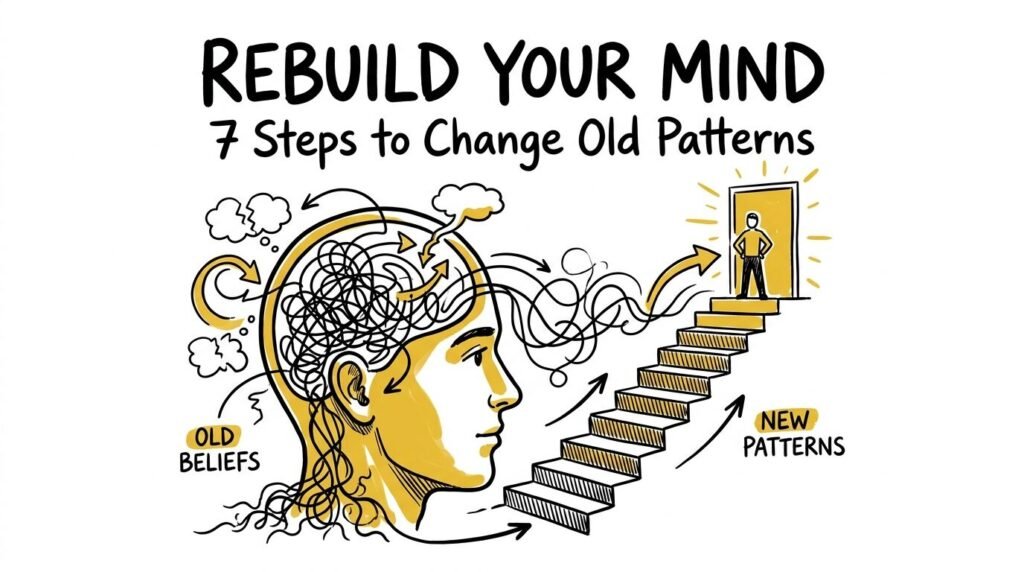
I developed the REBUILD Framework as a practical approach to changing beliefs and building better habits. Each step helps you move from recognizing a pattern to practicing a new response.
R — Recognize: Notice the pattern
Identify the thought, feeling, or behavior you want to change.
- You notice that you procrastinate whenever a task feels difficult.
- You realize you expect rejection before sharing your ideas.
E — Examine: Question the belief
Look at the evidence instead of automatically accepting every thought as true.
- Replace “I always fail” with “I have failed before, but I have also made progress.”
- Ask yourself whether people have actually rejected your ideas or whether you are assuming they will.
B — Build: Choose a better belief
Create a realistic replacement thought you can genuinely practice.
- Replace “I cannot do this” with “I can learn one step at a time.”
- Replace “I am not confident” with “I can act even when I feel nervous.”
U — Use: Practice the new response
Repeat the thought and mentally rehearse how you will act when the old pattern appears.
- Imagine starting your work even when you feel unmotivated.
- Rehearse speaking calmly before an important conversation.
I — Improve: Change your environment
Make the desired behavior easier and reduce cues that trigger unwanted habits.
- Put your phone away while working.
- Keep a book beside your bed if you want to read every night.
L — Link: Connect a trigger to an action
Create a simple if-then plan for the moment you usually struggle.
- “If I feel like procrastinating, I will work for five minutes.”
- “If I feel nervous in a meeting, I will share one prepared idea.”
D — Document: Track your progress
Record what happened, what you did, and what you can improve next time.
- Note how often you start a task instead of avoiding it.
- Record when you respond calmly instead of reacting automatically.
The framework is not about eliminating every negative thought. It is about practicing new responses consistently enough to give yourself a better way forward.
A simple daily routine to start today
You do not need hours of affirmations or an elaborate morning ritual. Start with this five-minute practice:
- Recognize: Identify one recurring thought or behavior.
- Rewrite: Choose a more balanced replacement thought.
- Rehearse: Spend one minute imagining yourself responding differently.
- Prepare: Create an if-then plan and remove one obstacle from your environment.
- Review: At the end of the day, record one action you took and what you learned.
Repeat this routine daily. Focus on your actions, not whether you feel positive every moment.
Final thoughts: Change what you practice
Reprogramming your subconscious mind is not about controlling every thought. It is about noticing old patterns and practicing better responses.
Joseph Murphy’s book offers a useful perspective on repeated thinking. The REBUILD Framework turns that idea into practical steps you can use in everyday life.
Start today: Write down one belief you want to change and take one small action that challenges it.
What is one pattern you are ready to leave behind? Share your thoughts in the comments, and subscribe to my newsletter for practical insights on rebuilding your mindset, habits, and identity.
How do you reprogram your subconscious mind?
You can begin by identifying a limiting belief, questioning whether it is accurate, and practicing a more helpful thought. Reinforce the new belief through repetition, mental rehearsal, and small daily actions that support the change.
How long does it take to reprogram your subconscious mind?
There is no fixed timeline. Some habits may change within weeks, while deeply ingrained beliefs can take months of consistent practice. Progress depends on the pattern you’re changing and how regularly you reinforce new responses.
Do affirmations actually reprogram your subconscious mind?
Affirmations can help you focus on the beliefs and behaviors you want to develop, but repeating words alone may not be enough. Choose realistic affirmations and support them with actions that give you evidence of change.
Can you reprogram your subconscious mind while sleeping?
Sleep plays an important role in learning and memory, but strong evidence that listening to affirmations throughout sleep directly changes subconscious beliefs is limited. Practice affirmations and mental rehearsal while awake, and prioritize consistent, quality sleep.