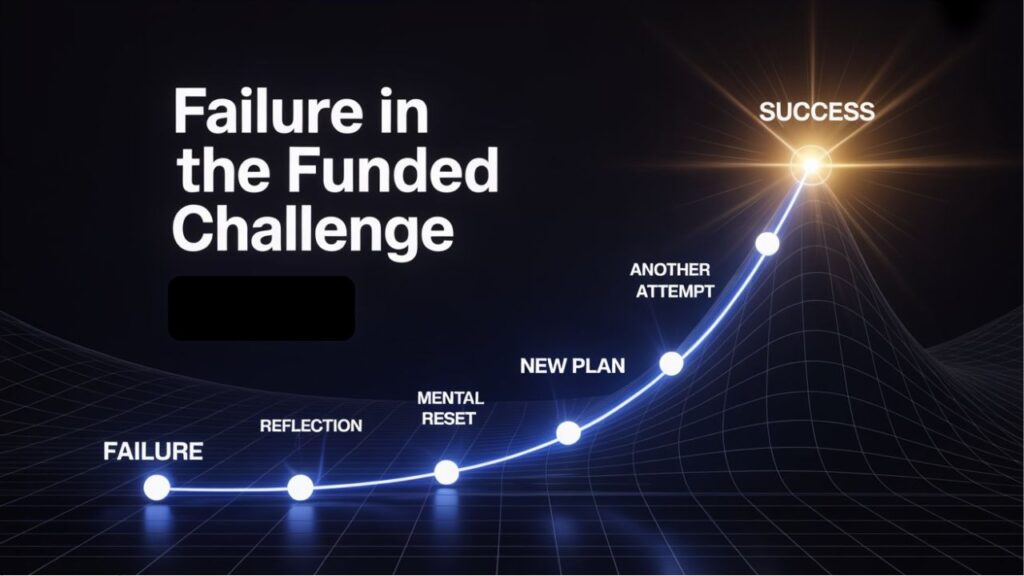
You are three days into your prop firm evaluation. Your strategy is solid, setups are clean and then one bad session, then another and then a third one.
Suddenly you are not trading your system anymore. You are trading your emotions. You are sizing up to recover faster. You are taking setups that don’t even match your criteria. You are checking your equity every four minutes like it is going to change by staring at it. That is not a strategy problem.
That is a losing streak psychology problem. And I promise you. it is far more common, far more destructive, and far less talked about than any technical failure you will ever face inside a funded evaluation.
I’ve faced this and i know what actually happens inside a trader’s brain during consecutive losing days. The patterns are remarkably consistent. The mental traps are predictable. And most importantly, every single one of them is fixable once you know what you are dealing with.
Here are the seven mental problems a prop firm losing streak creates, and the exact fix for each one.
“A losing streak doesn’t reveal your strategy’s weakness, it reveals the gap between who you are and who you need to become as a trader.” Shahzaib Khan, The Reborn Trader
Problem 1: Your Brain Stops Seeing Setups and Starts Seeing Threats
Here is something most traders never realize about what a losing streak in prop firm trading actually does to your brain at a neurological level. The moment you experience two or three consecutive losses, your amygdala, the brain’s threat detection center, shifts your entire cognitive processing from rational analysis into survival mode. You stop evaluating setups objectively. You start scanning the market for danger.
Every candlestick looks like a trap. Every valid entry looks suspicious. Every setup that would have been an easy yes on a green day suddenly feels uncertain, risky, and unworthy of your capital.
And the cruel irony? The setups didn’t change. The market didn’t change. Your perception changed, because your brain is now operating from fear rather than analysis.
The Fix: The Pattern Recognition Reset
Before your next session after a losing day, spend five minutes writing down three setups from your strategy that have historically worked. Not recent ones. Historical ones. Remind your brain, on paper, in writing that your edge exists independent of your last three trades. This simple act re-engages your prefrontal cortex and pulls your decision-making back out of survival mode before you place a single order.
Problem 2: Revenge Trading Becomes Irresistible
Honestly, this is the one that ends more funded trader evaluations than almost anything else. After a losing day, your brain does something deeply irrational, it frames the next trade not as an opportunity but as a correction. A way to fix what just happened. To take back what the market took from you.
That framing turns a disciplined trader into a gambler.
Revenge trading feels like confidence. It feels like decisiveness. It feels like you are taking control of a situation that felt out of control. But what it actually is, every single time is emotional decision-making dressed up as strategy.
The position size is too big. The setup criteria is too loose. The stop loss is placed based on what you need rather than what the chart shows. And the result is almost always the same: a bad day becomes a blown week.
The Fix: The 24-Hour Revenge Trading Rule
Implement this rule immediately and treat it as non-negotiable. After any session where you feel the urge to “win it back”, you do not trade for 24 hours. Not minimum size. Not one quick trade, nothing. The 24-hour window breaks the emotional momentum that revenge trading requires to survive. By the time tomorrow’s session arrives, the urgency has faded and your rational brain has returned to the driver’s seat.
Problem 3: Your Position Sizing Becomes Emotionally Driven
Furthermore, one of the most technically damaging things a prop firm losing streak does is corrupt your position sizing logic completely. On a normal trading day, you size based on your risk parameters, your equity, and your setup quality. But after consecutive losses, sizing decisions stop being mathematical and start being emotional.
You size up because you need to recover faster. Or you size down so aggressively that even your best setups can’t move your account meaningfully. Both responses are wrong. Both are driven by the losing streak rather than by the trade itself.
The Fix: The Pre-Session Size Lock
Before every session, especially after a losing day, write your position size for that session at the top of your trading journal before you look at a single chart. Lock it in writing. Commit to it as a rule, not a guideline. When you predetermine your size before emotional data enters the picture, you remove the losing streak’s ability to corrupt one of your most critical trading decisions.
Problem 4: You Start Changing Your Strategy Mid-Evaluation
This one is subtle, and it is devastating.
After two or three losing days, the self-doubt creeps in quietly. Maybe your strategy is broken. Maybe the market has changed. Maybe you need a different indicator, a different timeframe, a different approach entirely.
So you start tweaking. You add a filter. You change your entry criteria. You switch from your A-setup to something you saw on a YouTube video three weeks ago.
And now you are not executing a tested strategy under temporary pressure. You are executing an untested strategy under maximum emotional pressure, which is arguably the worst possible combination in futures prop firm trading.
The Fix: The Strategy Freeze Protocol
During any active evaluation, your strategy is frozen. No changes, no tweaks, no additions. If you genuinely believe your approach needs revision, write the proposed change in your journal with today’s date and commit to evaluating it only after the current evaluation concludes. This discipline protects you from the single most self-destructive pattern in funded trader psychology: abandoning a working system at precisely the moment it is about to prove itself.
Read this: The Dark Side of Trading Addiction
Problem 5: The Daily Loss Limit Becomes a Psychological Magnet
Here is something genuinely fascinating about daily loss limit psychology that I want you to sit with for a moment. Most traders think the daily loss limit exists to protect their account. And mechanically, yes, that is exactly what it does. But psychologically, something strange happens during a losing streak.
The daily loss limit starts functioning as a target rather than a boundary.
Your brain desperate to recover, desperate to do something, unconsciously trades toward the limit rather than away from it. Each losing trade feels like permission to take one more, because you still have room before the limit hits.
This is called loss chasing, and it is one of the most well-documented cognitive biases in behavioral finance.
The Fix: The Personal Daily Stop Rule
Set your own internal daily stop at exactly 50% of the official daily loss limit and treat it with more authority than the firm’s rule. If you lose half your allowed daily amount, your session is over. Walk away. This self-imposed boundary stops loss chasing before it starts, preserves your buffer for tomorrow, and critically, rebuilds the psychological experience of being in control of your own risk rather than being dragged toward a hard wall by emotional momentum.
Problem 6: Consecutive Losses Destroy Your Patience for Valid Setups
Additionally, here is a painful truth about what consecutive losing days do to your patience as a trader. Under normal circumstances, you are willing to wait. You sit on your hands through mediocre setups. You let the market come to your levels. You execute only when your criteria are fully met.
But after a losing streak? That patience evaporates completely.
Suddenly the market owes you a winner. Every bar that passes without a setup feels like lost recovery time. The slow, patient, disciplined version of you gets replaced by an anxious, impatient version that manufactures setups out of noise just to feel like something is happening.
Boredom trading and forced entries during losing streaks are responsible for more compounding account damage than the original losses themselves.
The Fix: The Minimum Setup Score System
Create a simple 5-point checklist for your primary setup, trend direction, structure level, confirmation signal, risk-reward ratio, and session timing. Before every entry during and after a losing streak, score the setup out of five. Commit to only taking trades that score four or five. This mechanical filter restores the patience that emotional trading strips away, because it gives your brain a process to follow instead of a feeling to chase.
Problem 7: You Start Measuring Yourself by Your Losing Streak
Finally and I want you to hear this one clearly, the most psychologically destructive thing a prop firm losing streak does has nothing to do with your account balance.
It makes you confuse a temporary performance pattern with a permanent identity.
Three losing days and suddenly you are “a losing trader.” A bad week and suddenly the internal narrative shifts from “I am going through a difficult stretch” to “I am not good enough for this.” That identity shift, from process to self-worth, is where funded trader mental resilience either gets built or completely collapses.
Your losing streak is data. It is not a verdict.
Every professional trader in the history of financial markets has experienced consecutive losing sessions. The ones who built lasting careers are not the ones who avoided losing streaks. They are the ones who refused to let a losing streak rewrite their identity.
The Fix: The Performance-Identity Separation Journal
After every losing session, write one sentence completing this statement: “Today’s result tells me about my execution, it tells me nothing about my potential.” This daily practice simple as it sounds, creates a cognitive firewall between your trading performance and your self-worth. Over time, it builds the kind of psychological resilience that allows you to execute your edge clearly on Day 4 of a losing streak, which is precisely when most traders are making their worst decisions.
Read this: Trader’s Identity Crisis: Why Your Life Shapes Your Trades
The Reborn Trader’s Final Word on Losing Streaks
Here is what I want you to carry with you into every session from this point forward.
A losing streak in prop firm trading is not the enemy. It is an exam. It is the evaluation asking you one specific question that no profit target, no daily loss limit, and no trailing drawdown rule can ask on its own: who are you when things are not going your way?
The seven mental problems above are not weaknesses. They are predictable human responses to an extraordinarily high-pressure environment. Every single one of them has a fix. Every single one of them is manageable with the right protocol, the right awareness, and the right commitment to process over outcome.
You already survived the losing streak that brought you to this article. Now go build the mental architecture that makes the next one irrelevant.
Every week inside The Reborn Trader Newsletter, We deliver one prop firm psychology breakdown, one real losing streak recovery lesson, and one actionable mental protocol you can apply before your very next session.
Just raw, specific, battle-tested mindset strategies built exclusively for funded traders who are serious about protecting their evaluation and their psychology at the same time. Subscribe Here
FAQ
What does a losing streak do to a trader’s psychology in a prop firm evaluation?
A losing streak shifts your brain from rational analysis into survival mode, making every valid setup look like a threat rather than an opportunity. Your amygdala hijacks your decision-making and you start trading fear instead of your actual strategy. Without a structured reset protocol, the emotional damage compounds faster than the account damage.
What is revenge trading and why is it dangerous in funded evaluations?
Revenge trading happens when you enter a trade not because the setup qualifies but because you emotionally need to recover what the market just took from you. It feels like confidence in the moment but it is pure emotional decision-making disguised as strategy. In a prop firm evaluation with strict loss limits, one revenge trading session can erase an entire week of disciplined progress.
How many losing days in a row is normal in prop firm trading?
Even professional traders with proven strategies experience three to five consecutive losing days as a completely normal statistical occurrence. The real issue is never the losing streak itself, it is your behavioral response to it that determines whether your evaluation survives. A structured reset protocol after each losing session is what separates recovery from compounding damage.
How do you stop revenge trading in a prop firm evaluation?
The most effective method is the 24-hour revenge trading rule, after any session where you feel the urge to win back losses immediately, you do not trade for a full 24 hours without exception. This window breaks the emotional momentum that revenge trading needs to survive. By the next session the urgency fades and rational decision-making returns before your first order.
Should you change your strategy during a losing streak in a prop firm?
No, changing your strategy mid-evaluation during a losing streak is one of the most self-destructive decisions a funded trader can make. You would be running an untested approach under maximum emotional pressure, which is the worst possible combination in prop trading. Freeze your strategy completely and journal any proposed changes to review only after the current evaluation ends.
How do you mentally recover after consecutive losing days in a funded account?
Start with a mandatory screen break after any emotionally driven session, ideally a full 24 hours minimum. Then write an honest journal entry identifying the specific emotional trigger behind each poor decision that session. Before your next trade, lock your position size in writing and run every entry through your minimum setup score checklist until confidence rebuilds naturally.