Most traders who attempt the Topstep Trading Combine arrive technically prepared. They know their setup. They’ve backtested their entries. They understand the profit targets and contract limits on paper. And then they fail anyway.
Not because the market broke their strategy. Because they broke under the pressure of the rules.
In this article, I’ll tell you that the missing ingredient is almost never technical. It’s psychological. This guide exists to fill that gap completely. You’re going to walk away understanding not just what the rules are, but what they do to your brain and exactly how to handle it.
Understanding the Trailing Drawdown as a Psychological Object
Before you can manage the mental weight of the Topstep trailing drawdown, you need to understand it in a way that most guides skip entirely.
The mechanics are simple enough. On a $50K account, your Maximum Loss Limit starts at $48,000, exactly $2,000 below your opening balance. Every time you close a session at a new equity high, that floor rises permanently. It never comes back down, not for a bad day, not for a losing week, not for anything.
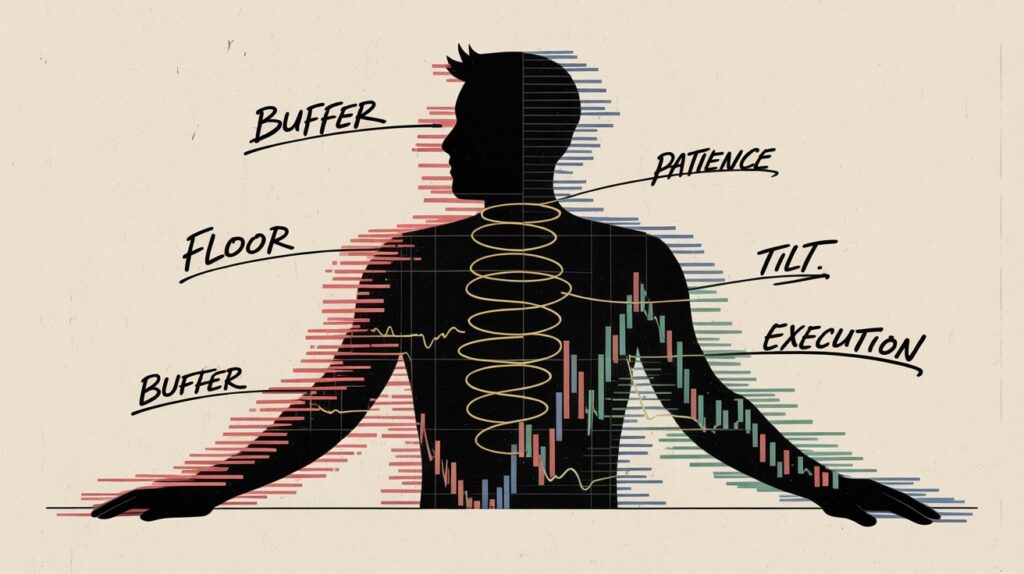
But here’s what nobody tells you, the floor is just a number on a screen. The fear of the floor is what actually kills Combines.
The EOD Advantage Most Traders Waste
Topstep does something genuinely generous that most prop firms don’t. They calculate your trailing drawdown using your end-of-day balance, not your intraday peak. That means if you’re up $1,500 during the session and it pulls back to $400 by the close, your floor only moves up based on that $400 closing gain. Not the $1,500 intraday high.
Other firms trail your floor using intraday peaks. One good trade followed by a normal pullback and your account is gone, even if you’re still profitable on the day.
Topstep gives you room to breathe. But here’s the frustrating reality. Most traders don’t actually use this advantage. They panic at intraday dips as if the floor is chasing them in real time, close trades early, reduce size mid-session for no mechanical reason, they let imaginary intraday rules govern their behavior.
You need to burn this into your mind before your next session: the floor only moves at the close. Trade your plan. Let positions breathe. The end-of-day calculation is Topstep’s gift to you, stop throwing it away.
Why the Buffer Feels Different at $52K vs $50K
This is the psychological trap almost nobody talks about openly, and honestly, it’s the one I find most fascinating.
On Day 1, your buffer is $2,000 and your hands are steady. After eight solid trading days, your balance might be at $52,500. Your MLL floor has climbed to $50,500. Your buffer is still $2,000, mechanically identical to Day 1.
But it doesn’t feel identical. Not even close.
Because now you’re protecting accumulated gains. Your brain has shifted from “building” mode into “protecting” mode. And in protecting mode, every $300 dip feels like a $300 threat to everything you’ve earned, not just a $300 fluctuation in a normal trading session.
That shift is called loss aversion, and it’s one of the most powerful psychological forces in trading. The pain of losing something you already have is approximately twice as intense as the pleasure of gaining the same amount. So as your Combine account grows, the emotional stakes quietly double, even though the mechanical rules stay exactly the same.
“The trailing drawdown doesn’t shrink your account, it shrinks your courage. Your only job is to make sure courage outlasts the floor.” The Reborn Trader
Read this: The Psychology of Passing Prop Firm Challenges
The Mental Architecture of a Combine Attempt
Understanding the rules is one thing. Understanding what happens inside your head as the Combine progresses, that’s what separates funded traders from frustrated ones.
Every Topstep Combine follows a remarkably predictable emotional arc. The details change. The feeling doesn’t. And once you know the arc, you can prepare for each phase instead of being ambushed by it.
The Four Emotional Phases Every Trader Experiences
1. Cautious Optimism: This is Days 1 through 3 for most traders. You’re careful, deliberate. You follow your plan almost religiously because the fear of early failure keeps you honest. Position sizes are correct. Stops are respected. You might actually be slightly under-trading because nervousness is acting as a natural governor.
Ironically, this is often your best trading phase.
2. Confidence After First Profits: This is where it quietly gets dangerous. A few green days boost your self-belief, which is good but overconfidence starts bleeding in around the edges. You begin taking marginal setups because “the account can handle it.” You add a contract because “the setup is really strong this time.” This phase ends more Combines than Phase One ever does, because the mistakes here feel like decisions, not errors.
3. Greed or Impatience at Mid-Evaluation: If your balance is building, greed whispers that you should finish faster. If progress has stalled, impatience screams that you need to do something. Both responses increase your risk at precisely the wrong moment. This is the phase where revenge trading and overtrading become genuinely tempting, not just theoretical risks.
4. Fear Near the Target: You can almost taste the pass. And suddenly every trade carries the weight of the entire journey. You hesitate on valid setups. You cut winners early to “lock in” progress. You start trading the scoreboard instead of the market. This phase is where technically passing traders fail themselves.
The Compression Paradox Explained
Additionally, there’s a structural dynamic inside the Topstep Combine that creates psychological pressure regardless of which emotional phase you’re in.
As your equity rises, your trailing MLL floor rises with it. Your buffer stays the same size in dollar terms. But your perception of that buffer compresses, because the stakes attached to every dollar have increased. This is what I call the Compression Paradox, the better you do, the more pressure you feel per dollar of remaining room.
The practical response to this is deliberate position scaling. Experienced funded traders actually reduce contract size as their equity climbs during the Combine. It’s not because any rule requires it, but because smaller size per trade is the only rational way to keep the emotional weight of each session from becoming unbearable.
How Winning Streaks Quietly Destroy Trading Discipline
Furthermore, there’s something that almost nobody warns you about, and it feels almost offensive to say out loud. Winning streaks are dangerous.
It’s not because they’re bad. Because of what they do to your standard. After five green days in a row, your brain starts treating your current performance as the baseline. Average setups start looking like great setups. The appropriate size starts feeling too small. The discipline that created the winning streak quietly gets dismantled by the confidence the winning streak produced.
The traders who pass the Topstep Combine most cleanly are the ones who treat green days with the same respect they treat red days. Every session gets the same preparation. Every trade gets the same evaluation. No exceptions for momentum. No “I’m hot right now” position sizes.
The 5-Winning-Days Rule and Your Psychology
The 5-winning-days requirement is widely misread as a simple performance checkpoint. You need five days where your net profit clears $200 each, and then you can request a payout. That’s the mechanical truth.
But psychologically, it’s doing something far more important and understanding this completely changes how you approach each session.
Why Topstep Paces You on Purpose
Topstep is not just measuring whether you can make money. They’re measuring whether you can make money repeatedly, across multiple separate sessions, without letting one big day carry your entire result.
The 5-winning-days rule forces distribution of your performance. It stops you from crushing one $2,000 day and declaring victory. It rewards consistent trading discipline over episodic brilliance. And in doing so, it mirrors exactly what professional trading actually requires in the real world.
When you stop seeing this rule as a gate and start seeing it as a pacing guide, your behavior shifts. You stop forcing sessions on slow days just to “get a winning day.” You stop sizing up on the last trade of the day to push a $140 day over the $200 threshold. You start trading each session as a complete, self-contained performance because that’s what the rule is actually rewarding.
The 2026 Rule Changes and What They Mean Mentally
Consequently, the 2026 updates to Topstep’s structure added an important wrinkle. Your first payout still follows the standard path. But every subsequent payout now requires two conditions simultaneously, meeting the winning days requirement and remaining profitable since your last payout.
What this means psychologically is significant. You can no longer take a payout, have a rough stretch, and immediately request another one once you’ve scraped together five winning days. You need to rebuild and stay above your post-payout balance first.
This rule change essentially demands that you manage your psychology between payouts, not just during the initial Combine. The mental game doesn’t end when you pass. It continues and in many ways, it deepens.
Consistency XFA: A New Mental Framework for 2026
The new Consistency XFA path introduced in February 2026 gives you an alternative route, payout eligibility in as few as three trading days, but with a consistency formula attached. Your single largest winning day cannot exceed 40% of your total net profit during the payout window.
Mentally, this is a remarkable design. It makes one massive outlier day less valuable than three steady, disciplined sessions. It structurally rewards the trader who shows up and executes calmly, every single day, rather than the trader who gambling-sized their way to one home run.
Whichever path you choose, the psychological message from Topstep in 2026 is identical: repeatable discipline beats occasional brilliance, every single time.
The Six Mental Traps That End Combines
Transitioning from theory to battlefield reality, here are the six specific psychological failure modes I see most often in Topstep Combine attempts, in plain language.
Revenge trading after drawdown is the most common. One rough morning becomes a second session chasing recovery, and suddenly you’ve consumed your weekly buffer in two hours of emotional trading.
Overconfidence during a winning streak is the quiet killer. Green days lower your guard. Marginal setups start looking valid. An extra contract sneaks in. The discipline that built your equity gets dismantled by the confidence that equity produced.
Floor anxiety as equity grows is the Compression Paradox in live action. You start trading defensively, avoiding obvious setups because the feeling of being close to the floor overrides your actual market read.
Target fixation hits when you’re $400 from the finish line. Every trade becomes about the number rather than the setup. You stop being a trader and start being a finisher, which, ironically, is the fastest way to not finish.
The boredom trade is underrated as a Combine killer. Slow market days produce bad decisions. The urge to manufacture action when none exists is powerful, expensive, and completely predictable once you know to watch for it.
Strategy abandonment after one loss is perhaps the most self-defeating pattern. One stopped-out trade does not invalidate a working system. But the emotional sting of a loss can feel like evidence that everything is broken, right before it would have worked perfectly.
Your Daily Mental Protocol
Finally, the part you can actually do something with starting today.
Pre-Session: The 2-Minute State Check
Before you look at a single chart, sit still for two minutes and ask yourself three questions honestly.
Am I tired? Am I carrying frustration from yesterday? Am I trying to prove something to someone, including myself?
If the honest answer to any of those is yes, trade minimum size or don’t trade at all. No setup is worth the decision-making quality of an emotionally compromised session. This pre-trade mental routine is the single highest-leverage habit I’ve seen among consistently funded traders.
Read this: The Trading Routine That Prepares Your Mind Before Charts
During the Session: The Two-Loss Rule
Give yourself one non-negotiable rule during every session: after two consecutive losses, you step away from the screen for at least 30 minutes.
Not because two losses means your strategy is broken. But because two consecutive losses changes your emotional state in ways you cannot fully detect in real time. The version of you that trades after two losses is measurably different from the version that opened the session calm and focused. Protect that second version by giving it time to return.
Post-Session: The Emotional Trading Journal
After every session, your trading journal entry should include two things alongside your trade data, your emotional state at the open, and your emotional state at each significant decision point during the session.
Over time, this log becomes the most honest mirror you’ll ever look into as a trader. Patterns appear. You’ll notice you force trades on Tuesdays. You’ll see that your worst sizing decisions happen after a winning streak, not a losing one. You’ll find the specific emotional trigger that lives three trades before your worst blowups.
That awareness, built over weeks, becomes your most durable trading edge.
After the Combine, Keeping the Trading Mindset in the Funded Account
Passing the Topstep Trading Combine is genuinely worth celebrating. But I want to tell you something directly, because I’ve seen too many traders learn this the hard way.
The funded account is psychologically harder than the Combine. In the Combine, you’re building. There’s a clear target ahead. The trailing drawdown is the only thing standing between you and a pass, and that simplicity creates a certain kind of focus.
In the funded account, the goalposts shift. The MLL still applies and in the Live Funded Account, it becomes intraday rather than end-of-day, making it significantly tighter. The payout rules now require sustained profitability across multiple windows. The psychological stakes feel higher because you’ve already proven something, and the thought of losing that proof is its own unique pressure.
The solution is ruthlessly simple: keep the same mental protocols you used to pass the Combine. The two-minute state check. The two-loss rule. The emotional journal. The deliberate position sizing as equity grows.
Don’t let success quietly dismantle the habits that produced it.
The Reborn Trader’s Commitment
Here’s what I want you to take away from everything written above.
The Topstep Combine is not testing your chart-reading ability. It’s not testing your strategy. It’s asking one deeper, harder question: can you execute your edge, consistently, under pressure, across multiple sessions, without letting the rules become an emotional weight you carry into every trade?
The trailing drawdown is a mirror. The 5-winning-days rule is a pacing guide. The six mental traps are just your unexamined habits showing up in a high-stakes environment.
You already have what it takes technically. Now build what it takes mentally, one clean, disciplined, intentional session at a time.
Every week inside The Reborn Trader Newsletter, I break down one trading mindset concept, one real psychology lesson, and one actionable mental protocol you can apply before your next session.
This is raw, specific, and built for traders who are serious about passing their Combine and keeping their funded account, mentally and technically. SUBSCRIBE HERE
FAQ
How does the Topstep trailing drawdown work psychologically?
The Topstep trailing drawdown raises your floor every time you close a session at a new equity high and it never drops back down. This creates growing pressure as your account builds, because you shift from building mode into protecting mode. Most traders make their worst decisions precisely when their balance looks its healthiest.
Why do traders fail the Topstep Combine even with a good strategy?
Most Topstep Combine failures are psychological, not technical. Revenge trading, overconfidence during winning streaks, and target fixation near the profit goal are the most common killers. A solid strategy executed under emotional pressure will always underperform a simple strategy executed with full discipline.
What is the Topstep 5-winning-days rule and how does it affect your mindset?
The 5-winning-days rule requires five separate sessions with at least $200 net profit each before you can request a payout. Psychologically it acts as a pacing mechanism, rewarding consistent discipline over one lucky big day. Traders who rush it almost always force trades and damage the account they are trying to qualify.
What is the difference between end-of-day and intraday trailing drawdown?
Topstep uses end-of-day trailing drawdown, meaning your floor only rises when you close a session at a new equity high, intraday peaks do not move it. Other firms trail the floor in real time, so a normal mid-trade pullback can end your account even on a profitable day. The end-of-day calculation gives you room to let trades breathe without panicking over every fluctuation.
How do you mentally recover after a bad day in the Topstep Combine?
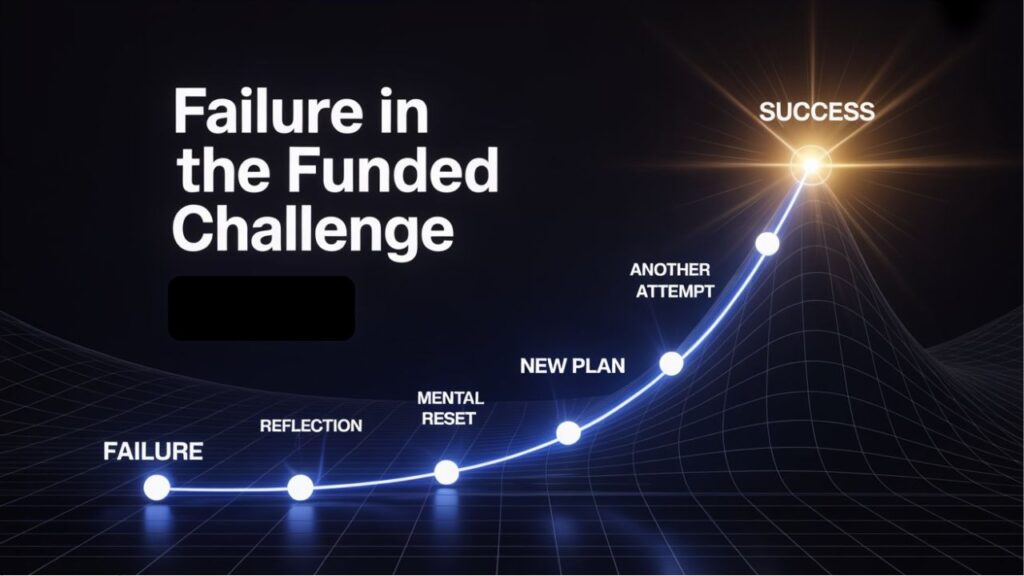
Take a full break from the screen before your next session and write an honest emotional journal entry identifying what triggered each poor decision. On your next trading day, commit in writing to the two-loss rule, stop trading after two consecutive losses, no exceptions. This structured reset stops one bad day from compounding into a blown Combine.
Does the Topstep trailing drawdown apply in the funded account too?
Yes, but it gets stricter. The Combine uses end-of-day calculation, while the Live Funded Account tracks your balance intraday including unrealized profits from open trades. This is one of the most important mindset transitions when moving from the Combine to a Live account, because the margin for emotional error shrinks considerably.