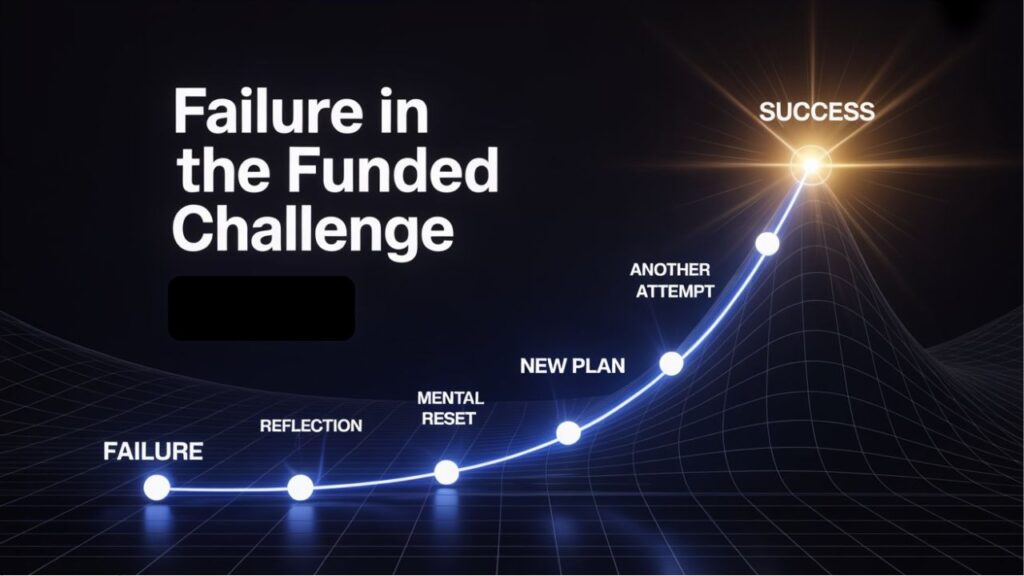
The Real Reason 94% of Traders Fail Has Nothing to Do With Their Strategy
Let me be honest with you. You didn’t fail the FTMO Challenge because your setup was wrong. You failed it because your mind broke before your strategy did.
I’ve spoken with hundreds of traders who had solid systems, backtested edge, and real market knowledge and they still blew their challenges. Not on Day 30, not even on Day 20. Most of them cracked in the first week.
That number isn’t anecdotal. Research confirms that around 94% of traders fail prop firm challenges, and the majority of those failures are driven by psychological breakdown, not technical incompetence.
So today, I want to walk you through what actually happens inside your brain across each phase of a 30-day FTMO Challenge. Day by day. Phase by phase. Because once you understand the mental architecture of this journey, you stop fighting yourself and start trading like the professional you’re training to become.
This is the guide I wish existed when I started.
Why the FTMO Challenge Is Fundamentally a Psychological Test
Here’s something most trading educators won’t tell you directly. FTMO itself internally attributes 80% of trading success to psychological factors. Not your indicator settings. Not your entry model. Not your risk-reward ratio.
Eighty percent. Trading Psychology.
The math of the challenge is almost insultingly simple. Hit a 10% profit target. Don’t breach your 5% daily loss limit. Don’t exceed your 10% maximum drawdown. Complete a minimum of 10 trading days across 30.
That’s it. And yet most failures happen within the very first week.
Why? Because trading performance anxiety doesn’t care about your edge. The moment real money and real consequences enter the picture, even on a demo evaluation, your nervous system changes the game entirely.
You’re no longer just trading. You’re performing under observation. And that shift is everything.
“The Prop Firm Challenge doesn’t test whether you can trade. It tests whether you can trade while your mind is trying to protect you from imaginary danger.” The Reborn Trader
Let’s break down exactly what that looks like across each phase.
Phase 1: The Ignition Anxiety (Days 1 to 5)
Your brain is treating day one like a threat to your survival. You open the platform on Day 1 and something strange happens.
You’ve traded this exact setup a hundred times in the demo. You know the pattern. You know the risk. But your finger hovers over the button and you just freeze.
That’s not a weakness. That’s neurochemistry.
Research published in Scientific Reports found that elevated cortisol, the body’s primary stress hormone, predicted subsequent risk-taking and price instability in experimental asset markets. When you begin the FTMO Challenge, your brain registers the novelty, the financial stakes, and the evaluation pressure as a genuine threat. Cortisol floods your system. Your amygdala hijack trading response kicks in, pulling blood flow away from your prefrontal cortex, the very region responsible for calm, rational decision-making.
In plain terms: stress literally makes you dumber in the exact moments you need to be sharpest.
What this looks like in real trading behavior during Days 1 to 5:
You take your first valid setup and immediately second-guess it. You either skip the trade entirely, analysis paralysis, or you enter late, miss the move, and feel the sting of confirmation that “you can’t trade under pressure.”
Then comes the first-week prop firm challenge stress spiral: one bad trade, emotional response, forced revenge entry, early drawdown. By Day 5, some traders have already lost 3 to 4% of their buffer before they’ve even found their rhythm.
What to do instead:
Treat Days 1 to 3 as calibration days. Your only job is to execute one to two setups at minimum position size. You are not trying to make money yet. You are proving to your nervous system that the platform is safe, your rules work, and the market hasn’t changed just because FTMO is watching.
Reduce the psychological load. Hide your equity balance if you need to. Focus exclusively on process execution, not the P&L number.
Phase 2: False Confidence or the Early Spiral (Days 6 to 10)
A winning streak is just as dangerous as a losing one. By day six, one of two things had happened.
Either you’ve strung together a few clean trades and you’re feeling good, maybe a little too good, or you’ve taken a couple of losses and the revenge trading prop firm impulse is quietly building in the background.
Both of these states are dangerous. And both are completely predictable.
Here’s what the science says: the psychological impact of a loss is approximately twice that of an equivalent gain. This is loss aversion, a core concept from Kahneman and Tversky’s Prospect Theory, and it hits hardest in the Days 6 to 10 window when your emotional baseline is still unsettled.
If you’ve been winning, overconfidence bias trading starts to creep in. You widen your position sizes “just a little.” You take a setup that’s 70% of your usual quality because “I’m on a roll.” You start believing your edge is bigger than it actually is.
If you’ve been losing, the opposite happens. You start chasing. You enter on FOMO trading challenge impulses, jumping into moves you didn’t plan for because the fear of missing profit feels worse than the risk of losing money.
Both behaviors are your brain trying to manage discomfort. Neither of them is your trading strategy.
The intervention here is simple but hard:
Keep a trading journal psychology FTMO log every single day. Not just what you traded, but how you felt before, during, and after each position. When you can see your emotional state in writing, you create distance between the feeling and the action. That distance is where discipline lives.
Phase 3: The Mid-Challenge (Days 11 to 20)
This is where motivated traders quietly self-destruct. Nobody talks about this phase. And it might be the most dangerous one.
Days 11 through 20 feel flat. The initial adrenaline has worn off. You’re not panicking anymore, but you’re not fired up either. You sit down to trade and everything feels like going through the motions.
This is the FTMO challenge boredom window. And I want you to understand something important: this is not laziness. This is a neurological event.
After sustained high-stakes performance, your dopaminergic reward system habituates. The novelty is gone. The excitement of day one has been replaced by routine. And your brain, wired to seek stimulation, starts pushing you toward impulsive behavior just to feel something again.
This is where overtrading FTMO challenge destroys otherwise solid campaigns. Traders start taking setups that barely qualify, entering markets they don’t usually trade, or adding positions mid-move out of sheer restlessness.
Research on the psychology of flow states, optimal performance states described by psychologist Mihaly Csikszentmihalyi, found that flow occurs only when challenge level and skill level are both high and roughly matched. When skill exceeds challenge, boredom sets in.
That’s exactly what’s happening in the mid-challenge lull. Your skill is adequate. The challenge feels repetitive. And boredom becomes the enemy of trading discipline mid-challenge.
What actually works here:
Shift your focus from the profit target entirely. Your new daily mission is execution quality scoring. After every session, rate each trade out of ten, not on profit, but on how closely it matched your plan. A disciplined 6/10 trade that lost money is worth more than a chaotic 3/10 trade that happened to win.
This reframing keeps your brain engaged with something meaningful when the P&L no longer provides stimulation on its own.
Read this: The Funded Shock: Why Your Brain Freezes After Funding
Phase 4: The Pressure Spike (Days 21 to 27)
The finish line is the most dangerous place on the chart You’ve made it to the final stretch. Maybe you’re sitting at 7% profit with a week to go. The target is visible. The end is real.
And suddenly, you start trading worse than you have at any point in the challenge.
Welcome to what I call the Proximity Paradox.
When you’re close to the target, two things happen simultaneously. Loss aversion prop firm challenge kicks in with maximum force. You now have something real to lose, namely the 7% you’ve already earned. So paradoxically, some traders start under-sizing and missing valid setups out of fear of giving back progress.
Meanwhile, anchoring bias trading challenge sets in. You become fixated on the 10% number. Every day you’re not at 10% feels like failure, even if you’re sitting at a perfectly healthy 7.5% on Day 23.
Both behaviors, excessive caution AND target-chasing, are cognitive distortions driven by proximity pressure.
The antidote is almost counterintuitively boring:
Nothing changes on Day 21. Your risk per trade stays exactly what it was on Day 2. Your entry criteria don’t loosen because you need 3% in 7 days. Your trading plan doesn’t know what day of the challenge it is, and neither should you, as much as possible.
Funded trader emotional resilience is not about being fearless in this phase. It’s about having rules robust enough that fear can’t override them.
Phase 5: The Cliff Edge or the Controlled Landing (Days 28 to 30)
How you finish tells you everything about who you’re becoming as a trader. The final three days of an FTMO Challenge are a psychological fingerprint.
Some traders arrive here calm, professional, already mentally past the finish line. They execute their last few setups the same way they executed their first, methodically, without drama.
Others arrive here desperate. They’re at 6% with three days left and they’re doing the math on what lot size they’d need to hit 10% in a single trade. That’s not trading anymore. That’s gambling with a prop firm’s evaluation fee.
Real FTMO-funded traders consistently confirm that the key differentiator in the final phase isn’t strategy. It’s treating the challenge with the same emotional seriousness as a live funded account from Day 1.
If you’ve been doing that since Day 1, the final days feel like the last few holes of a round you’re already winning. Steady. Present. Unattached to the outcome in the way that only comes from trusting your process completely.
If you haven’t, if you’ve been running on adrenaline and gut decisions, Day 28 will feel like standing on a cliff edge.
The honest truth here is this:
FTMO challenge day by day success isn’t built in the final three days. It’s built in how you handle the ignition anxiety on day 1, how you journal through the spiral on day 7, how you push through the discipline test on day 14, and how you hold your rules steady when the finish line is right in front of you on day 24.
The challenge is thirty days long. But the mental game starts the moment you decide to begin.
Read this guide: The Psychology of Passing Prop Firm Challenges
Conclusion: Trading Psychology Is Your Edge
You can have the best strategy in the world. You can understand market structure, order flow, and institutional levels better than most retail traders alive.
None of that matters if you can’t manage what happens between your ears when the pressure arrives.
Trading mindfulness performance, deliberate pre-trade routines, journaling, position sizing that matches your emotional state, these aren’t soft extras. They are the actual work.
The traders who pass don’t have fewer emotions than you. They’ve just built systems that are bigger than their emotions.
That’s the whole game. And now that you understand the phase structure, you’re already better prepared than most of the 94% who never saw it coming.
Want the Full Mental Edge Every Week?
Every week inside The Reborn Trader Newsletter, I break down one trading psychology concept, one mindset mistake costing you money, and one actionable mental framework you can apply to your very next session.
Just the kind of deep, practical mindset work that actually moves the needle on your trading performance. Join hundreds of traders rebuilding their mental game from the ground up. Subscribe here free and get your first issue this week.
FAQ
Why do most traders fail the FTMO Challenge psychologically?
Most traders fail because emotional responses like revenge trading, FOMO, and overconfidence override their strategy. Research shows 94% of prop firm challenge failures are rooted in psychological breakdown, not technical skill gaps.
What is the hardest psychological phase of the FTMO Challenge?
The mid-challenge phase between Days 11 and 20 is arguably the most dangerous phase. Motivation drops, boredom sets in, and traders begin forcing low-quality setups just to feel active, quietly destroying an otherwise solid campaign.
How does cortisol affect your trading during the FTMO Challenge?
Elevated cortisol triggered by evaluation pressure suppresses your prefrontal cortex, the brain’s rational decision-making centre. This leads to impulsive entries, widened stop losses, and emotionally driven trades that violate your plan.
What should you do on Day 1 of the FTMO Challenge mentally?
Treat Days 1 to 3 as calibration days only. Trade minimum position sizes, hide your equity balance, and focus purely on executing your plan correctly. Your goal is not profit yet. It is proving to your nervous system that the environment is safe.
How do you handle the final week pressure of the FTMO Challenge?
Keep your risk per trade identical to what it was on Day 2. Do not loosen entry criteria just because the target feels close. The Proximity Paradox is real. Most late-stage failures happen because traders start protecting gains emotionally instead of trading their system.
Does trading psychology really matter more than strategy in FTMO?
According to FTMO’s own data, 80% of trading success is linked to psychological factors. A perfect strategy with poor emotional control will fail the challenge. A solid strategy with strong mental discipline will pass it consistently.