The trailing drawdown is the most psychologically damaging rule in prop trading and most traders don’t even realize it’s breaking them until it’s too late. In this article, I break down exactly how the trailing drawdown psychology works, why a moving floor triggers deeper fear than any static limit, how it silently destroys your trade sizing behavior, and the proven mental frameworks to detach from the number before it costs you your funded account.
Most traders don’t blow their funded accounts because of bad strategies. They blow them because of a rule they never truly understood, psychologically.
The trailing drawdown in prop trading is the single most misunderstood, most feared, and most psychologically destructive rule in the entire prop firm world. And the worst part? It doesn’t hurt you when you’re losing. It hurts you when you’re winning.
That’s what makes it different from everything else you’ve ever faced as a trader.
What Is a Trailing Drawdown and How Does It Actually Work?
Before we get into psychology, you need to understand the mechanics completely. Because if the rule isn’t crystal clear in your mind, the fear it generates makes no rational sense.
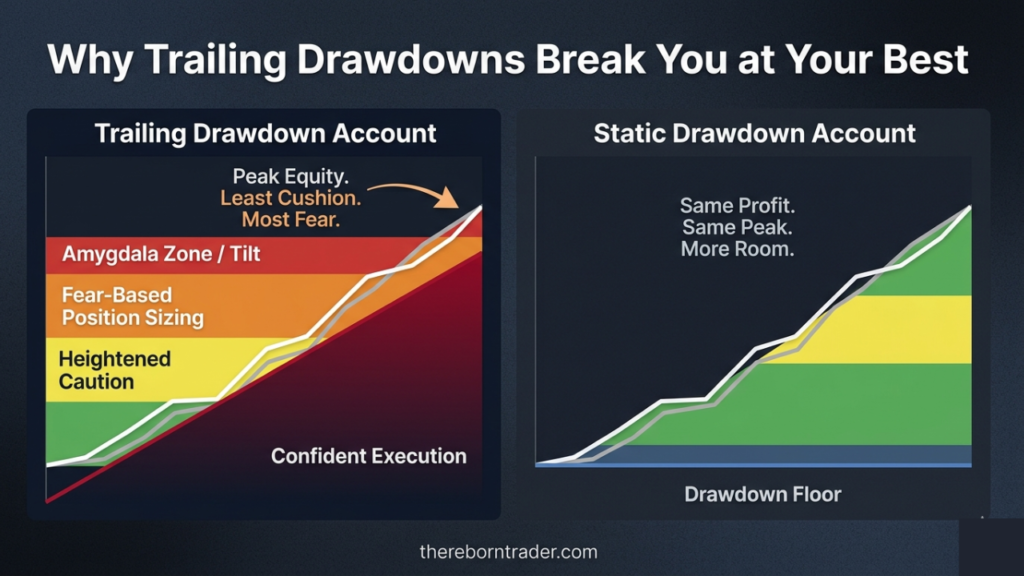
A trailing drawdown follows your highest account balance upward and it never comes back down. Every time you hit a new equity peak, the floor rises with it. Permanently. Unlike a static drawdown, which is fixed at your starting point regardless of how much profit you make, the trailing version locks in your gains as a new minimum protection line. Sounds fair, right? Almost protective?
Here’s where it turns sinister.
Imagine you start with a $100,000 funded account and a $3,000 trailing drawdown limit. Your floor starts at $97,000. You have a great week. Account climbs to $110,000. Your floor is now sitting at $107,000. Then the market gives back $4,000 on a normal pullback and your account is at $106,000. You just breached. You’re done.
Under a static drawdown, that same scenario leaves you with $16,000 of breathing room above your fixed $90,000 floor. That is the trap. That is the cruelty of it.
There are two main types you’ll encounter: intraday trailing drawdown, which recalculates in real time including your unrealized floating profits, and end-of-day trailing drawdown, which only adjusts at market close. The intraday version is the more punishing of the two, because a trade that runs $3,000 in profit and then reverses can breach your account on a day you finished green overall.
Now you understand the rule. Let’s talk about what it does to your brain.
Why the Moving Ceiling Triggers Deeper Fear Than Any Fixed Rule
Here’s something most trading psychology content won’t tell you.
The reason the trailing drawdown psychology hits so much harder than a static limit isn’t just about math. It’s about how your brain processes changing reference points versus fixed ones.
Daniel Kahneman and Amos Tversky established in their landmark 1979 Prospect Theory research that people don’t evaluate outcomes in absolute terms. They evaluate them relative to a reference point. And the pain of a loss is psychologically about twice as powerful as the pleasure of an equivalent gain.
A static drawdown gives you one reference point. It never changes. Your brain can anchor to it, accept it, and move on.
But a trailing drawdown creates a constantly moving reference point. Every time you hit a new equity high, your brain quietly updates its loss threshold and the fear recalibrates upward with it. You don’t just feel like you might lose money. You feel like you might lose something you’ve already earned and psychologically claimed as yours.
This is what behavioral economists call the endowment effect. Once your brain perceives those floating profits as “already yours,” losing them triggers a loss response, not a missed-gain response. And that loss response is twice as painful.
“The trailing drawdown doesn’t just test your strategy. It tests whether your identity is attached to a number that was never yours to keep in the first place.” Shahzaib Khan
The result? You start trading scared at exactly the moment your account is performing its best. The floor rises. The psychological pressure rises. And you, the trader who was just executing beautifully are suddenly making decisions from a place of threat rather than confidence.
That’s not a discipline failure. That’s neuroscience.
When your brain perceives a threat, including a financial one, your amygdala activates the body’s fight-or-flight response. Cortisol floods your system. Your prefrontal cortex, the part responsible for rational decision-making, planning, and impulse control, becomes progressively impaired. You are now making trading decisions from your emotional brain, not your analytical one.
And here’s the painful irony: the closer your trailing floor gets to your current equity, the more impaired your decision-making becomes, at the exact moment precision matters most.
Read this: How to Recover After Failing a Prop Firm Challenge
The Emotional State Map: What’s Really Happening on Your Equity Curve
Let me walk you through what the emotional journey of a trailing drawdown prop firm account actually looks like, phase by phase.
Phase 1: Confident Execution (Account at Starting Balance)
You’re fresh. The floor feels far away. You’re trading your plan, sizing properly, respecting your edge. This is you at your best.
Phase 2: Heightened Awareness (Small Profits, Floor Begins to Rise)
You’ve made some money. Good. But now you notice the floor has moved. Your brain registers: “I have less room than I did when I started.” Caution begins. You start placing slightly tighter stops. You exit winners a few ticks earlier than your plan says.
Phase 3: Fear-Based Position Sizing (Significant Profits, Floor Significantly Higher)
This is where position sizing behavior changes dramatically. You start risking less per trade, not because your risk model changed, but because the psychological cushion feels thin. You’re now trading to protect, not to execute. The disposition effect kicks in hard here: you’re selling winners too early to “lock in” gains and stop the floor from rising further.
Phase 4: The Amygdala Zone (Floor Near Current Equity)
You are now, in clinical terms, in a chronic threat state. Cortisol levels are elevated. The amygdala is hyperactive. Every tick against your position feels like an existential threat. You start taking setups you’d normally skip, hoping to build a buffer fast or you freeze entirely and miss everything. Both outcomes are equally devastating.
This is the zone where funded accounts die. Not because of the market. Because of the gap between the moving number on the screen and the trader’s ability to psychologically separate themselves from it.
How the Trailing Drawdown Silently Destroys Your Trade Sizing
You might think you’re making logical decisions. You’re not.
Research by Shefrin and Statman established that traders held losing positions 1.7 times longer than winning ones, a behavior driven by loss aversion and mental accounting distortions. When you layer a trailing drawdown on top of that psychological wiring, the distortions compound.
Here’s what actually happens to your trade sizing under trailing drawdown pressure:
You start cutting winners short because every open profit temporarily raises your trailing floor (in intraday models), making you feel exposed. You start widening stops on losers because closing them “makes it real” and moves you closer to the floor. You start reducing position size not based on volatility or strategy, but based on the gap between your current equity and the moving floor.
Every single one of these behaviors destroys your edge. Silently. Over time.
The Yerkes-Dodson Law from performance psychology tells us that performance improves with moderate arousal but collapses once emotional arousal exceeds a certain threshold. A trailing drawdown that’s far from your equity? Moderate arousal. Good for focus. A trailing floor that’s $200 from your current balance? You’ve blown past the peak of that curve and entered performance collapse territory.
And the worst part, you probably won’t even notice it happening.
Read this: How Prop Traders Manage Stress
How to Mentally Detach from the Moving Number
Now let’s talk about solutions. Because understanding the problem without addressing it is just anxiety with extra steps.
Reframe What the Trailing Drawdown Actually Is
The first and most powerful shift you can make is a cognitive reframing of what the number represents. The trailing floor is not your money. It was never your money. It is a risk parameter, a line the firm uses to measure your discipline. The moment you attach your identity or your financial security to it, you’ve already lost the psychological battle.
I’ve seen this pattern repeat hundreds of times: the traders who pass funded challenges consistently are not the ones who “beat” the trailing drawdown. They’re the ones who stopped caring about it.
Use a Process-Oriented Mindset, Not Outcome-Oriented
This comes straight from funded trader psychology research and the work of Dr. Gary Dayton, whose Acceptance and Commitment Therapy (ACT) framework applied to trading is arguably the most evidence-based approach available. Stop measuring your trading by whether the floor moved. Measure it by whether you followed your plan. One is in your control, the other is not.
Before every trading session, write down your three non-negotiables: your maximum risk per trade, your setup criteria, and your stop condition for the day. Then execute those and only those. The trailing drawdown becomes irrelevant background noise when your performance metric is process compliance, not equity level.
Shrink Your Risk Until the Psychology Is Right
This is practical and it works. If you find yourself in Phase 3 or Phase 4 of the emotional state map described above, reduce your position size by 50%, not because your edge is broken, but because your psychological state is compromised. You cannot trade your full size when your amygdala is running the show. Half size with a clear head is worth five times the returns of full size under cortisol-driven fear.
The Two-Strikes Protocol
After two consecutive losing trades in a session, stop. Walk away. Reset. This isn’t weakness, it’s emotional regulation, the same mechanism elite athletes use to prevent performance collapse during high-stakes competition. Research by Brett Steenbarger, arguably the most cited trading psychologist alive, shows that journal-based behavioral pattern identification is the primary diagnostic tool that separates consistently funded traders from the rest.
Conclusion: Stop Fighting the Trailing Drawdown. Start Using It.
Here’s the final thing I want you to understand. The trailing drawdown rule was not designed to be your enemy. It was designed to test whether you are a disciplined professional or an emotional gambler. That’s it.
The traders who consistently pass prop firm challenges, retain funded accounts, and scale their capital are not smarter than you. They don’t have better strategies than you. They have one thing you might not yet have fully developed: the ability to trade the same way whether the floor is $500 below them or $5,000 below them.
That equanimity, that emotional neutrality under trailing drawdown pressure, is not a personality trait. It is a trainable skill. And it starts the moment you decide to stop treating a moving number on a screen like a threat to your survival.
Because it isn’t. It’s just a rule. And rules, when you understand them deeply, become your edge, not your enemy.
Want weekly trading mindset breakdowns delivered straight to your inbox? Every week, The Reborn Trader Newsletter covers one high-impact psychology concept, one practical framework, and one prop firm strategy you can apply immediately, all in under five minutes of reading.
No noise, no generic tips. Just the mental edge that separates funded traders from everyone else.
Join free here and get your first issue this week.
FAQ
What is a trailing drawdown in prop trading? FTMO & FundedNext.
A trailing drawdown is a dynamic risk limit that follows your highest account equity upward and never resets lower. Every new profit peak raises your floor permanently, meaning the more you earn, the less buffer you have before an account breach is triggered.
Why is trailing drawdown more psychologically damaging than static drawdown?
Unlike a static drawdown, the trailing version creates a constantly moving reference point. According to Prospect Theory, people evaluate losses relative to a reference point, and when that point keeps shifting upward, loss aversion intensifies at precisely the moments when traders feel they should be most confident, producing fear-based decisions at peak performance.
How does trailing drawdown affect trade sizing behavior? The5ers
Traders under trailing drawdown pressure unconsciously cut winning trades short, widen stops on losers, and reduce position sizes based on emotional proximity to the floor rather than sound risk management principles. This compounds over time and silently destroys edge even when the underlying strategy remains valid.
What is the difference between intraday and end-of-day trailing drawdown? Apex Trader Funding
Intraday trailing drawdown recalculates in real time, including unrealized floating profits, meaning a trade that peaks in profit and reverses can breach your account on an overall green day. End-of-day trailing drawdown only adjusts at market close, giving traders room to absorb normal intraday pullbacks without triggering a breach.
How do you mentally detach from the trailing drawdown number? topstep
The most effective approach is cognitive reframing: the trailing floor is a risk parameter, not your money. Pairing that with a process-oriented mindset, reduced position sizing during emotional distress, and a two-strikes daily stop protocol allows traders to execute their edge without the moving floor
Can traders train themselves to handle trailing drawdown pressure?
Yes. Emotional neutrality under trailing drawdown pressure is a trainable skill, not a fixed personality trait. Evidence-based frameworks including Acceptance and Commitment Therapy adapted for trading, structured journaling, and pre-session checklists have been shown to reduce emotionally driven trading decisions significantly over time.