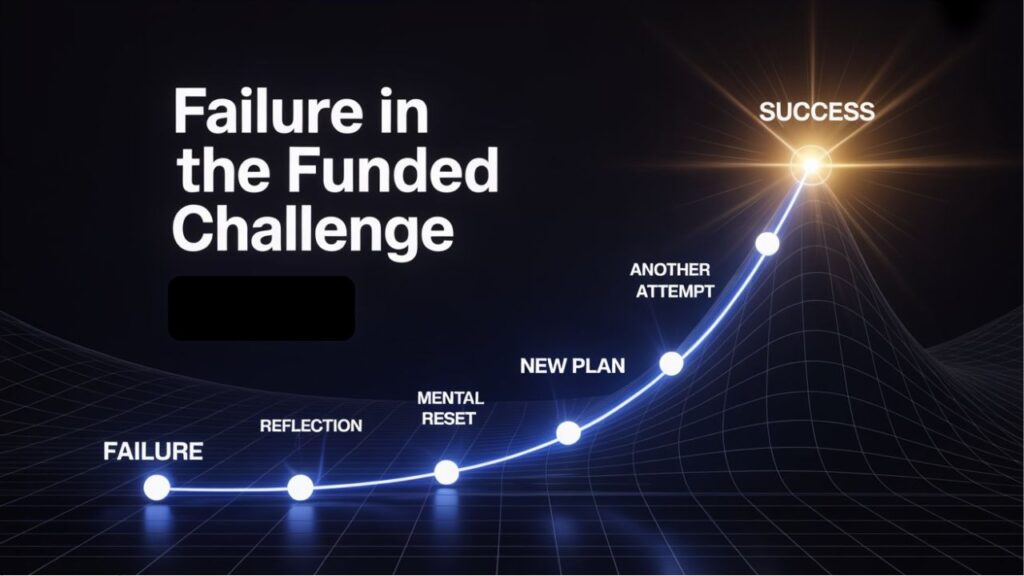
If you just passed your prop firm challenge and suddenly feel paralyzed, second-guessing every entry you used to take without thinking, you are not alone, and you are not broken. This article introduces The Funded Shock, a coined term for the identity-pressure response that hits traders the moment they go live on a funded account. You will learn exactly why your brain freezes, what neuroscience and behavioral psychology say about it, and how to use a structured 5-day protocol to trade normally again starting this week.
You passed the challenge. The email landed in your inbox. The dashboard flipped to live. Your name is now attached to a real funded account.
And then, nothing. You sit there staring at the charts, the same setups you’ve been executing for weeks, and your finger just won’t click.
That’s not a weakness. That’s not imposter syndrome lying to you about your skills. That’s your brain doing something deeply biological, deeply predictable, and once you understand it, completely fixable.
Shahzaib Khan calls this The Funded Shock. And if nobody has ever explained this to you before, today changes everything.
What Is The Funded Shock?
The moment you cross from challenge to funded, something shifts inside your brain that has nothing to do with your strategy.
Let me be direct: The Funded Shock is the identity-pressure response that follows getting funded, a neurological and psychological freeze triggered by your brain suddenly recategorizing the capital you’re managing as emotionally real.
During the challenge, your brain treated the capital as a performance task. There was a finish line. You were proving a point.
The moment funding arrives, the finish line disappears, and your brain replaces it with something far more threatening: the fear of losing something you now own.
This is not theoretical. This is biology.
“The funded account doesn’t change your edge. It changes how much your brain is willing to let you use it.”
Shahzaib Khan, The Reborn Trader
The psychology after passing a prop firm challenge is one of the most under-discussed, over-experienced phenomena in prop trading, and it’s costing traders their funded accounts in the first week, not because their strategy failed them, but because their nervous system did.
The Neuroscience Behind The Freeze
This section will probably be the most important thing you read about funded trader psychology all year. Here’s what’s happening inside your skull.
Your Prefrontal Cortex Goes Quiet
Your prefrontal cortex, the part of your brain responsible for rational decision-making, executive planning, and impulse regulation, is extremely sensitive to stress hormones.
The moment you go live on a funded account, your threat-detection system fires. Your amygdala reads funded capital as something to be protected, not risked. Cortisol floods your neural circuits. And here’s the brutal part: your prefrontal cortex begins to go quiet precisely when you need it most.
Research from Amy Arnsten at Yale showed that sustained stress actually causes the synaptic connections within the prefrontal cortex’s pyramidal neurons to physically retract. Not just function less. Physically retract.
You become slower to decide. You second-guess entries you’ve made a hundred times. Your analysis paralysis on trade entries isn’t laziness. It’s a literal reduction in your brain’s executive processing power.
The Endowment Effect Kicks In Instantly
Here’s where behavioral science gets personal. Richard Thaler’s foundational endowment effect research demonstrated that the moment a person takes ownership of something, they immediately value it more than an objective outsider would.
In the famous mug experiment, sellers demanded around $7 for a mug that buyers were only willing to pay $3 for. Same mug, same moment, completely different psychological valuation.
Now apply that to your funded account.
The second that capital becomes yours to manage, your brain re-prices every potential trade loss. Loss aversion in funded trading means you’re not just risking pips anymore. You’re risking something your brain has categorized as owned, protected, and precious.
That’s why the psychological shift from demo to funded account feels so visceral. It’s not imagined, it’s neural.
Dopamine Depletion After The Win
There’s one more layer that nobody talks about. Passing a prop firm challenge produces a significant dopamine response. The chase, the pressure, the final pass, your brain floods with reward chemistry.
And then it stops. When you open Day 1 of your funded account, your neurochemistry hasn’t reset. Dopamine depletion after a challenge passes, leaves your motivation systems temporarily exhausted, your emotional regulation depleted, and your risk tolerance misaligned.
You’re being asked to perform optimally in a brand new, high-stakes environment with a brain that just finished a neurochemical marathon.
The Imposter Syndrome Spike: When Success Feels Like a Trap
Okay, now let’s talk about the voice. You know the one. The one that shows up the moment you get funded and starts whispering: “What if it was luck? What if you can’t do it again? What if they figure out you’re not actually that good?”
That is imposter syndrome after passing a prop firm challenge, and it is one of the most statistically common psychological experiences among high-achievers on the planet.
Why Getting Funded Triggers Impostorism
Psychologists Clance and Imes, who first defined the imposter phenomenon back in 1978, identified a specific pattern: calling attention to your own success can paradoxically trigger imposter feelings. Receiving an award, passing an exam, getting promoted, these are all classic activation moments.
Getting funded is your activation moment. Suddenly you’re attributing your challenge pass to external factors, a good run, the right market conditions, luck, rather than the skill, discipline, and process that actually got you there.
Trading with other people’s money psychology amplifies this further. You’re now accountable to a firm. The fear of being “found out” activates the same neurological stress response as a genuine physical threat.
Your amygdala, as neuroscientists confirmed, doesn’t distinguish between social threats and physical ones. The anticipation of being exposed as a fraud produces the exact same cortisol spike as seeing a car swerving toward you.
That’s why your hands hesitate over the keyboard on Monday morning of your first funded week.
The Attribution Inversion
Here’s the specific cognitive distortion you need to name and dismantle.
Maladaptive attribution style, attributing successes to external factors like luck and failures to internal inadequacy, is the psychological engine underneath every funded trader freeze.
When you win a trade during the challenge: “The market was just moving well.”
When you lose a trade during funding: “See? I told you I wasn’t really good enough.”
That inversion is destroying your edge before the market ever gets the chance to.
Read this: Why profitable traders still doubt themselves (Imposter syndrome explained)
What The Funded Shock Looks Like In Real Trading
Let’s ground this in what you’re actually experiencing.
Execution hesitation after funding looks like this: you identify a perfectly valid setup, the same one you took seventeen times during your challenge, and you simply don’t click. You wait for more confirmation. The move starts without you. You tell yourself you’ll catch the next one. You miss that too.
Overthinking trade entries on a funded account looks like opening ten timeframes on a single trade idea and talking yourself out of every one.
Fear of losing a funded account looks like reducing your position size so aggressively that even your winners don’t make a meaningful impact on your account, which slowly erodes your psychology further because now your wins feel hollow.
And risk aversion on a funded account looks like avoiding high-conviction setups during major session opens because “the conditions feel uncertain today.”
Conditions always feel uncertain when your brain is in self-protection mode. The cruel irony is this: the behavior designed to protect your account is the exact behavior most likely to cost you it.
Read this: Scaling Your Funded Account Starts With Scaling Your Mindset First
The Reborn Trader 5-Day Re-Acclimation Technique
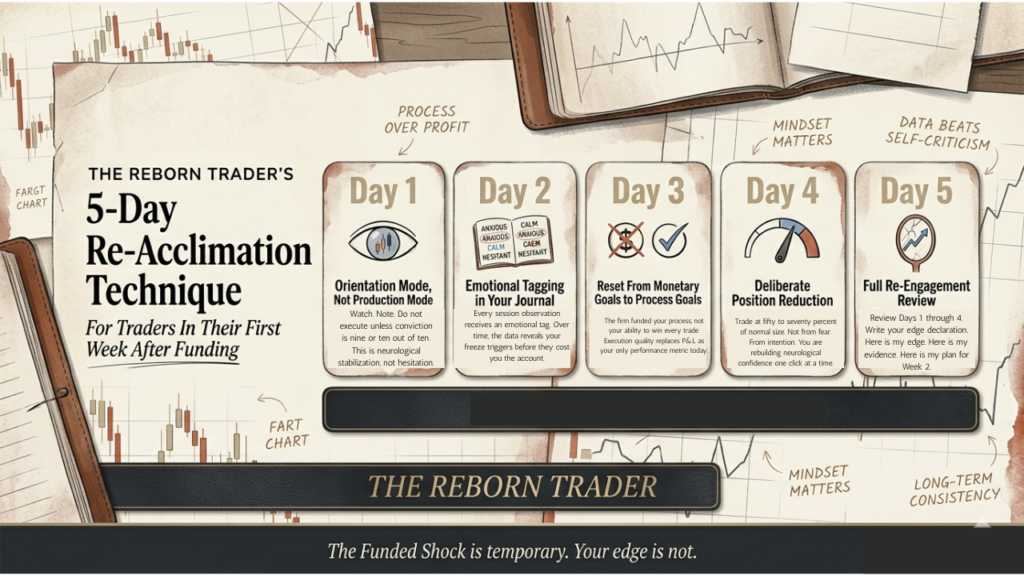
Shahzaib Khan developed The Reborn Trader 5-Day Re-Acclimation Technique specifically for the first five trading days after funding began. Not as a strategy adjustment, your strategy doesn’t need adjusting. As a neurological reset.
This is what separates traders who survive the Funded Shock from those who blow their account quietly in the first two weeks.
Day 1: Orientation Mode, Not Production Mode
Do not treat Day 1 as a trading day. Treat it as a reconnaissance mission.
Watch your setups. Note where you would have entered. Don’t execute anything unless your conviction is a nine or ten out of ten. This is not fear management. This is giving your prefrontal cortex decision-making under stress time to stabilize before asking it to perform under live conditions.
Day 2: Emotional Tagging in Your Journal
Every single session observation gets an emotional tag today. Anxious. Calm. Excited. Hesitant. Frustrated.
Trading journal emotional tags on a funded account are not soft practices. Over fifty to a hundred trades, the data from these tags reveals patterns that objective statistics never will. You’ll see that your hesitation clusters around specific sessions, specific setups, or specific account balance thresholds.
Data beats self-criticism every time.
Day 3: Reset From Monetary Goals to Process Goals
Write this down somewhere physical: “The firm funded my process. Not my ability to win every trade.”
Switching to process goals vs monetary goals in prop trading removes the P&L as your performance metric and replaces it with execution quality. Did you follow your entry criteria? Did you honor your stop? Did you take the setup when it appeared?
That is what success looks like on Day 3.
Day 4: Deliberate Position Reduction
On Day 4, deliberately trade at fifty to seventy percent of your normal position size, not because you’re afraid, but because you’re rebuilding neuromuscular confidence in your execution process.
Reducing position size in the first week of funded trading is not a timid strategy. It’s a calibrated neurological warm-up. You’re teaching your brain that clicking the button and losing a small trade is survivable. That knowledge, built trade by trade, is what dissolves the freeze.
Day 5: Full Re-Engagement Review
Review Days 1 through 4 completely. What did your emotional tags reveal? Where did your process hold? Where did the Funded Shock still show up?
The first week funded trading strategy should end with a written declaration: “Here is my edge. Here is the evidence I have of it. Here is my plan for Week 2.”
You are not reassuring yourself. You are compiling evidence, the same way a scientist would, that your past performance is a legitimate indicator of your process quality.
The Funded Shock Is Temporary. Your Edge Is Not.
The psychological reset after passing a prop challenge does not last forever.
Your brain adapts. The endowment effect stabilizes. The imposter spike fades when your first live profits begin building evidence against it. The prefrontal cortex recovers once cortisol levels normalize and you start proving to yourself, one executed trade at a time, that you belong in this seat.
You earned the funded account. Your brain just needs five days to catch up with what your discipline already knew.
You survived the challenge. Now survive the first week. Every week, The Reborn Trader Weekly drops one mindset framework, one psychological insight, and one actionable technique directly into your inbox, written specifically for funded traders who want to stay funded.
No generic trading tips. No recycled motivational content. Just premium, research-backed mental performance strategy from Shahzaib Khan, built for the trader you are becoming.
Join the newsletter and get your first issue.
FAQ
What is The Funded Shock in prop trading?
The Funded Shock is a term coined by Shahzaib Khan to describe the identity-pressure response traders experience immediately after receiving a funded account. It is a neurological and psychological freeze caused by the brain suddenly re-categorizing managed capital as emotionally owned, triggering loss aversion, imposter syndrome, and execution hesitation even in traders who performed consistently during their challenge.
Why do traders hesitate to take trades after getting funded?
When a trader goes live on a funded account, the amygdala activates the body’s stress response, flooding the brain with cortisol and suppressing prefrontal cortex activity. This reduces executive decision-making, rational risk assessment, and impulse control, the exact cognitive functions needed to execute trades confidently. The result is analysis paralysis, overthinking, and missed setups despite having a proven strategy.
Is imposter syndrome normal after passing a prop firm challenge?
Yes, completely. Research by psychologists Clance and Imes confirms that high-achieving individuals commonly experience imposter syndrome precisely at moments of recognized success, such as passing an exam, receiving a promotion, or in this case, getting funded. Around 70 percent of adults experience impostorism at least once, and traders are particularly vulnerable because they attribute their challenge pass to luck rather than skill, which directly undermines execution confidence on Day 1 of funding.
How long does The Funded Shock last?
For most traders, the acute phase of The Funded Shock lasts between five and ten trading days. The Reborn Trader 5-Day Re-Acclimation Technique is specifically designed to compress that recovery window into one structured week by resetting process goals, rebuilding neurological confidence through deliberate position sizing, and using emotional journaling to identify freeze triggers before they cost you the account.