
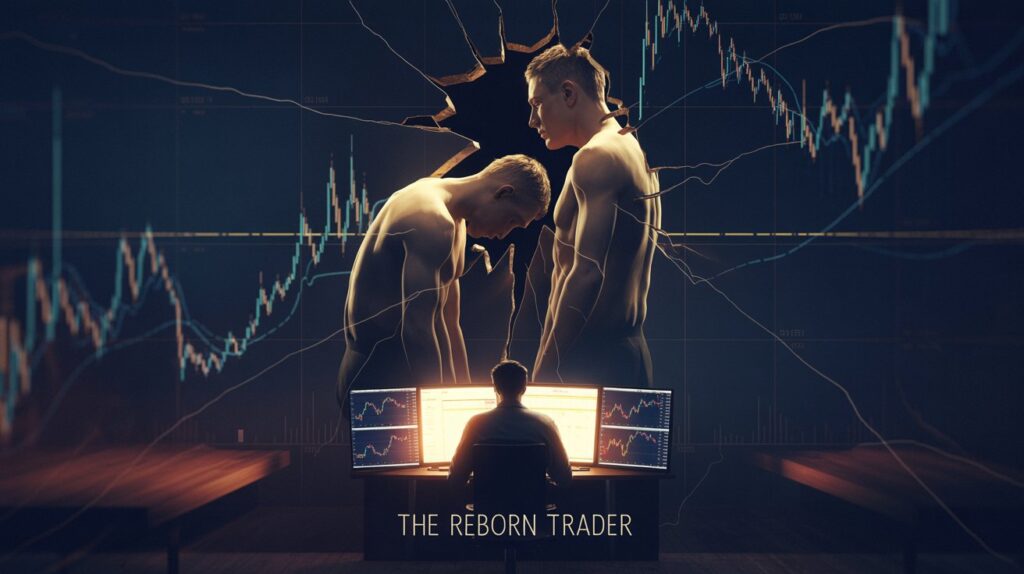
Most traders spend years perfecting their technical analysis skills, only to keep losing money. Why? Because the real leak isn’t in your charts. It’s in your head. This article breaks down the science-backed truth behind trading psychology vs technical analysis, shows you exactly which cognitive biases are draining your account, and gives you a practical framework to finally integrate both disciplines the right way. Whether you’re a beginner overwhelmed by indicators or an experienced trader stuck in a losing pattern, what you’re about to read will change how you approach every single trade from here on out.
You’ve studied the charts. You’ve memorized the RSI levels. You know when the MACD crosses bullish and when a head-and-shoulders pattern is forming. You’ve probably spent hours backtesting strategies, stacking indicators, and reading every technical analysis guide you could find.
And yet you’re still losing money. Or maybe you’re breaking even when you should be printing profits. Or you’re watching your well-researched setups turn into emotional trainwrecks the second real money is on the line.
Here’s the truth nobody in the trading community wants to say out loud:
Your charts are not your problem. You are.
The False War: Trading Psychology vs Technical Analysis
Let me be clear about something before we go any further.
This isn’t actually a battle. Framing trading psychology vs technical analysis as an either or debate is like asking whether your car needs an engine or a steering wheel. You need both. But here’s what nobody tells you: one of them breaks down far more often than the other.
Over 70% of retail traders cite emotional decision-making as their primary cause of losses. Not a bad chart read. Not a wrong indicator. Not a missed breakout. Pure, unfiltered emotion blowing up otherwise solid setups.
Think about that for a second. You could have the most technically perfect entry in the world: perfect confluence, volume confirmation, clean support level, and still blow the trade because fear made you exit early, or greed made you hold too long, or FOMO made you chase an entry you knew wasn’t right.
That’s not a technical analysis failure. That’s a psychology failure.
But here’s where it gets interesting. Technical analysis isn’t just a set of mathematical tools. At its core, it’s a study of collective human behavior: fear, greed, panic, and euphoria all compressed into price bars on your screen.
So the two are more connected than most traders realize.
“The market doesn’t beat you. Your unmanaged mind does. Master the psychology, and the technicals finally start making sense.” Shahzaib Khan
What Technical Analysis Actually Gets Right
The Tool Is Not the Problem
Here’s something I want you to understand about technical analysis before we move on.
It works. The data says so. A 2024 study analyzing RSI and MACD indicators on the LQ45 index found that both indicators provide a reasonably good accuracy rate in predicting stock volatility. A combined MACD and RSI strategy has shown a 73% win rate across 235 backtested trades when used with a mean reversion filter.
Those numbers are not nothing. Moving average crossovers, Fibonacci retracements, RSI overbought and oversold signals, and support and resistance levels: all of these carry real predictive weight when applied correctly and consistently.
The problem isn’t the tools. The problem is the trader holding them.
The 6-Second Window Nobody Talks About
Here’s a stat that should shake you. According to the J.P. Morgan Market Microstructure Report, the average duration of a clear technical analysis signal on liquid assets dropped from 18 minutes in 2016 to under 6 seconds in 2024.
High-frequency trading algorithms now scan, identify, and act on the same patterns you’re watching on your chart before you can move your cursor to the buy button.
This doesn’t mean technical analysis is dead. It means the psychological edge, your ability to stay disciplined, manage position size correctly, and execute without hesitation, has never been more valuable.
The machine sees the same pattern. The machine doesn’t hesitate. The machine doesn’t second-guess. The machine doesn’t revenge trade after a loss.
That’s where you need to be. Mechanically consistent.
Why Support and Resistance Is Really a Psychology Game
I want you to think about support and resistance levels differently. Why does a price bounce at a round number like $100 or $50? Not because of mathematics. Because thousands of traders are watching the same level and reacting to it in the same emotional way: fear of losing, greed of capturing a reversal.
Fibonacci retracements work for the same reason. They’re a self-fulfilling prophecy built on collective trader behavior. Enough people believe the 61.8% level matters and so it does.
This is market psychology wearing the costume of technical analysis. That’s the bridge most traders never cross.
The Psychology Case: Where Real Money Is Won and Lost
Your Brain Is the Most Expensive Trading Mistake You’ll Ever Make
Let me hit you with some numbers that changed the way I look at trading forever.
Brad Barber and Terrance Odean, two of the most cited researchers in behavioral finance, published a landmark study showing that overconfident traders underperform by 6.5% annually. That’s not a rounding error. That’s the difference between a profitable year and a devastating one.
The same research showed traders are 1.5 times more likely to sell their winning positions than their losing ones, a psychological trap called the disposition effect.
You sell winners early because profit feels safe. You hold losers too long because realizing a loss feels like admitting failure.
Meanwhile, your account bleeds out slowly while your ego stays intact. This is behavioral finance in action, and it’s costing retail traders billions every single year.
The Big 5 Psychological Traps Killing Your Trades
Let me walk you through the five most damaging cognitive biases you’re probably dealing with right now.
Loss aversion sits at the top of the list. Kahneman and Tversky’s Prospect Theory proved it decades ago: a $500 loss hurts roughly twice as much psychologically as a $500 gain feels good. This warps your stop-loss decisions and makes you hold losers way past the point of rational management.
Overconfidence bias creeps in after a winning streak. You start increasing position sizes, skipping confirmation signals, and believing you’ve figured it out. The market always humbles that belief eventually, usually in the most expensive way possible.
Confirmation bias is the one that makes you selectively read charts. You want the trade to work, so you only see the signals that agree with your thesis. You dismiss the red flags. You ignore the volume divergence. You go in anyway.
FOMO, the fear of missing out in trading, turns rational traders into impulsive ones. You see a move already underway, you jump in without a proper setup, and you end up holding the bag at the top.
And anchoring bias keeps you locked to an entry price that the market no longer respects. You entered at $150. The stock is now at $120. But because you’re anchored to $150, you can’t objectively assess whether the trade thesis even still exists.
Every single one of these biases is measurable. Every single one of them has a dollar cost attached to it.
Read this: Emotional Biases That Affect Stock Traders and How to Overcome Them
Revenge Trading: The Silent Account Killer
Now let me talk about something that I see destroy traders faster than almost anything else. Revenge trading, you take a loss. A bad one, maybe. Your chest tightens. Your rational brain steps aside and an emotional reflex takes over: I need to get that money back right now.
So you enter another trade. Larger size, no setup, no plan. Pure emotion. And you lose again. More this time.
I’ve seen traders wipe out weeks of solid gains in a single afternoon of revenge trading. Not because their technical analysis was wrong. Because their psychology was completely unmanaged.
This is what separates the traders who last from the ones who blow up. Not the indicators they use. Not the timeframe they trade. The ability to sit on their hands after a loss and not pull the trigger until the next genuine setup appears. That’s discipline.
How to Actually Integrate Both: The Reborn Trader Framework
The Psychology-First Approach to Technical Execution
Alright, so here’s where I give you something actionable. The most effective approach I’ve found to trading psychology and technical analysis working together looks like this.
Step one: use technical analysis for setup identification only.
Your indicators, your chart patterns, your support and resistance levels, your Fibonacci zones, all of that gets used strictly to identify a potential trade. No emotion lives here. This is math.
Step two: run a psychology checklist before you execute.
Before you place the order, answer three questions honestly. Am I in the right mental state to trade right now? Is this setup meeting my written criteria, or am I bending the rules? Am I sizing this position based on my rules, or based on how confident I feel? If you can’t answer all three cleanly, you don’t trade. Simple.
Step three: journal every trade with a psychological tag.
After every trade closes, tag it. Was it planned or impulsive? Did you follow your rules or deviate? What emotion, if any, drove the decision?
Over time, this data becomes your most valuable trading asset. You stop guessing why you’re losing. You see it clearly, in your own handwriting. This is what I call tracking your psychology cost: putting a real dollar number on your emotional decision-making.
When you see that FOMO has cost you $2,300 this month, you stop treating mindset work as optional.
The 2025 Frontier: Where Psychology and Data Are Merging
AI Is Now Doing What Your Undisciplined Mind Couldn’t
Here’s something that should excite and motivate you in equal measure.
A 2025 UCLA research paper published on arXiv showed that combining real-time sentiment analysis using large language models like FinBERT with traditional technical indicators significantly improved S&P 500 trading strategy performance.
In plain language: the integration of market psychology data and technical signals is now being automated at an institutional level. For you as a discretionary trader in 2025, this means one thing clearly.
Your human edge is no longer in pattern recognition. Algorithms do that better and faster now. Your edge is in emotional self-regulation. Your edge is in the discipline to follow a system when the system feels uncomfortable. Your edge is in the psychological resilience to take a loss, close the laptop, and come back tomorrow with a clear head. That’s the moat no algorithm can replicate.
Conclusion: Trading Psychology vs Technical Analysis
Here’s what I want you to walk away with. Technical analysis gives you the map. It tells you where the price has been, where it’s likely to face friction, and where momentum is building. It is a legitimate, evidence-backed toolkit that works when applied with precision and patience.
But trading psychology determines whether you can actually follow that map, or whether you’ll crumple it up the moment the market moves against you for thirty seconds. The traders who win consistently aren’t the ones with the best indicators. They’re the ones who have done the inner work. Who have tracked their biases. Who have built systems to protect themselves from their own worst impulses.
You already have the technical knowledge. Now build the psychological foundation to actually use it. That’s what it means to be a Reborn Trader.
You’ve done the reading. Now do the work. Every week inside The Reborn Trader Newsletter, we break down one trading mindset principle, one technical concept, and one real-world framework, so you stop learning and start executing like the trader you already know you can be.
Join hundreds of traders rebuilding their edge from the inside out. Subscribe Here
FAQ
Is trading psychology more important than technical analysis?
Yes, and the data backs it up. Over 70% of retail traders lose money due to emotional decisions, not bad chart reads. Technical analysis gives you the setup. Psychology determines whether you can execute it without self-sabotage.
Can you be profitable using technical analysis alone?
Technically yes, but most traders aren’t. Research by Barber and Odean shows overconfident traders underperform by 6.5% annually. Without psychological discipline, even a winning strategy bleeds out through impulsive decisions, revenge trading, and poor position sizing.
What is the psychology behind technical chart patterns?
Most chart patterns work because enough traders believe they work, making them a self-fulfilling prophecy rooted in collective fear and greed. Support levels, Fibonacci retracements, and candlestick patterns are really just maps of human emotional behavior compressed into price.
How do I stop emotions from affecting my trading?
Start by tagging every trade as planned or impulsive in a trading journal. Run a 3-question psychology checklist before every entry. Over time, you’ll put a real dollar number on your emotional leakage and that number alone will change your behavior faster than any strategy will.
Does technical analysis still work in 2025?
Yes, but the window is shrinking. J.P. Morgan data shows TA signal duration dropped from 18 minutes in 2016 to under 6 seconds in 2024. The edge isn’t gone, but execution discipline and psychological consistency now matter more than the pattern itself.